U.S. flag

An official website of the United States government

Alaska Science Center

The mission of the Alaska Science Center is to provide objective and timely data, information, and research findings about the earth and its flora and fauna to Federal, State, and local resource managers and the public to support sound decisions regarding natural resources, natural hazards, and ecosystems in Alaska and circumpolar regions. We have offices in Anchorage, Juneau, and Fairbanks. 

News

USGS Measures Glacial Flooding in Juneau, Alaska

USGS Measures Glacial Flooding in Juneau, Alaska

Science Spotlight: USGS Monitoring of Glacial Outburst Flood in Juneau Alaska

Science Spotlight: USGS Monitoring of Glacial Outburst Flood in Juneau Alaska

Project Spotlight: USGS Scientists Work with Kenai Peninsula Communities to Define Baseline Water Data Amid Climate Uncertainty

Project Spotlight: USGS Scientists Work with Kenai Peninsula Communities to Define Baseline Water Data Amid Climate Uncertainty

Publications

Tectonic implications of transitional melting regimes from petrological, geochronological, and compositional characterization of the ophiolitic Seventymile terrane, Alaska, USA Tectonic implications of transitional melting regimes from petrological, geochronological, and compositional characterization of the ophiolitic Seventymile terrane, Alaska, USA

New geochemical, U-Pb geochronology, and Sr-Nd-Hf isotope data provide evidence for the tectonic evolution of the Seventymile terrane in interior Alaska, USA. Ultramafic and mafic rocks of the Seventymile terrane are thought to represent components of a dismembered ophiolite and provide unique constraints on regional terrane evolution and accretion. The Seventymile ophiolite represents...
Authors
Erin Todd, Jonathan Saul Caine, Michael Bizimis, Andrew R.C. Kylander-Clark, Robert Reece Hammond, Alicja Wypych

A time-space model of graphite mineral systems A time-space model of graphite mineral systems

Increasing demand for graphite in energy storage systems warrants review of graphite ore genesis in a mineral systems framework. Orogenic graphite encompasses the metamorphic and orogenic mineral systems that produce flake graphite and hydrothermal vein (lump and chip) graphite deposits, respectively. A common feature of orogenic graphite deposits is an association with upper amphibolite...
Authors
George N.D. Case

Power source, data retrieval method, and attachment type affect success of dorsally mounted tracking tag deployments in 37 species of shorebirds Power source, data retrieval method, and attachment type affect success of dorsally mounted tracking tag deployments in 37 species of shorebirds

Animal-borne trackers are commonly used to study bird movements, including in long-distance migrants such as shorebirds. Selecting a tracker and attachment method can be daunting, and methodological advancements often have been made by trial and error and conveyed by word of mouth. We synthesized tracking outcomes across 2745 dorsally mounted trackers on 37 shorebird species around the...
Authors
Emily L. Weiser, Richard Lanctot, Daniel R. Ruthrauff, Sarah T. Saalfeld, Lee Tibbitts, José Abad-Gómez, Joaquin Aldabe, Juliana Bose de Almeida, José A. Alves, Guy Anderson, Phil F. Battley, Heinrich Belting, Joël Bêty, Kristin Bianchini, Mary Anne Bishop, Roeland A. Bom, Katharine Bowgen, Glen S. Brown, Stephen C. Brown, Leandro Bugoni, Niall Burton, David R. Bybee, Camilo Carneiro, Gabriel Castresana, Ying-Chi Chan, Chi-Yeung Choi, Katherine Christie, Nigel A. Clark, Jesse R. Conklin, Medardo Cruz-López, Stephen J. Dinsmore, Steve Dodd, David C. Douglas, Luke Eberhart-Hertel, Willow B. English, Harry Ewing, Fernando A. Faria, Samantha E. Franks, Richard A. Fuller, Robert E. Gill, Marie-Andrée Giroux, Cheri L Gratto-Trevor, David Green, Rhys E. Green, Ros Green, Tómas Gunnarsson, Jorge S. Gutiérrez, Autumn-Lynn Harrison, C. Alex Hartman, Chris J. Hassell, Sarah Hoepfner, Jos C. E. W. Hooijmeijer, James Johnson, Oscar W. Johnson, Bart Kempenaers, Marcel Klaassen, Eva Kok, Johannes Krietsch, Clemens Küpper, Andy Kwarteng, Eunbi Kwon, Jean-Francois Lamarre, Christopher Latty, Nicolas Lecomte, A.H. Loonstra, Zhijun Ma, Lucas Mander, Christopher Marlow, Peter P. Marra, Jose A. Masero, Laura Anne McDuffie, Rebecca L McGuire, Johannes Melter, David S. Melville, Verónica Méndez, Tyler Michels, Christy Morrissey, Tong Mu, David Newstead, Gary W. Page, Allison K. Pierce, Theunis Piersma, Márcio Repenning, Brian H. Robinson, Afonso Rocha, Danny I. Rogers, Amy L. Scarpignato, Shiloh Schulte, Emily Scragg, Nathan R. Senner, Paul Smith, Audrey R. Taylor, Rachel C. Taylor, Böðvar Þórisson, Mihai Valcu, Mo A. Verhoeven, Lena Ware, Nils Warnock, Michael Weber, Lucy J. Wright, Michael B. Wunder

Science

Alaska Science Center Weekly Findings

Alaska Science Center Weekly Findings

Recent findings by USGS Alaska Science Center staff and their collaborators.
Learn More

Heat stress in Alaska's Pacific salmon

Alaska's freshwater spans a wide range of summer water temperatures, from ice-cold glacier water to warm rivers that routinely reach stressful levels for salmon, exceeding 18°C/64°F and even surpassing 21°C/70°F. Pacific salmon population trends are also varied and include declines in many Chinook salmon populations. Salmon declines are kitchen table issues because salmon fishing is key to the...
Heat stress in Alaska's Pacific salmon
Heat stress in Alaska's Pacific salmon
Alaska's freshwater spans a wide range of summer water temperatures, from ice-cold glacier water to warm rivers that routinely reach stressful levels for salmon, exceeding 18°C/64°F and even surpassing 21°C/70°F. Pacific salmon population trends are also varied and include declines in many Chinook salmon populations. Salmon declines are kitchen table issues because salmon fishing is key to the...
Learn More

Polar Bear Research

Polar bears ( Ursus maritimus) are one of 4 marine mammal species managed by the U.S. Department of Interior. The USGS Alaska Science Center leads long–term research on polar bears to inform local, state, national and international policy makers regarding conservation of the species and its habitat. Our studies, ongoing since 1985, are focused on population dynamics, health and energetics...
Polar Bear Research

Polar Bear Research

Polar bears ( Ursus maritimus) are one of 4 marine mammal species managed by the U.S. Department of Interior. The USGS Alaska Science Center leads long–term research on polar bears to inform local, state, national and international policy makers regarding conservation of the species and its habitat. Our studies, ongoing since 1985, are focused on population dynamics, health and energetics...
Learn More

Multimedia

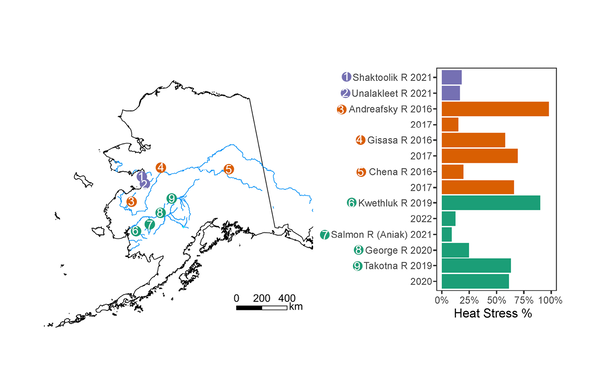
Black outline of Alaska with purple, orange, and green circles with numbers and a bar plot corresponding to the colors
Bar plot showing the percentage of Chinook salmon with evidence of heat stress across Alaska
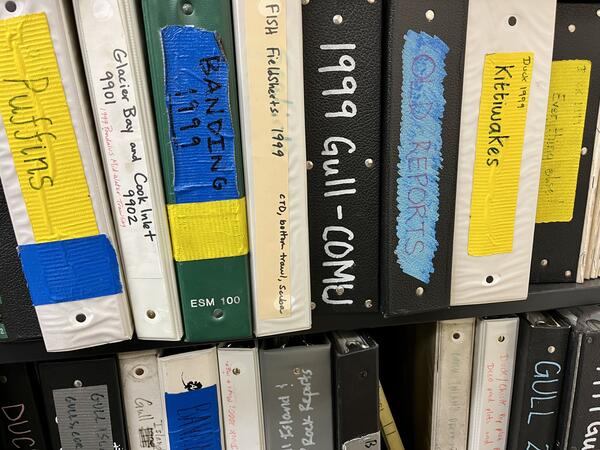
Black and white three-ring binders with content labels.
Shelf of legacy seabird data
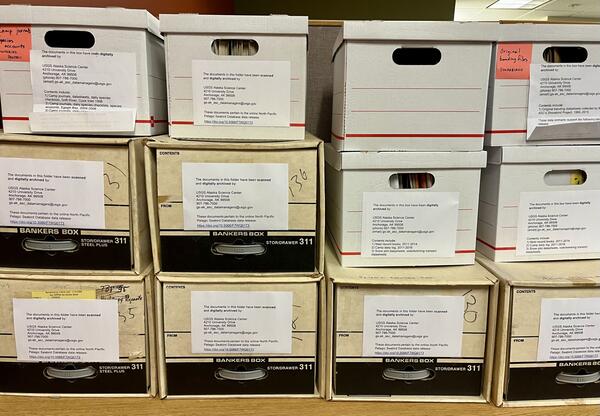
White and brown carboard boxes stacked on top of each other.
Physical data ready for archive
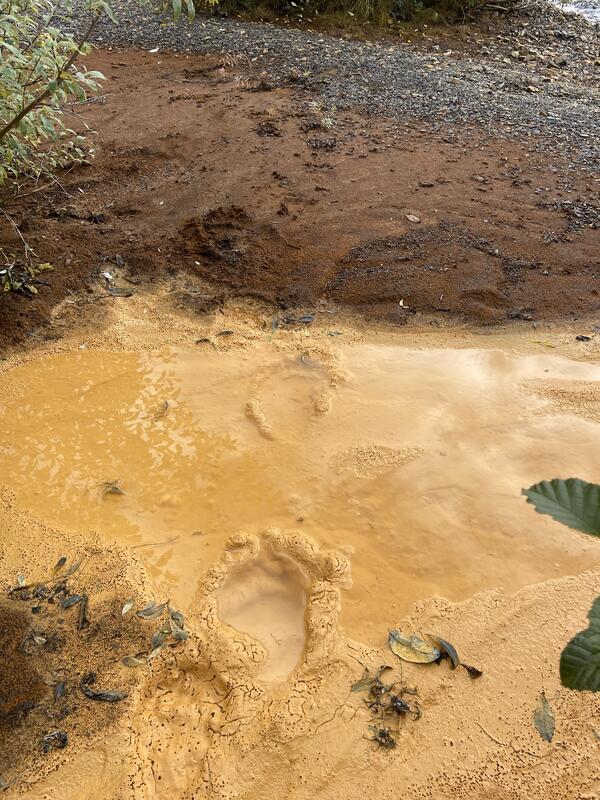
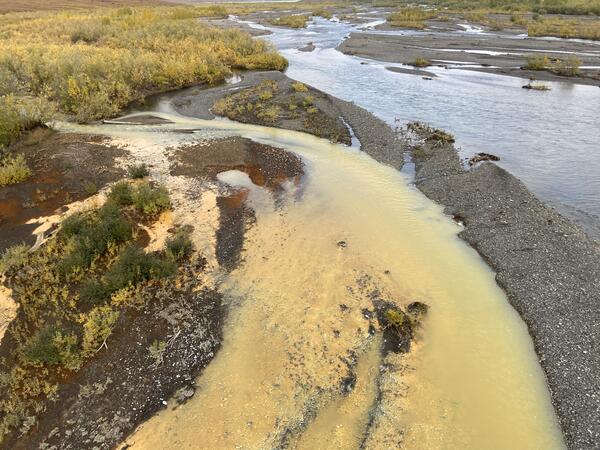
Bear tracks in an orange-stained river.
Bear tracks in an orange tributary of the Kugururok River, Noatak National Preserve, Alaska
Pale orange creek flowing into clear blue river.
Orange waters mixing in to the mainstem of the Kugururok River
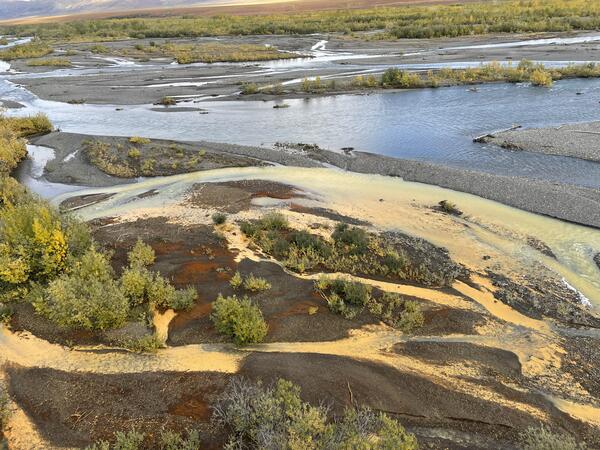
pale orange river flowing into a clear blue river.
An orange tributary of the Kugururok River in Noatak National Preserve, Alaska
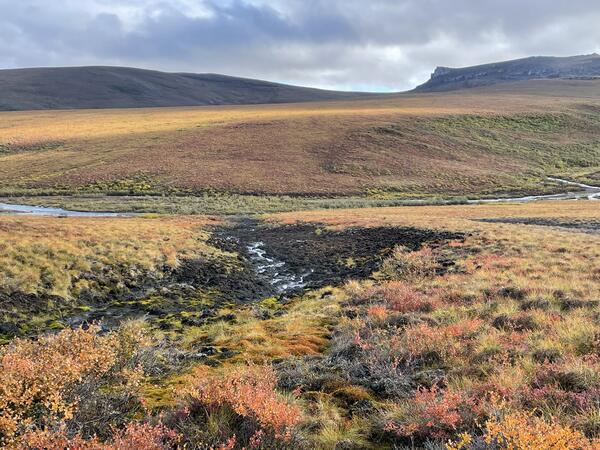
Black vegetation surrounding a creek.
An acid seep on the Nakolikurok Creek
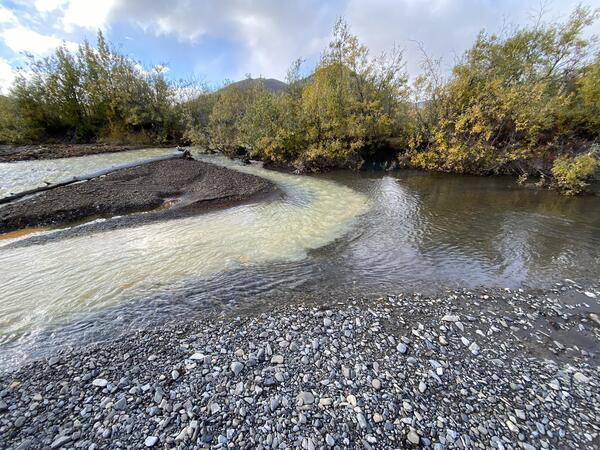
Pale orange river entering clear blue river.
An orange tributary of the Kugururok River in Alaska's Noatak National Preserve
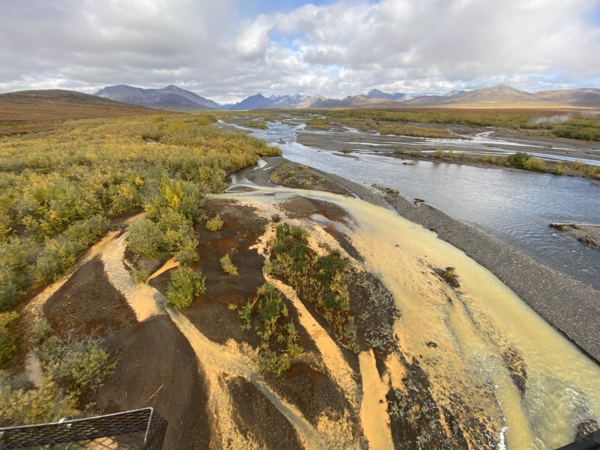
A pale orange and clear blue river mixing.
Mixing of an orange tributary and Kugururok River, Noatak National Preserve, Alaska
Was this page helpful?