



This image was taken of the Martian surface by the NASA MSL rover on sol 4158, showing an assortment of clasts.
Images
Browse here for some of our available imagery. We may get permission to use some non-USGS images and these should be marked and are subject to copyright laws. USGS Astrogeology images can be freely downloaded.
Filter Total Items: 330

MSL image of the Martian Surface on sol 4158
This image was taken of the Martian surface by the NASA MSL rover on sol 4158, showing an assortment of clasts.

Python Hyperspectral Analysis Tool (PyHAT) Banner Image
Python Hyperspectral Analysis Tool (PyHAT) Banner ImageThis image is intended as a summary/promotional image for the Python Hyperspectral Analysis Tool (PyHAT) software.
Python Hyperspectral Analysis Tool (PyHAT) Banner Image
Python Hyperspectral Analysis Tool (PyHAT) Banner ImageThis image is intended as a summary/promotional image for the Python Hyperspectral Analysis Tool (PyHAT) software.
Python Hyperspectral Analysis Tool (PyHAT) Mineral Parameter Map Example - Jezero Crater, Mars
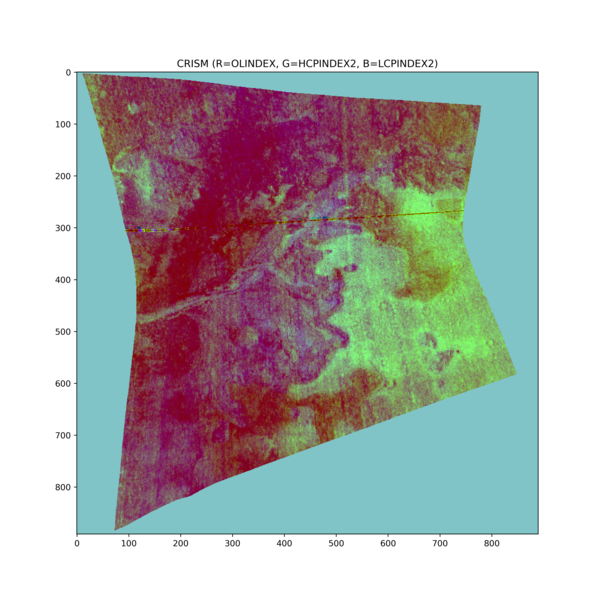
Python Hyperspectral Analysis Tool (PyHAT) Mineral Parameter Map Example - Jezero Crater, MarsThis figure shows an example mineral parameter map image generated using PyHAT. The area in this Compact Reconnaissance Imaging Spectrometer for Mars (CRISM) image is Jezero crater, the landing site of NASA's Mars Perseverance rover.
Python Hyperspectral Analysis Tool (PyHAT) Mineral Parameter Map Example - Jezero Crater, Mars
Python Hyperspectral Analysis Tool (PyHAT) Mineral Parameter Map Example - Jezero Crater, MarsThis figure shows an example mineral parameter map image generated using PyHAT. The area in this Compact Reconnaissance Imaging Spectrometer for Mars (CRISM) image is Jezero crater, the landing site of NASA's Mars Perseverance rover.
Python Hyperspectral Analysis Tool (PyHAT) Principal Component Analysis (PCA) Plot Example
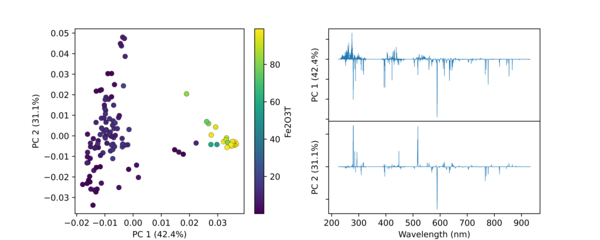
Python Hyperspectral Analysis Tool (PyHAT) Principal Component Analysis (PCA) Plot ExampleThis figure shows an example PCA plot generated using PyHAT. The input data were laser induced breakdown spectroscopy (LIBS) spectra. PyHAT was used to apply a baseline correction and normalization to the total intensity for each spectrum.
Python Hyperspectral Analysis Tool (PyHAT) Principal Component Analysis (PCA) Plot Example
Python Hyperspectral Analysis Tool (PyHAT) Principal Component Analysis (PCA) Plot ExampleThis figure shows an example PCA plot generated using PyHAT. The input data were laser induced breakdown spectroscopy (LIBS) spectra. PyHAT was used to apply a baseline correction and normalization to the total intensity for each spectrum.

NLB_764937797EDR_F1061524NCAM00277M_.jpeg
Image shows a poorly sorted collection of clasts, taken by the NASA Mars Curiosity rover on sol 4139.
Image shows a poorly sorted collection of clasts, taken by the NASA Mars Curiosity rover on sol 4139.
Python Hyperspectral Analysis Tool (PyHAT) Partial Least Squares Cross Validation Example
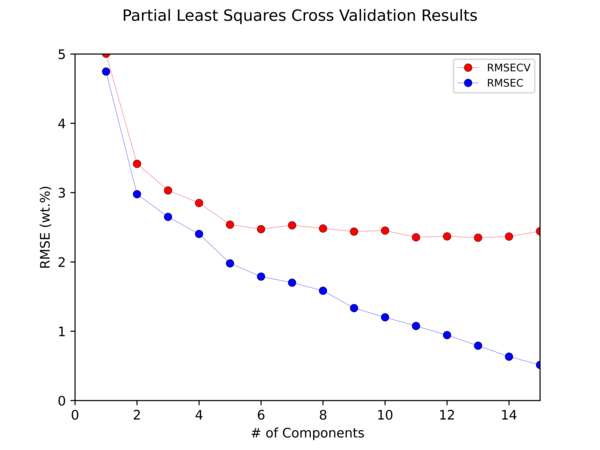
Python Hyperspectral Analysis Tool (PyHAT) Partial Least Squares Cross Validation ExampleThis figure shows the results of cross-validating a Partial Least Squares (PLS) model to predict the abundance of CaO in geologic targets using PyHAT. Cross validation is necessary to optimize the parameters of a regression algorithm to avoid overfitting.
Python Hyperspectral Analysis Tool (PyHAT) Partial Least Squares Cross Validation Example
Python Hyperspectral Analysis Tool (PyHAT) Partial Least Squares Cross Validation ExampleThis figure shows the results of cross-validating a Partial Least Squares (PLS) model to predict the abundance of CaO in geologic targets using PyHAT. Cross validation is necessary to optimize the parameters of a regression algorithm to avoid overfitting.
Python Hyperspectral Analysis Tool (PyHAT) Regression Example
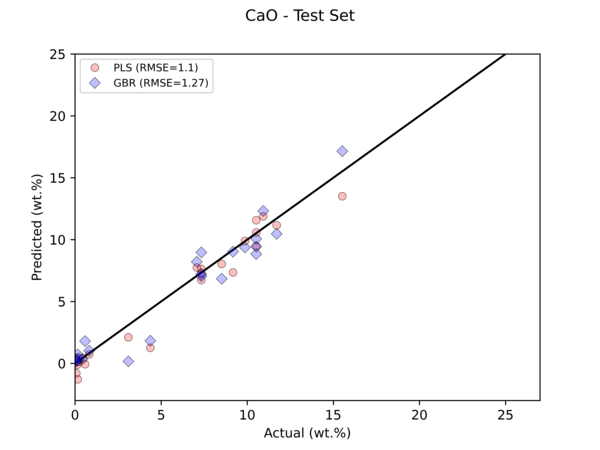
Python Hyperspectral Analysis Tool (PyHAT) Regression ExampleThis figure compares the results of two regression models to predict the abundance of CaO in geologic standards based on their laser induced breakdown spectroscopy (LIBS) spectra using PyHAT. The horizontal axis is the independently measured CaO abundance, the vertical axis is the abundance predicted by the models.
Python Hyperspectral Analysis Tool (PyHAT) Regression Example
Python Hyperspectral Analysis Tool (PyHAT) Regression ExampleThis figure compares the results of two regression models to predict the abundance of CaO in geologic standards based on their laser induced breakdown spectroscopy (LIBS) spectra using PyHAT. The horizontal axis is the independently measured CaO abundance, the vertical axis is the abundance predicted by the models.
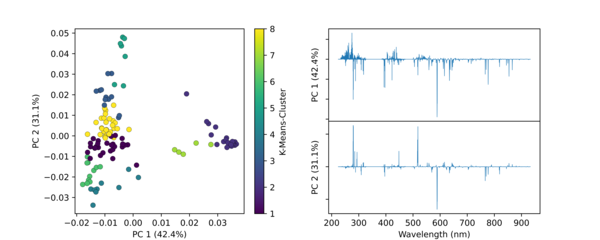
Python Hyperspectral Analysis Tool (PyHAT) Principal Component Analysis K-Means Clustering Example
Python Hyperspectral Analysis Tool (PyHAT) Principal Component Analysis K-Means Clustering ExampleThis figure shows an example PCA plot generated using PyHAT. The input data were laser induced breakdown spectroscopy (LIBS) spectra. PyHAT was used to apply a baseline correction and normalization to the total intensity for each spectrum.
Python Hyperspectral Analysis Tool (PyHAT) Principal Component Analysis K-Means Clustering Example
Python Hyperspectral Analysis Tool (PyHAT) Principal Component Analysis K-Means Clustering ExampleThis figure shows an example PCA plot generated using PyHAT. The input data were laser induced breakdown spectroscopy (LIBS) spectra. PyHAT was used to apply a baseline correction and normalization to the total intensity for each spectrum.
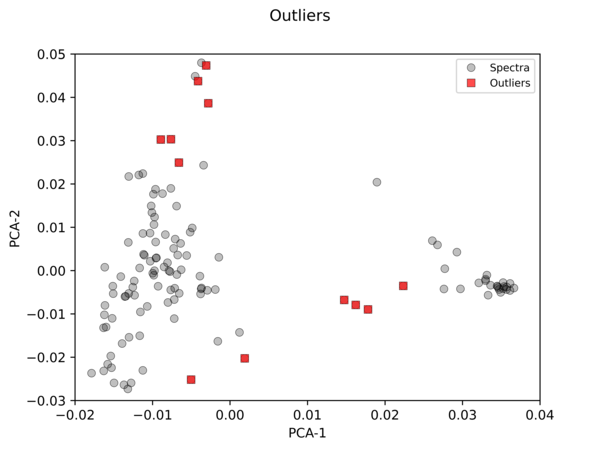
Python Hyperspectral Analysis Tool (PyHAT) Outlier Identification Example
Python Hyperspectral Analysis Tool (PyHAT) Outlier Identification ExampleThis figure shows an example of outlier identification using PyHAT. The input data were laser induced breakdown spectroscopy (LIBS) spectra. PyHAT was used to apply a baseline correction and normalization to the total intensity for each spectrum. Dimensionality was then reduced using principal components analysis (PCA).
Python Hyperspectral Analysis Tool (PyHAT) Outlier Identification Example
Python Hyperspectral Analysis Tool (PyHAT) Outlier Identification ExampleThis figure shows an example of outlier identification using PyHAT. The input data were laser induced breakdown spectroscopy (LIBS) spectra. PyHAT was used to apply a baseline correction and normalization to the total intensity for each spectrum. Dimensionality was then reduced using principal components analysis (PCA).
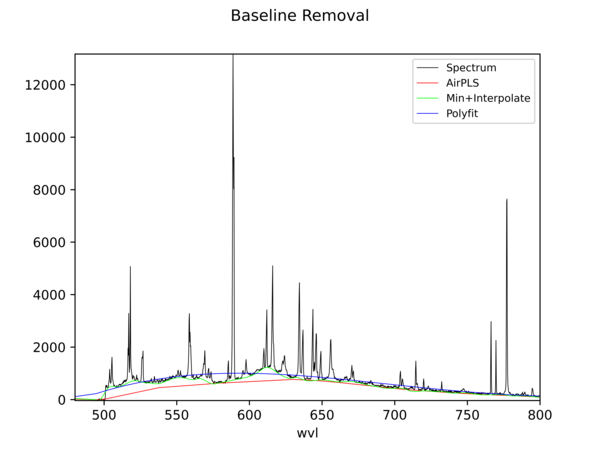
Python Hyperspectral Analysis Tool (PyHAT) Baseline Removal Plot Example
Python Hyperspectral Analysis Tool (PyHAT) Baseline Removal Plot ExampleThis figure shows an example spectrum plot generated using PyHAT. The black line is a laser induced breakdown spectroscopy (LIBS) spectrum of a basalt sample. The colored lines show the baseline estimated using several different algorithms.
Python Hyperspectral Analysis Tool (PyHAT) Baseline Removal Plot Example
Python Hyperspectral Analysis Tool (PyHAT) Baseline Removal Plot ExampleThis figure shows an example spectrum plot generated using PyHAT. The black line is a laser induced breakdown spectroscopy (LIBS) spectrum of a basalt sample. The colored lines show the baseline estimated using several different algorithms.

PyHAT Thumbnail
This is the small logo for the Python Hyperspectral Analysis Tool (PyHAT). It is intended for use as a thumbnail. The spectrum in the graphic is a laser induced breakdown spectroscopy spectrum, plotted on a logarithmic y axis to emphasize weaker emission peaks.
This is the small logo for the Python Hyperspectral Analysis Tool (PyHAT). It is intended for use as a thumbnail. The spectrum in the graphic is a laser induced breakdown spectroscopy spectrum, plotted on a logarithmic y axis to emphasize weaker emission peaks.

Grover Coloring Page
A coloring page and information about Grover, the USGS's geologic rover that went to the moon during the Apollo missions.
A coloring page and information about Grover, the USGS's geologic rover that went to the moon during the Apollo missions.

Photo of the GeoKings team.png
Photo of the GeoKings team taken by mentor Trent Hare in a ballroom full of other people, which is the poster session where they won their award. GeoKings from left to right: Zack Bryant, Jackson Brittain, John Cardeccia, Andrew Usvat, and Alex Poole.
Photo of the GeoKings team taken by mentor Trent Hare in a ballroom full of other people, which is the poster session where they won their award. GeoKings from left to right: Zack Bryant, Jackson Brittain, John Cardeccia, Andrew Usvat, and Alex Poole.

Ozuel Falls PIXL
Image of Ouzel Falls with a list of materials identified within it, including large, millimeter-scale regions rich in phosphate. Data from PIXL is laid over the image. Colored squares show different areas where PIXL’s X-ray beam scanned the rock’s surface.
Image of Ouzel Falls with a list of materials identified within it, including large, millimeter-scale regions rich in phosphate. Data from PIXL is laid over the image. Colored squares show different areas where PIXL’s X-ray beam scanned the rock’s surface.

Perseverance at Airey Hill
A 360 degree mosaic compiled by NASA of Perseverance Rover overlooking Airey Hill, the parking spot for the rover during the solar conjunction in 2023.
A 360 degree mosaic compiled by NASA of Perseverance Rover overlooking Airey Hill, the parking spot for the rover during the solar conjunction in 2023.

Screenshot GeoSTAC project.png
Screenshot of the user interface of the GeoSTAC project, with symbolized polygons on a Mars map (left) and a selection panel (right).
Screenshot of the user interface of the GeoSTAC project, with symbolized polygons on a Mars map (left) and a selection panel (right).

Yellowstone Turkey.png
Background: USGS Photo of Porkchop Geyer in Yellowstone. Foreground: A cartoon turkey wearing an astronaut helmet looks sheepishly at Porkchop Geyser erupting nearby. Cartoon images of common Thanksgiving side dishes are also placed around the turkey (in this case, a gravy boat and an ear of corn).
Background: USGS Photo of Porkchop Geyer in Yellowstone. Foreground: A cartoon turkey wearing an astronaut helmet looks sheepishly at Porkchop Geyser erupting nearby. Cartoon images of common Thanksgiving side dishes are also placed around the turkey (in this case, a gravy boat and an ear of corn).

Venisuan Turkey.png
Background: USGS/NASA Photo of Venus. Foreground: A cartoon turkey wearing an astronaut helmet while floating in space looks towards Venus. Cartoon images of common Thanksgiving side dishes are also placed around the turkey (in this case, dinner rolls and a green bean casserole).
Background: USGS/NASA Photo of Venus. Foreground: A cartoon turkey wearing an astronaut helmet while floating in space looks towards Venus. Cartoon images of common Thanksgiving side dishes are also placed around the turkey (in this case, dinner rolls and a green bean casserole).

Lunar Turkey.png
Background: USGS/NASA Photo of the Moon
Foreground: A cartoon turkey wearing an astronaut helmet while floating in space looks towards the Moon. Cartoon images of common Thanksgiving side dishes are also placed around the turkey (in this case, creamed corn and mashed potatoes).
Background: USGS/NASA Photo of the Moon
Foreground: A cartoon turkey wearing an astronaut helmet while floating in space looks towards the Moon. Cartoon images of common Thanksgiving side dishes are also placed around the turkey (in this case, creamed corn and mashed potatoes).

Ionian Turkey.png
Background: USGS/NASA Photo of Io. Foreground: A cartoon turkey wearing an astronaut helmet while floating in space looks towards Io. Cartoon images of common Thanksgiving side dishes are also placed around the turkey (in this case, cranberry sauce and a pumpkin pie).
Background: USGS/NASA Photo of Io. Foreground: A cartoon turkey wearing an astronaut helmet while floating in space looks towards Io. Cartoon images of common Thanksgiving side dishes are also placed around the turkey (in this case, cranberry sauce and a pumpkin pie).

Illustration of different giant impact histories leading to iron-rich planet formation
Illustration of different giant impact histories leading to iron-rich planet formationDifferent giant-impact histories can result in an iron-rich body (indicated with the letter C):
Top: A catastrophic collision (e.g., Benz et al. 2007).
Middle: A hit-and-run collision (e.g., Asphaug & Reufer 2014).
Bottom: A chain of hit-and-run collisions (e.g., Chau et al. 2018).
Illustration of different giant impact histories leading to iron-rich planet formation
Illustration of different giant impact histories leading to iron-rich planet formationDifferent giant-impact histories can result in an iron-rich body (indicated with the letter C):
Top: A catastrophic collision (e.g., Benz et al. 2007).
Middle: A hit-and-run collision (e.g., Asphaug & Reufer 2014).
Bottom: A chain of hit-and-run collisions (e.g., Chau et al. 2018).