
U.S. flag

An official website of the United States government

Headwater Ecosystems

Filter Total Items: 15
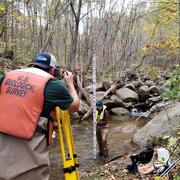
Using monitoring data to measure conditions over time in Chesapeake Bay streams

This study provides a comprehensive assessment of the health of streams throughout the Chesapeake Bay. Monitoring data were used to assess seven key indicators of stream condition, revealing consistent patterns of degradation in urban and agricultural areas. The findings offer critical insights that can inform watershed restoration efforts and improve long-term monitoring strategies.

Using monitoring data to measure conditions over time in Chesapeake Bay streams

Using monitoring data to measure conditions over time in Chesapeake Bay streams

This study provides a comprehensive assessment of the health of streams throughout the Chesapeake Bay. Monitoring data were used to assess seven key indicators of stream condition, revealing consistent patterns of degradation in urban and agricultural areas. The findings offer critical insights that can inform watershed restoration efforts and improve long-term monitoring strategies.
Learn More

Key Values of a Century of EESC Science

The USGS Eastern Ecological Science Center (EESC) is rooted in a proud tradition of service to the nation—advancing science that informs the conservation and management of fish, wildlife, and habitats across the eastern United States and beyond. Our mission is clear: deliver reliable, partner-driven science that supports natural resource decisions today, while ensuring these resources remain...
Key Values of a Century of EESC Science

Key Values of a Century of EESC Science

The USGS Eastern Ecological Science Center (EESC) is rooted in a proud tradition of service to the nation—advancing science that informs the conservation and management of fish, wildlife, and habitats across the eastern United States and beyond. Our mission is clear: deliver reliable, partner-driven science that supports natural resource decisions today, while ensuring these resources remain...
Learn More

Investigating Blotchy Bass Syndrome in Black Basses (Micropterus spp)

USGS is studying the spread and effects of “blotchy bass syndrome” on black basses ( Micropterus spp). USGS and state agencies have partnered with citizen scientists and recreational organizations to create a continent-wide biosurveillance network to monitor the syndrome.
Investigating Blotchy Bass Syndrome in Black Basses (Micropterus spp)

Investigating Blotchy Bass Syndrome in Black Basses (Micropterus spp)

USGS is studying the spread and effects of “blotchy bass syndrome” on black basses ( Micropterus spp). USGS and state agencies have partnered with citizen scientists and recreational organizations to create a continent-wide biosurveillance network to monitor the syndrome.
Learn More

Using Multiple Indicators to Assess Stream Condition in the Chesapeake Bay

USGS is working with federal, state and local partners to develop multiple assessments of stream and river conditions in non-tidal areas of the Chesapeake Bay watershed. These assessments will help managers preserve stream health and improve biological conditions in impaired streams as the human population and climate continue to change in this region.
Using Multiple Indicators to Assess Stream Condition in the Chesapeake Bay

Using Multiple Indicators to Assess Stream Condition in the Chesapeake Bay

USGS is working with federal, state and local partners to develop multiple assessments of stream and river conditions in non-tidal areas of the Chesapeake Bay watershed. These assessments will help managers preserve stream health and improve biological conditions in impaired streams as the human population and climate continue to change in this region.
Learn More

New studies reveal ecological importance of fine-scale groundwater connectivity for streams during drought

Stream ecosystems support vital resources that may be jeopardized by climate change and climate stressors such as drought.
New studies reveal ecological importance of fine-scale groundwater connectivity for streams during drought

New studies reveal ecological importance of fine-scale groundwater connectivity for streams during drought

Stream ecosystems support vital resources that may be jeopardized by climate change and climate stressors such as drought.
Learn More

Northeast Amphibian Research and Monitoring Initiative

The U.S. Geological Survey’s Eastern Ecological Science Center is home to the Northeast Amphibian Research and Monitoring Initiative (NEARMI), one of 7 ARMI regions across the United States. NEARMI works on public lands in thirteen states from Maine to Virginia, including many National Parks and National Wildlife Refuges.
Northeast Amphibian Research and Monitoring Initiative

Northeast Amphibian Research and Monitoring Initiative

The U.S. Geological Survey’s Eastern Ecological Science Center is home to the Northeast Amphibian Research and Monitoring Initiative (NEARMI), one of 7 ARMI regions across the United States. NEARMI works on public lands in thirteen states from Maine to Virginia, including many National Parks and National Wildlife Refuges.
Learn More

Study reveals importance of groundwater for stability of freshwater fish populations and resilience to climate change

Issue: Climate change is warming streams and rivers of the Chesapeake Bay watershed, and this is a critical concern for fisheries management and conservation. To address this issue, the Chesapeake Bay Program (CBP) recently identified four actions: • address the threats of climate change in all aspects of the partnership’s work; • prioritize communities, working lands, and most vulnerable habitats...
Study reveals importance of groundwater for stability of freshwater fish populations and resilience to climate change

Study reveals importance of groundwater for stability of freshwater fish populations and resilience to climate change

Issue: Climate change is warming streams and rivers of the Chesapeake Bay watershed, and this is a critical concern for fisheries management and conservation. To address this issue, the Chesapeake Bay Program (CBP) recently identified four actions: • address the threats of climate change in all aspects of the partnership’s work; • prioritize communities, working lands, and most vulnerable habitats...
Learn More

Brook trout vulnerability to drought: eastern component of USGS national integrated ecohydrological research

There is a growing and urgent need to develop and implement innovative strategies to research, monitor, and manage freshwater resources as societal demands escalate simultaneously with climate-driven changes in water availability.
Brook trout vulnerability to drought: eastern component of USGS national integrated ecohydrological research

Brook trout vulnerability to drought: eastern component of USGS national integrated ecohydrological research

There is a growing and urgent need to develop and implement innovative strategies to research, monitor, and manage freshwater resources as societal demands escalate simultaneously with climate-driven changes in water availability.
Learn More

Enabling AI for citizen science in fish biology

Artificial Intelligence (AI) is revolutionizing ecology and conservation by enabling species recognition from photos and videos. Our project evaluates the capacity to expand AI for individual fish recognition for population assessment. The success of this effort would facilitate fisheries analysis at an unprecedented scale by engaging anglers and citizen scientists in imagery collection. This...
Enabling AI for citizen science in fish biology

Enabling AI for citizen science in fish biology

Artificial Intelligence (AI) is revolutionizing ecology and conservation by enabling species recognition from photos and videos. Our project evaluates the capacity to expand AI for individual fish recognition for population assessment. The success of this effort would facilitate fisheries analysis at an unprecedented scale by engaging anglers and citizen scientists in imagery collection. This...
Learn More

Eastern Ecological Science Center partnership with Atlantic States Marine Fisheries Commission

Collaboration between the world-class expertise of USGS scientists, the Atlantic States Marine Fisheries Commission’s Science Program, and state and federal fishery agencies demonstrates the power of partnerships to solve seemingly-insurmountable problems in sustainable and cooperative management of Atlantic coastal fisheries.
Eastern Ecological Science Center partnership with Atlantic States Marine Fisheries Commission

Eastern Ecological Science Center partnership with Atlantic States Marine Fisheries Commission

Collaboration between the world-class expertise of USGS scientists, the Atlantic States Marine Fisheries Commission’s Science Program, and state and federal fishery agencies demonstrates the power of partnerships to solve seemingly-insurmountable problems in sustainable and cooperative management of Atlantic coastal fisheries.
Learn More

Assessing Faunal Recovery in a Headwater Stream

A catastrophic fish-kill in a small tributary stream of the Etowah River system (Dawson County, Georgia) has created the opportunity to assess faunal recovery, including recolonization by a federally-listed fish species (the Cherokee darter Etheostoma scotti). Fishes are expected to recolonize Flat Creek by moving upstream from downstream sources. In particular, Flat Creek flows into a larger...
Assessing Faunal Recovery in a Headwater Stream

Assessing Faunal Recovery in a Headwater Stream

A catastrophic fish-kill in a small tributary stream of the Etowah River system (Dawson County, Georgia) has created the opportunity to assess faunal recovery, including recolonization by a federally-listed fish species (the Cherokee darter Etheostoma scotti). Fishes are expected to recolonize Flat Creek by moving upstream from downstream sources. In particular, Flat Creek flows into a larger...
Learn More

Assessing stream health and fish habitat in streams of the Chesapeake Bay Watershed

Streams and rivers provide habitat for a diverse array of aquatic and semi-aquatic species. However, human alteration to landscapes and riverscapes has affected this habitat resulting in its degradation and thus loss of habitat and associated sensitive aquatic species. While this relationship has been known for many years, only recently has the availability of data and analytical capabilities...
Assessing stream health and fish habitat in streams of the Chesapeake Bay Watershed

Assessing stream health and fish habitat in streams of the Chesapeake Bay Watershed

Streams and rivers provide habitat for a diverse array of aquatic and semi-aquatic species. However, human alteration to landscapes and riverscapes has affected this habitat resulting in its degradation and thus loss of habitat and associated sensitive aquatic species. While this relationship has been known for many years, only recently has the availability of data and analytical capabilities...
Learn More
Was this page helpful?