



North American Breeding Bird Survey
North American Breeding Bird Survey
Filter Total Items: 10
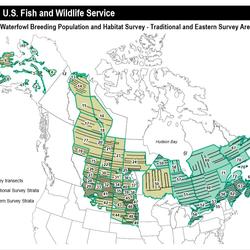
Redesigning the Eastern Breeding Waterfowl Population and Habitat Survey
USGS and partners are revising the design of a key waterfowl survey to increase management efficiency and cost-effectiveness, and inform annual harvest regulations in the U.S. and Canada.

Key Values of a Century of EESC Science
The USGS Eastern Ecological Science Center (EESC) is rooted in a proud tradition of service to the nation—advancing science that informs the conservation and management of fish, wildlife, and habitats across the eastern United States and beyond. Our mission is clear: deliver reliable, partner-driven science that supports natural resource decisions today, while ensuring these resources remain...

EESC Makes an Impact: Preserving our Hunting Resources
Hunting is an economic engine for the U.S. and responsible management of these resources directly supports 45.2 billion dollars spent by hunters annually. Conservation and management of hunting resources also contributes substantially to the 394.8 billion dollars spent on all wildlife-related recreation. Hunting traditions are an integral component of our American heritage, with 14.4 million...

EESC Makes an Impact: Reducing Management Costs and Increasing Efficiency
Decision analysis is widely used in business applications to improve cost saving and increase efficiency under uncertainty. Scientists at the U.S. Geological Survey Eastern Ecological Science Center (EESC) include world-renowned experts who use data, mathematics, statistics, and computer science to help frame and solve decision problems to support U.S. national security, public health, wildlife...

North American Breeding Bird Survey
The North American Breeding Bird Survey (BBS) is the primary source for critical quantitative data to evaluate the status of continental bird species, keeping common birds common and helping fuel a $75 billion wildlife watching industry. Each year thousands of citizen scientists skilled in avian identification collect data on BBS routes throughout North America allowing us to better understand...

Spatio-Temporal Statistical Models for Forecasting Climate Change Effects on Bird Distribution
Ecological indicators of climate change are needed to measure concurrent changes in ecological systems, inform management decisions, and forecast the consequences of climate change. We seek to develop robust bird-based, climate-change indicators using North American Breeding Bird Survey data.

Comprehensive 1966 - 2017 Results! North American Breeding Bird Survey
The North American Breeding Bird Survey program (BBS) provides critical science-based population data for more than 400 bird species to improve our understanding of how these federally entrusted species respond to environmental variability and ecosystem change. The BBS generates results that inform Federal wildlife managers in the Fish and Wildlife Service, the National Park Service, Department of...

Implementing Cross Validation Approaches for Model Selection and Evaluating Goodness of Fit in Complex Hierarchical Models
It is (relatively) easy to construct complex hierarchical models for analysis of the North American Breeding Bird Survey (BBS), but deciding which model best describes population change is difficult. We are developing methods for model selection for BBS and other important survey data sets, and using them to refine our estimates of population change from this important survey.

Design and Analysis of Surveys for Estimation of Temporal and Spatial Change in Animal Populations
Designing and analyzing large-scale animal surveys is an important focus of our research. Although we conduct research into analysis methods for many surveys, the primary focus of this project is to conduct analyses and develop web-based summaries of data from the North American Breeding Bird Survey (BBS).

The North American Breeding Bird Survey: Refining Scale to Provide New Insights
The Challenge: Since 1966, the North American Breeding Bird Survey (BBS) has filled a vital role in identifying at-risk bird species for Federal, State, and private entities. The BBS is a scientifically rigorous population count performed by a highly skilled, largely volunteer work force of nearly 2,500 observers. Every year these observers visit most of the survey’s 4,500 routes, which consist of...