
U.S. flag

An official website of the United States government

Birds

Filter Total Items: 60

USGS Sagebrush Science: Supporting Public Safety and Economic Decision Making Across the West

The sagebrush biome is one of the largest ecosystems in North America. Encompassing nearly one-third of the continental U.S., it provides critical resources for millions of Americans and a home for hundreds of plants and animal species in the West. Natural resource management in sagebrush ecosystems can be complex, and science can support management decisions by providing knowledge and tools to...
USGS Sagebrush Science: Supporting Public Safety and Economic Decision Making Across the West

USGS Sagebrush Science: Supporting Public Safety and Economic Decision Making Across the West

The sagebrush biome is one of the largest ecosystems in North America. Encompassing nearly one-third of the continental U.S., it provides critical resources for millions of Americans and a home for hundreds of plants and animal species in the West. Natural resource management in sagebrush ecosystems can be complex, and science can support management decisions by providing knowledge and tools to...
Learn More

Molecular Ecology Lab (MEL)

The Molecular Ecology Laboratory applies innovative genetic and genomic technologies to address a variety of complex questions and issues facing the Nation's natural resources. While we continually update the scale and efficiency of laboratory procedures to meet stakeholder needs, we must also be innovative and flexible in addressing those needs that have no off-the-shelf solution. We help...
Molecular Ecology Lab (MEL)

Molecular Ecology Lab (MEL)

The Molecular Ecology Laboratory applies innovative genetic and genomic technologies to address a variety of complex questions and issues facing the Nation's natural resources. While we continually update the scale and efficiency of laboratory procedures to meet stakeholder needs, we must also be innovative and flexible in addressing those needs that have no off-the-shelf solution. We help...
Learn More

Prioritizing restoration and conservation of Wyoming’s sagebrush ecosystems for wildlife and sagebrush connectivity

To support strategic ecosystem management across the imperiled sagebrush steppe in Wyoming, USA, we developed an extension of the Prioritizing Restoration of Sagebrush Ecosystems Tool (PReSET). Our expanded tool leverages emerging spatial data resources to provide a structured but customizable set of scenarios that can guide landscape-scale planning efforts by prioritizing conservation and...
Prioritizing restoration and conservation of Wyoming’s sagebrush ecosystems for wildlife and sagebrush connectivity

Prioritizing restoration and conservation of Wyoming’s sagebrush ecosystems for wildlife and sagebrush connectivity

To support strategic ecosystem management across the imperiled sagebrush steppe in Wyoming, USA, we developed an extension of the Prioritizing Restoration of Sagebrush Ecosystems Tool (PReSET). Our expanded tool leverages emerging spatial data resources to provide a structured but customizable set of scenarios that can guide landscape-scale planning efforts by prioritizing conservation and...
Learn More

Prioritizing Restoration of Sagebrush Ecosystems Tool (PReSET): A USGS-facilitated Decision-support Tool for Sagebrush Ecosystem Conservation and Restoration Actions

Sagebrush ecosystems represent one of the most imperiled systems in North America and face continued and widespread degradation due to multiple factors including invasive species and increased human development. Effective sagebrush management must consider how to best conserve and restore habitats to stem the decline of species that rely on them, especially given limited conservation resources. To...
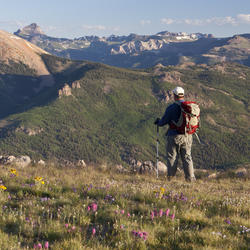
Prioritizing Restoration of Sagebrush Ecosystems Tool (PReSET): A USGS-facilitated Decision-support Tool for Sagebrush Ecosystem Conservation and Restoration Actions

Prioritizing Restoration of Sagebrush Ecosystems Tool (PReSET): A USGS-facilitated Decision-support Tool for Sagebrush Ecosystem Conservation and Restoration Actions

Sagebrush ecosystems represent one of the most imperiled systems in North America and face continued and widespread degradation due to multiple factors including invasive species and increased human development. Effective sagebrush management must consider how to best conserve and restore habitats to stem the decline of species that rely on them, especially given limited conservation resources. To...
Learn More

Social and economic analysis research in support of public safety, outdoor recreation, and economic growth

FORT researchers provide sound science to support the Department of the Interior in its efforts to reduce the risks wildfires pose to people and property, expand outdoor recreation and tourism opportunities, and promote economic decision making in public lands management. This research is developed in partnership with resource managers from local, State, Federal and Tribal governments, industry...
Social and economic analysis research in support of public safety, outdoor recreation, and economic growth

Social and economic analysis research in support of public safety, outdoor recreation, and economic growth

FORT researchers provide sound science to support the Department of the Interior in its efforts to reduce the risks wildfires pose to people and property, expand outdoor recreation and tourism opportunities, and promote economic decision making in public lands management. This research is developed in partnership with resource managers from local, State, Federal and Tribal governments, industry...
Learn More

Fish and wildlife science in support of heritage preservation, efficient decision making, wild ungulate management, and outdoor recreation

FORT researchers provide sound science to support the Department of Interior in its efforts to preserve American heritage, streamline species listing decisions and promote species recovery, manage wild horses and burros using efficient, cost-effective tools, and sustain hunting and fishing on public lands. This research is developed in partnership with resource managers from local, State, Federal...
Fish and wildlife science in support of heritage preservation, efficient decision making, wild ungulate management, and outdoor recreation

Fish and wildlife science in support of heritage preservation, efficient decision making, wild ungulate management, and outdoor recreation

FORT researchers provide sound science to support the Department of Interior in its efforts to preserve American heritage, streamline species listing decisions and promote species recovery, manage wild horses and burros using efficient, cost-effective tools, and sustain hunting and fishing on public lands. This research is developed in partnership with resource managers from local, State, Federal...
Learn More

Estimating locally relevant scales of effect for population trends of a species of conservation concern

Wildlife movement and distribution can be influenced by local conditions like topography and landscape features, and the distances within which species respond to their landscape – scales of effect – can vary over space and time. We are estimating scales of effect for wildlife population trends to help land managers determine the distance within which wildlife will respond to landscape change.
Estimating locally relevant scales of effect for population trends of a species of conservation concern

Estimating locally relevant scales of effect for population trends of a species of conservation concern

Wildlife movement and distribution can be influenced by local conditions like topography and landscape features, and the distances within which species respond to their landscape – scales of effect – can vary over space and time. We are estimating scales of effect for wildlife population trends to help land managers determine the distance within which wildlife will respond to landscape change.
Learn More

Fire Behavior and Effects Model Evaluation and Demonstration across Innovation Landscapes.

U.S. Geological Survey (USGS) scientists are working with the U.S. Department of War (DoW) Environmental Security Technology Certification Program (ESTCP) to demonstrate and improve how next-generation fire behavior models inform land management decision-making for partners within the National Innovation Landscape Network (Innovation Landscapes Network). Specifically, this project looks to...
Fire Behavior and Effects Model Evaluation and Demonstration across Innovation Landscapes.

Fire Behavior and Effects Model Evaluation and Demonstration across Innovation Landscapes.

U.S. Geological Survey (USGS) scientists are working with the U.S. Department of War (DoW) Environmental Security Technology Certification Program (ESTCP) to demonstrate and improve how next-generation fire behavior models inform land management decision-making for partners within the National Innovation Landscape Network (Innovation Landscapes Network). Specifically, this project looks to...
Learn More

Prey Availability

Migratory wildlife need to balance the benefits of migration and reproduction with the physiological costs. This is particularly challenging in dynamic environments like wetlands, where food levels can vary greatly from year to year. For shorebirds in the Great Basin region, saline or terminal lakes provide essential habitats during their annual life cycle. To understand how changes in hydrology...
Prey Availability

Prey Availability

Migratory wildlife need to balance the benefits of migration and reproduction with the physiological costs. This is particularly challenging in dynamic environments like wetlands, where food levels can vary greatly from year to year. For shorebirds in the Great Basin region, saline or terminal lakes provide essential habitats during their annual life cycle. To understand how changes in hydrology...
Learn More

Creating range-wide predictive maps of Greater Sage-Grouse seasonal habitats

Through a collaborative effort with multiple state and federal agencies, university researchers, and individual stakeholders, we are producing a set of predictive seasonal habitat maps for greater sage-grouse ( Centrocercus urophasianus) spanning the entirety of the species’ U.S. distribution. This is the largest habitat modeling effort of its kind for the species and uses a large, compiled...
Creating range-wide predictive maps of Greater Sage-Grouse seasonal habitats

Creating range-wide predictive maps of Greater Sage-Grouse seasonal habitats

Through a collaborative effort with multiple state and federal agencies, university researchers, and individual stakeholders, we are producing a set of predictive seasonal habitat maps for greater sage-grouse ( Centrocercus urophasianus) spanning the entirety of the species’ U.S. distribution. This is the largest habitat modeling effort of its kind for the species and uses a large, compiled...
Learn More

Geology, Geophysics, and Geochemistry Stable Isotope Laboratory (GSIL)

The GSIL is a state-of-the-art facility located on the Denver Federal Center that specializes in the measurement of light stable isotope — Hydrogen (H), Carbon (C), Nitrogen (N), Oxygen (O), and Sulfur (S) — compositions and other chemical and biomarker analytes in matrices relevant to the Earth sciences. Chemical and isotopic tracers offer novel insights into ecosystem biogeochemistry, food webs...
Geology, Geophysics, and Geochemistry Stable Isotope Laboratory (GSIL)

Geology, Geophysics, and Geochemistry Stable Isotope Laboratory (GSIL)

The GSIL is a state-of-the-art facility located on the Denver Federal Center that specializes in the measurement of light stable isotope — Hydrogen (H), Carbon (C), Nitrogen (N), Oxygen (O), and Sulfur (S) — compositions and other chemical and biomarker analytes in matrices relevant to the Earth sciences. Chemical and isotopic tracers offer novel insights into ecosystem biogeochemistry, food webs...
Learn More

Food Webs and Wildlife Nutrition

Wildlife nutrition is an essential element of fitness, and contextualizing resource use within the broader framework of local and regional food webs is paramount to species health, function, and management.
Food Webs and Wildlife Nutrition

Food Webs and Wildlife Nutrition

Wildlife nutrition is an essential element of fitness, and contextualizing resource use within the broader framework of local and regional food webs is paramount to species health, function, and management.
Learn More
Was this page helpful?