



Map showing the maximum coastal change likelihood value derived from support vector machine supervised learning that combines the fabric data with the event and perpetual hazards and selects the maximum outcome of that combination for A, the northeastern United States and B, detail for an area along the Delmarva Peninsula that is characterized by developed and undev
Images
Woods Hole Coastal and Marine Science Center images
Filter Total Items: 1298

CCL
Map showing the maximum coastal change likelihood value derived from support vector machine supervised learning that combines the fabric data with the event and perpetual hazards and selects the maximum outcome of that combination for A, the northeastern United States and B, detail for an area along the Delmarva Peninsula that is characterized by developed and undev

Hurricane Florence Numerical Modeling Geonarrative
Hurricane Florence Numerical Modeling GeonarrativeThe USGS partnered with North Carolina State University, Louisiana State University, and University Corporation for Atmospheric Research to investigate hurricane-induced compound flooding and sediment dispersal using coupled hydrology and ocean models.
Hurricane Florence Numerical Modeling Geonarrative
Hurricane Florence Numerical Modeling GeonarrativeThe USGS partnered with North Carolina State University, Louisiana State University, and University Corporation for Atmospheric Research to investigate hurricane-induced compound flooding and sediment dispersal using coupled hydrology and ocean models.

Bathymetry of Cape Cod Bay, MA
Bathymetry of Cape Cod Bay, MA collected in 2019. Warmer colors indicate shallow depths while cool colors indicate deeper depths.
Bathymetry of Cape Cod Bay, MA collected in 2019. Warmer colors indicate shallow depths while cool colors indicate deeper depths.

Coastal Change Likelihood
Where are coastal landscapes likely to change?
Where are coastal landscapes likely to change?

Coastal Change Likelihood
The U.S. Geological Survey, in cooperation with the National Park Service, developed the Coastal Change Likelihood assessment to determine the future likelihood of coastal change along the Northeast U.S. coastline in the next decade. The CCL data displayed here are for the mid-Atlantic Bight, and extend from the shoreline to 10m elevation inland.
The U.S. Geological Survey, in cooperation with the National Park Service, developed the Coastal Change Likelihood assessment to determine the future likelihood of coastal change along the Northeast U.S. coastline in the next decade. The CCL data displayed here are for the mid-Atlantic Bight, and extend from the shoreline to 10m elevation inland.

CCL and CVI
The CCL is an updated version of the older Coastal Vulnerability Index, first published in 1999. While the original product was focused on change in the next 50-100 years based solely on sea level rise, the new CCL is more near-term, focusing on change over the next decade as a result of multiple coastal hazards.
The CCL is an updated version of the older Coastal Vulnerability Index, first published in 1999. While the original product was focused on change in the next 50-100 years based solely on sea level rise, the new CCL is more near-term, focusing on change over the next decade as a result of multiple coastal hazards.

Coastal Change Likelihood
The U.S. Geological Survey, in cooperation with the National Park Service, developed the Coastal Change Likelihood assessment to determine the future likelihood of coastal change along the Northeast U.S. coastline in the next decade.
The U.S. Geological Survey, in cooperation with the National Park Service, developed the Coastal Change Likelihood assessment to determine the future likelihood of coastal change along the Northeast U.S. coastline in the next decade.

Coastal Change Likelihood - Fabric Data
The assessment integrates data describing coastal characteristics, landscape composition, and the level of resistance to change to produce the initial fabric layer.
The assessment integrates data describing coastal characteristics, landscape composition, and the level of resistance to change to produce the initial fabric layer.

Coastal Change Likelihood
The CCL is an updated version of the older Coastal Vulnerability Index, first published in 1999. While the original product was focused on change in the next 50-100 years based solely on sea level rise, the new CCL is more near-term, focusing on change over the next decade as a result of multiple coastal hazards.
The CCL is an updated version of the older Coastal Vulnerability Index, first published in 1999. While the original product was focused on change in the next 50-100 years based solely on sea level rise, the new CCL is more near-term, focusing on change over the next decade as a result of multiple coastal hazards.

Coastal Change Likelihood - Perpetual Hazard Data
Data defining the drivers of change that impact the coast, such as waves and flooding are synthesized in hazards layers.
Data defining the drivers of change that impact the coast, such as waves and flooding are synthesized in hazards layers.

Coastal Vulnerability Index
The CCL is an updated version of the older Coastal Vulnerability Index, first published in 1999. While the original product was focused on change in the next 50-100 years based solely on sea level rise, the new CCL is more near-term, focusing on change over the next decade as a result of multiple coastal hazards.
The CCL is an updated version of the older Coastal Vulnerability Index, first published in 1999. While the original product was focused on change in the next 50-100 years based solely on sea level rise, the new CCL is more near-term, focusing on change over the next decade as a result of multiple coastal hazards.

Coastal Change Likelihood
The U.S. Geological Survey, in cooperation with the National Park Service, developed the Coastal Change Likelihood assessment to determine the future likelihood of coastal change along the Northeast coastline in the next decade. Pictured here is coastal change likelihood on Cape Cod.
The U.S. Geological Survey, in cooperation with the National Park Service, developed the Coastal Change Likelihood assessment to determine the future likelihood of coastal change along the Northeast coastline in the next decade. Pictured here is coastal change likelihood on Cape Cod.

Coastal Change Likelihood - Fabric Data
The CCL assessment integrates data describing coastal characteristics, landscape composition, and the level of resistance to change, with data defining the drivers of change that impact the coast, such as waves and flooding. These data types are known as fabric and hazards, respectively.
The CCL assessment integrates data describing coastal characteristics, landscape composition, and the level of resistance to change, with data defining the drivers of change that impact the coast, such as waves and flooding. These data types are known as fabric and hazards, respectively.

Coastal Change Likelihood
The U.S. Geological Survey, in cooperation with the National Park Service, developed the Coastal Change Likelihood assessment to determine the future likelihood of coastal change along the Northeast U.S. coastline in the next decade. Here is the CCL map for Chesapeake, Va.
The U.S. Geological Survey, in cooperation with the National Park Service, developed the Coastal Change Likelihood assessment to determine the future likelihood of coastal change along the Northeast U.S. coastline in the next decade. Here is the CCL map for Chesapeake, Va.

Coastal Vulnerability Index - 1999
The CCL is an updated version of the older Coastal Vulnerability Index, first published in 1999. While the original product was focused on change in the next 50-100 years based solely on sea level rise, the new CCL is more near-term, focusing on change over the next decade as a result of multiple coastal hazards.
The CCL is an updated version of the older Coastal Vulnerability Index, first published in 1999. While the original product was focused on change in the next 50-100 years based solely on sea level rise, the new CCL is more near-term, focusing on change over the next decade as a result of multiple coastal hazards.

Coastal Change Likelihood
The U.S. Geological Survey, in cooperation with the National Park Service, developed the Coastal Change Likelihood assessment to determine the future likelihood of coastal change along the Northeast U.S. coastline in the next decade.
The U.S. Geological Survey, in cooperation with the National Park Service, developed the Coastal Change Likelihood assessment to determine the future likelihood of coastal change along the Northeast U.S. coastline in the next decade.

ganju_headshot.jpg
Headshot of Neil Kamal Ganju, a Research Oceanographer with the USGS Woods Hole Coastal and Marine Science Center.
Headshot of Neil Kamal Ganju, a Research Oceanographer with the USGS Woods Hole Coastal and Marine Science Center.

Sea-Floor Mapping: 2022 by the numbers
The year of 2022 was big for the Sea-Floor Mapping Group at the Woods Hole Coastal and Marine Science Center! These data were collected as part of a collaborative research program and include data collected by USGS and our partners.
The year of 2022 was big for the Sea-Floor Mapping Group at the Woods Hole Coastal and Marine Science Center! These data were collected as part of a collaborative research program and include data collected by USGS and our partners.
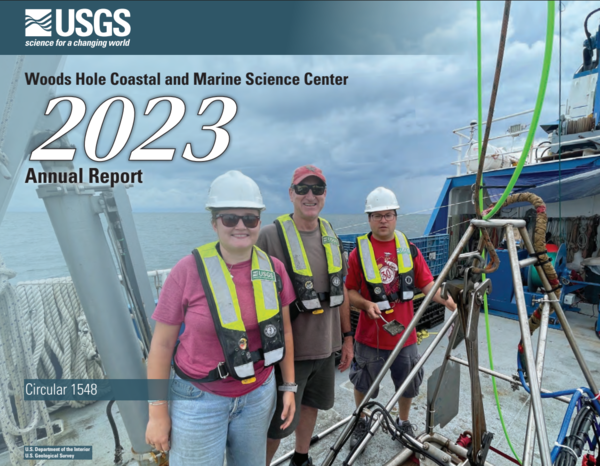
2023 Woods Hole Annual Report
The 2023 annual report of the U.S. Geological Survey Woods Hole Coastal and Marine Science Center highlights accomplishments of 2023, includes a list of 2023 publications, and summarizes the work of the center, as well as the work of each of its science groups.
The 2023 annual report of the U.S. Geological Survey Woods Hole Coastal and Marine Science Center highlights accomplishments of 2023, includes a list of 2023 publications, and summarizes the work of the center, as well as the work of each of its science groups.

2022 Annual Report Cover
The 2022 annual report of the U.S. Geological Survey Woods Hole Coastal and Marine Science Center highlights accomplishments of 2022, includes a list of 2022 publications, and summarizes the work of the center, as well as the work of each of its science groups.
The 2022 annual report of the U.S. Geological Survey Woods Hole Coastal and Marine Science Center highlights accomplishments of 2022, includes a list of 2022 publications, and summarizes the work of the center, as well as the work of each of its science groups.

2022 Coring
As sea levels rise, salt water extends further up tidal rivers. As sea-level rise accelerates, vegetation transitions are increasingly observed and USGS scientists are busy assessing those changes. USGS scientists take soil cores in the marsh.
As sea levels rise, salt water extends further up tidal rivers. As sea-level rise accelerates, vegetation transitions are increasingly observed and USGS scientists are busy assessing those changes. USGS scientists take soil cores in the marsh.