



Assessing the effects of mining on the Transboundary Koocanusa Reservoir
The Kootenai River Watershed is an international resource cooperatively managed by the U.S., Canada, and Tribal governments. In recent years, coal mining in the Canadian portion of the watershed has resulted in elevated concentrations of several constituents, including selenium, nitrate, and sulfate downstream (Storb et al., 2023). At increased levels, these mining byproducts can affect water quality and pose a risk the health of aquatic ecosystems. Since 2018, the U.S. Geological Survey (USGS) has been studying the effects of mining on the water quality of Lake Koocanusa and the Kootenai River Watershed. This work delivers high-frequency water-quality data and independent research to help inform water management decisions in the U.S. and Canada.
Stay up-to-date with our latest publications
Key Points
- Coal mining in the Canadian portion of the watershed has resulted in elevated concentrations of selenium, nitrate, and sulfate in Lake Koocanusa and other downstream areas (Storb et al., 2023).
- At elevated concentrations, selenium can affect water quality and can be toxic to animals, particularly fish and birds.
- In recent years, selenium concentrations in parts of Lake Koocanusa have exceeded state and federal water-quality standards (Storb et al., 2023).
- USGS scientists are studying the effects of increased concentrations of selenium on the Kootenai River Watershed
- Studies show a substantial increase in selenium concentrations in the Elk River and Lake Koocanusa and elevated selenium concentrations as far as 357 miles (574 kilometers) downstream in the Columbia River (Foster et al., 2024).
- In 2023, USGS scientists found that surface-water treatment methods used by mining companies were reducing concentrations entering the Elk River but were not adequately reducing the load (i.e. the mass) of selenium entering Lake Koocanusa and downstream. (Storb et al., 2023)

Originating in southeastern British Columbia, the Kootenai River (known as Kootenay in Canada) and its tributaries flow southward through Montana’s Lake Koocanusa, then into Idaho, before re-entering British Columbia and joining the Columbia River beyond Lake Kootenay. The Kootenai River and its tributaries support aquatic ecosystems, and provide water for drinking, agriculture, and recreational opportunities. The watershed also holds significant cultural importance for the Ktunaxa Nation, including the Confederated Salish and Kootenai Tribes, and the Kootenai Tribes of Idaho. Many dams regulate alter the flow of the Kootenai River, providing flood storage, hydroelectric power production, and recreational opportunities.
The Kootenai Watershed also supports aquatic habitat, including critical habitat for culturally important, threatened, and endangered fish species such as white sturgeon (Acipenser transmontanus), bull trout (Salvelinus confluentus), and westslope cutthroat trout (Oncorhynchus clarkii lewisid). As the second largest tributary to the Columbia River, the Kootenai River also helps maintain flows and water quality for several endangered salmon and steelhead runs on the Columbia River.
Coal mining effects on international water quality
Expanded coal mining on the Elk River, a tributary to the Kootenai River in the Canadian portion of the watershed, has led to elevated selenium, nitrate, and sulfate concentrations in the Kootenai River and Lake Koocanusa, a reservoir that straddles the international border (Storb et al., 2023). Selenium is a naturally occurring element but can also be released from mine waste and enter waterways. At low concentrations, selenium is an essential micro-nutrient for animals. However, it can be toxic at elevated concentrations. In aquatic ecosystems, chronic exposure in fish and aquatic invertebrates can affect juvenile growth and survival and cause reproductive issues, including deformities and increased mortality. Birds that eat aquatic organisms with high selenium levels are also vulnerable to its effects.
In Lake Koocanusa and parts of the Kootenai River, concentrations of selenium currently exceed U.S. state and federal water-quality standards designed to protect the health of aquatic ecosystems (Storb et al., 2023). Increases in mining byproducts are an international concern, as communities throughout the region rely on the Kootenai watershed for healthy fisheries and water quality.
Developing water-quality standards for Lake Koocanusa and the Kootenai River
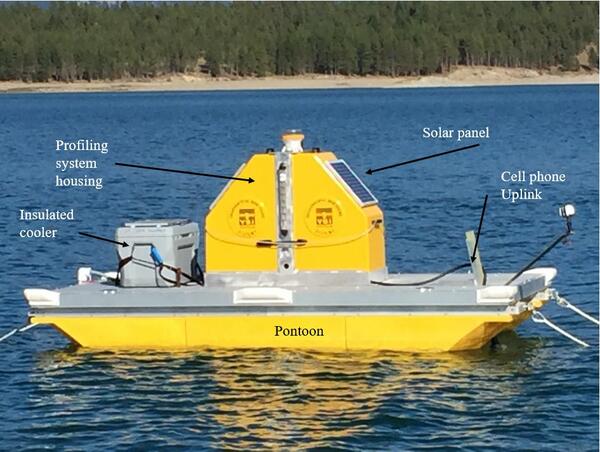
Concerned about the effects of selenium and other mining byproducts on fish, wildlife, and people in the region, the Montana Department of Environmental Quality (DEQ) designated Lake Koocanusa as threatened by increasing concentrations of selenium, under the U.S. Clean Water Act in 2012. Between 2015 and 2020, the State of Montana, the Province of British Columbia, and stakeholders in the Lake Koocanusa Monitoring and Research Working Group collaborated to develop a conceptual framework for selenium standards development tailored to Lake Koocanusa. Water-quality standards are designed to protect designated beneficial uses, including recreation, drinking water, and aquatic species.
To guide this effort, the USGS developed a model that tracks how selenium moves through and accumulates in the environment, including in fish tissue (Presser and Naftz, 2020). Montana DEQ used this model to determine a water column selenium concentration limit to protect aquatic life. In 2020, Montana DEQ adopted a site-specific selenium water-quality standard for Lake Koocanusa, setting the water column concentration limit at 0.8 micrograms per liter for Lake Koocanusa. A limit of 3.1 micrograms per liter was also set for the Kootenai River and for fish tissue in both bodies of water. The Environmental Protection Agency (EPA) approved the State’s standards under the Clean Water Act. The Province of British Columbia worked closely with Montana and the Lake Koocanusa Monitoring and Research Working Group to identify a comparable water-quality guideline for Lake Koocanusa, but as of spring 2025, they have not finalized an updated guideline.
USGS science in the Kootenai River Watershed
In 2019, prompted by water quality and aquatic health concerns, the U.S. Congress directed the USGS to study the potential effects of mining in Lake Koocanusa and the broader Kootenai Watershed. USGS has collected water-quality data and conducted several studies in the watershed since 2019.
As a non-regulatory agency and without management responsibility, USGS play an important scientific role and an impartial entity to collect and disseminate scientific data and publish interpretive studies to improve understanding of the effects of mining on the reservoir and watershed. This information is shared with Federal, State, Provincial, Tribal entities, and the public on both sides of the international border. These data and studies can be used by the other entities to facilitate informed decisions and efforts to protect, restore, and manage aquatic environments within the complicated regulatory setting of a transboundary watershed.
Collecting consistent water-quality data
USGS scientists collected water-quality data from the reservoir as early as the 1970s. However, in 2019, USGS began high-frequency water-quality monitoring to understand changing selenium levels in the reservoir and the river below Libby Dam. Water-quality samples and environmental data (such as pH and water temperature) have been collected from sites on the reservoir and river as well.
View the water-quality data
Understanding the source of selenium contamination in Lake Koocanusa
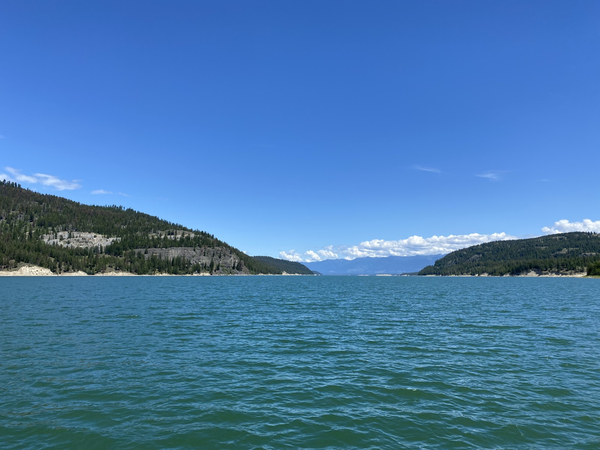
The Elk River is one of the main tributaries to Lake Koocanusa and the site of most coal mining in the region. A 2023 USGS study determined that of the two main tributaries to Lake Koocanusa, the Elk River contributed only 29% of the flow, but 95% of the selenium entering the reservoir. The study also found that from 1979 to 2022, selenium concentrations rose alongside expanded mining, increasing by 551%. This is one of the largest documented percent increases in selenium concentrations of any scientific study. Nitrate and sulfate concentrations also increased by 784% and 120%, respectively.
The study found that concentrations of dissolved minerals (selenium, nitrate, sulfate), peaked during low flows. This contrasts with data from 40 years ago, when the highest concentrations of solutes were more commonly linked with high flows. This change suggests that growing mining operations could be causing a continuous release of pollutants that are less diluted when flows are low. Increased concentrations of these minerals in groundwater from mining activities or surface water runoff associated with waste rock could cause changes in the changes observed in the concentrations, though further research is needed.
Recent efforts to treat surface water near the mines have shown some success in reducing selenium concentrations during low flow periods. However, they have not significantly reduced the amount (i.e. mass) of contaminants entering the reservoir each year. This suggests that current water treatment methods, which focus on surface water, may not be effective enough to reduce selenium levels to U.S. water-quality standards for Lake Koocanusa. In turn, because selenium in Lake Koocanusa flows downstream to the rest of the watershed, ineffective water treatment could degrade water quality throughout the downstream watershed. Coal mining companies in the Elk River region have implemented more treatment measures, but the effectiveness of these efforts is not yet known.
Check out the Elk River study
Determining how far selenium travels downstream in the Kootenai Watershed
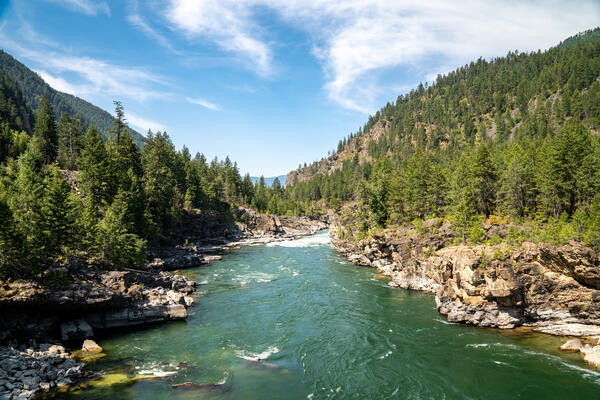
A 2024 USGS study documented increasing selenium concentrations over 17 years (2005-2021) in the Elk, Kootenai, and Columbia Rivers, downstream from the Elk River mines. Elevated selenium concentrations were found as far as 357 miles (574 kilometers) downstream in the Columbia River and were largely attributed to coal mining waste in the Elk River Valley.Rising selenium levels suggest that potential risks to aquatic life are also increasing. These findings highlight the usefulness of monitoring selenium levels far downstream from mining sites to effectively manage selenium in surface mining environments.
Check out the selenium transport study
Continuing scientific efforts for a healthy Kootenai Watershed
The scientific efforts of the USGS are important for understanding and addressing the documented far-reaching effects of coal mining on the international Kootenai River Watershed. Documented increases in selenium exceed both Canadian and U.S. water-quality standards and pose risks to aquatic ecosystems as far downstream as the Columbia River. Continued water-quality monitoring and research into the sources, transport mechanisms, biological risk, and extent of these constituents can help inform other agencies with the development of transboundary mitigation measures and management strategies. These collaborative actions could be essential for protecting the ecological integrity and beneficial uses of this shared resource. As such, USGS scientists continue to collect data and conduct studies on Lake Koocanusa and the Kootenai River Watershed.
References
Foster, M.J., Storb, M.B., Blake, J.M., Schmidt, T.S., Nustad, R.A., Bussell, A.M., Evidence of long-range transport of selenium downstream of coal mining operations in the Elk River Valley, Canada, Environmental Science & Technology Letters 2024 11 (8), 856-861, DOI: 10.1021/acs.estlett.4c00222.
Presser, T.S., and Naftz, D.L., 2020, Understanding and documenting the scientific basis of selenium ecological protection in support of site-specific guidelines development for Lake Koocanusa, Montana, U.S.A., and British Columbia, Canada: U.S. Geological Survey Open-File Report 2020–1098, 40 p., https://doi.org/10.3133/ofr20201098.
Storb, M.S., Bussell, A.M., Caldwell, S.L., Hirsch, R.M., Schmidt, T.S., Growth of coal mining operations in the Elk River Valley (Canada) linked to increasing solute transport of Se, NO3–, and SO42– into the transboundary Koocanusa Reservoir (USA–Canada), Environmental Science & Technology 2023 57 (45), 17465-17480, DOI: 10.1021/acs.est.3c05090.

Evidence of selenium transport from Elk River Valley, Canada to the Columbia River

Monitoring Mining Effects in the Kootenai River Watershed
Growth of coal mining operations in the Elk River Valley linked to increasing transport of selenium, nitrate, and sulfate into Lake Koocanusa

Developing CE-QUAL-W2 Models of the Kootenai River and Koocanusa Reservoir, Montana and Idaho
The Kootenai River Watershed is an international resource cooperatively managed by the U.S., Canada, and Tribal governments. In recent years, coal mining in the Canadian portion of the watershed has resulted in elevated concentrations of several constituents, including selenium, nitrate, and sulfate downstream (Storb et al., 2023). At increased levels, these mining byproducts can affect water quality and pose a risk the health of aquatic ecosystems. Since 2018, the U.S. Geological Survey (USGS) has been studying the effects of mining on the water quality of Lake Koocanusa and the Kootenai River Watershed. This work delivers high-frequency water-quality data and independent research to help inform water management decisions in the U.S. and Canada.
Stay up-to-date with our latest publications
Key Points
- Coal mining in the Canadian portion of the watershed has resulted in elevated concentrations of selenium, nitrate, and sulfate in Lake Koocanusa and other downstream areas (Storb et al., 2023).
- At elevated concentrations, selenium can affect water quality and can be toxic to animals, particularly fish and birds.
- In recent years, selenium concentrations in parts of Lake Koocanusa have exceeded state and federal water-quality standards (Storb et al., 2023).
- USGS scientists are studying the effects of increased concentrations of selenium on the Kootenai River Watershed
- Studies show a substantial increase in selenium concentrations in the Elk River and Lake Koocanusa and elevated selenium concentrations as far as 357 miles (574 kilometers) downstream in the Columbia River (Foster et al., 2024).
- In 2023, USGS scientists found that surface-water treatment methods used by mining companies were reducing concentrations entering the Elk River but were not adequately reducing the load (i.e. the mass) of selenium entering Lake Koocanusa and downstream. (Storb et al., 2023)
Originating in southeastern British Columbia, the Kootenai River (known as Kootenay in Canada) and its tributaries flow southward through Montana’s Lake Koocanusa, then into Idaho, before re-entering British Columbia and joining the Columbia River beyond Lake Kootenay. The Kootenai River and its tributaries support aquatic ecosystems, and provide water for drinking, agriculture, and recreational opportunities. The watershed also holds significant cultural importance for the Ktunaxa Nation, including the Confederated Salish and Kootenai Tribes, and the Kootenai Tribes of Idaho. Many dams regulate alter the flow of the Kootenai River, providing flood storage, hydroelectric power production, and recreational opportunities.
The Kootenai Watershed also supports aquatic habitat, including critical habitat for culturally important, threatened, and endangered fish species such as white sturgeon (Acipenser transmontanus), bull trout (Salvelinus confluentus), and westslope cutthroat trout (Oncorhynchus clarkii lewisid). As the second largest tributary to the Columbia River, the Kootenai River also helps maintain flows and water quality for several endangered salmon and steelhead runs on the Columbia River.
Coal mining effects on international water quality
Expanded coal mining on the Elk River, a tributary to the Kootenai River in the Canadian portion of the watershed, has led to elevated selenium, nitrate, and sulfate concentrations in the Kootenai River and Lake Koocanusa, a reservoir that straddles the international border (Storb et al., 2023). Selenium is a naturally occurring element but can also be released from mine waste and enter waterways. At low concentrations, selenium is an essential micro-nutrient for animals. However, it can be toxic at elevated concentrations. In aquatic ecosystems, chronic exposure in fish and aquatic invertebrates can affect juvenile growth and survival and cause reproductive issues, including deformities and increased mortality. Birds that eat aquatic organisms with high selenium levels are also vulnerable to its effects.
In Lake Koocanusa and parts of the Kootenai River, concentrations of selenium currently exceed U.S. state and federal water-quality standards designed to protect the health of aquatic ecosystems (Storb et al., 2023). Increases in mining byproducts are an international concern, as communities throughout the region rely on the Kootenai watershed for healthy fisheries and water quality.
Developing water-quality standards for Lake Koocanusa and the Kootenai River
Concerned about the effects of selenium and other mining byproducts on fish, wildlife, and people in the region, the Montana Department of Environmental Quality (DEQ) designated Lake Koocanusa as threatened by increasing concentrations of selenium, under the U.S. Clean Water Act in 2012. Between 2015 and 2020, the State of Montana, the Province of British Columbia, and stakeholders in the Lake Koocanusa Monitoring and Research Working Group collaborated to develop a conceptual framework for selenium standards development tailored to Lake Koocanusa. Water-quality standards are designed to protect designated beneficial uses, including recreation, drinking water, and aquatic species.
To guide this effort, the USGS developed a model that tracks how selenium moves through and accumulates in the environment, including in fish tissue (Presser and Naftz, 2020). Montana DEQ used this model to determine a water column selenium concentration limit to protect aquatic life. In 2020, Montana DEQ adopted a site-specific selenium water-quality standard for Lake Koocanusa, setting the water column concentration limit at 0.8 micrograms per liter for Lake Koocanusa. A limit of 3.1 micrograms per liter was also set for the Kootenai River and for fish tissue in both bodies of water. The Environmental Protection Agency (EPA) approved the State’s standards under the Clean Water Act. The Province of British Columbia worked closely with Montana and the Lake Koocanusa Monitoring and Research Working Group to identify a comparable water-quality guideline for Lake Koocanusa, but as of spring 2025, they have not finalized an updated guideline.
USGS science in the Kootenai River Watershed
In 2019, prompted by water quality and aquatic health concerns, the U.S. Congress directed the USGS to study the potential effects of mining in Lake Koocanusa and the broader Kootenai Watershed. USGS has collected water-quality data and conducted several studies in the watershed since 2019.
As a non-regulatory agency and without management responsibility, USGS play an important scientific role and an impartial entity to collect and disseminate scientific data and publish interpretive studies to improve understanding of the effects of mining on the reservoir and watershed. This information is shared with Federal, State, Provincial, Tribal entities, and the public on both sides of the international border. These data and studies can be used by the other entities to facilitate informed decisions and efforts to protect, restore, and manage aquatic environments within the complicated regulatory setting of a transboundary watershed.
Collecting consistent water-quality data
USGS scientists collected water-quality data from the reservoir as early as the 1970s. However, in 2019, USGS began high-frequency water-quality monitoring to understand changing selenium levels in the reservoir and the river below Libby Dam. Water-quality samples and environmental data (such as pH and water temperature) have been collected from sites on the reservoir and river as well.
View the water-quality data
Understanding the source of selenium contamination in Lake Koocanusa
The Elk River is one of the main tributaries to Lake Koocanusa and the site of most coal mining in the region. A 2023 USGS study determined that of the two main tributaries to Lake Koocanusa, the Elk River contributed only 29% of the flow, but 95% of the selenium entering the reservoir. The study also found that from 1979 to 2022, selenium concentrations rose alongside expanded mining, increasing by 551%. This is one of the largest documented percent increases in selenium concentrations of any scientific study. Nitrate and sulfate concentrations also increased by 784% and 120%, respectively.
The study found that concentrations of dissolved minerals (selenium, nitrate, sulfate), peaked during low flows. This contrasts with data from 40 years ago, when the highest concentrations of solutes were more commonly linked with high flows. This change suggests that growing mining operations could be causing a continuous release of pollutants that are less diluted when flows are low. Increased concentrations of these minerals in groundwater from mining activities or surface water runoff associated with waste rock could cause changes in the changes observed in the concentrations, though further research is needed.
Recent efforts to treat surface water near the mines have shown some success in reducing selenium concentrations during low flow periods. However, they have not significantly reduced the amount (i.e. mass) of contaminants entering the reservoir each year. This suggests that current water treatment methods, which focus on surface water, may not be effective enough to reduce selenium levels to U.S. water-quality standards for Lake Koocanusa. In turn, because selenium in Lake Koocanusa flows downstream to the rest of the watershed, ineffective water treatment could degrade water quality throughout the downstream watershed. Coal mining companies in the Elk River region have implemented more treatment measures, but the effectiveness of these efforts is not yet known.
Check out the Elk River study
Determining how far selenium travels downstream in the Kootenai Watershed
A 2024 USGS study documented increasing selenium concentrations over 17 years (2005-2021) in the Elk, Kootenai, and Columbia Rivers, downstream from the Elk River mines. Elevated selenium concentrations were found as far as 357 miles (574 kilometers) downstream in the Columbia River and were largely attributed to coal mining waste in the Elk River Valley.Rising selenium levels suggest that potential risks to aquatic life are also increasing. These findings highlight the usefulness of monitoring selenium levels far downstream from mining sites to effectively manage selenium in surface mining environments.
Check out the selenium transport study
Continuing scientific efforts for a healthy Kootenai Watershed
The scientific efforts of the USGS are important for understanding and addressing the documented far-reaching effects of coal mining on the international Kootenai River Watershed. Documented increases in selenium exceed both Canadian and U.S. water-quality standards and pose risks to aquatic ecosystems as far downstream as the Columbia River. Continued water-quality monitoring and research into the sources, transport mechanisms, biological risk, and extent of these constituents can help inform other agencies with the development of transboundary mitigation measures and management strategies. These collaborative actions could be essential for protecting the ecological integrity and beneficial uses of this shared resource. As such, USGS scientists continue to collect data and conduct studies on Lake Koocanusa and the Kootenai River Watershed.
References
Foster, M.J., Storb, M.B., Blake, J.M., Schmidt, T.S., Nustad, R.A., Bussell, A.M., Evidence of long-range transport of selenium downstream of coal mining operations in the Elk River Valley, Canada, Environmental Science & Technology Letters 2024 11 (8), 856-861, DOI: 10.1021/acs.estlett.4c00222.
Presser, T.S., and Naftz, D.L., 2020, Understanding and documenting the scientific basis of selenium ecological protection in support of site-specific guidelines development for Lake Koocanusa, Montana, U.S.A., and British Columbia, Canada: U.S. Geological Survey Open-File Report 2020–1098, 40 p., https://doi.org/10.3133/ofr20201098.
Storb, M.S., Bussell, A.M., Caldwell, S.L., Hirsch, R.M., Schmidt, T.S., Growth of coal mining operations in the Elk River Valley (Canada) linked to increasing solute transport of Se, NO3–, and SO42– into the transboundary Koocanusa Reservoir (USA–Canada), Environmental Science & Technology 2023 57 (45), 17465-17480, DOI: 10.1021/acs.est.3c05090.
Evidence of selenium transport from Elk River Valley, Canada to the Columbia River
Monitoring Mining Effects in the Kootenai River Watershed
Growth of coal mining operations in the Elk River Valley linked to increasing transport of selenium, nitrate, and sulfate into Lake Koocanusa