Social media graphic used for promoting the 2023 update to the National Seismic Hazard Model | U.S. Geological Survey (usgs.gov)
Images
Images
Social media graphic used for promoting the 2023 update to the National Seismic Hazard Model | U.S. Geological Survey (usgs.gov)
The “Did you feel it?” ZIP Map for the 1994 Northrdige earthquake.
The “Did you feel it?” ZIP Map for the 1994 Northrdige earthquake.The “Did you feel it?” ZIP Map for the 1994 Northrdige earthquake. Found at this link: https://earthquake.usgs.gov/earthquakes/eventpage/ci3144585/dyfi/zip
The “Did you feel it?” ZIP Map for the 1994 Northrdige earthquake.
The “Did you feel it?” ZIP Map for the 1994 Northrdige earthquake.The “Did you feel it?” ZIP Map for the 1994 Northrdige earthquake. Found at this link: https://earthquake.usgs.gov/earthquakes/eventpage/ci3144585/dyfi/zip
Northridge earthquake Did you feel it webpage screenshot
Northridge earthquake Did you feel it webpage screenshotScreenshot from the "Did you feel it?" felt report form from the Northridge earthquake. Found at this link: https://earthquake.usgs.gov/earthquakes/eventpage/ci3144585/tellus
Northridge earthquake Did you feel it webpage screenshot
Northridge earthquake Did you feel it webpage screenshotScreenshot from the "Did you feel it?" felt report form from the Northridge earthquake. Found at this link: https://earthquake.usgs.gov/earthquakes/eventpage/ci3144585/tellus
Hazard map from the 2023 50-state update of the National Seismic Hazard Model Project
Hazard map from the 2023 50-state update of the National Seismic Hazard Model ProjectThis hazard map is a simplified 2% in 50-year probability of exceedance map for fixed VS30 760 m/s.
Hazard map from the 2023 50-state update of the National Seismic Hazard Model Project
Hazard map from the 2023 50-state update of the National Seismic Hazard Model ProjectThis hazard map is a simplified 2% in 50-year probability of exceedance map for fixed VS30 760 m/s.
Northridge Earthquake USGS “Did you feel it?” website screenshot
Northridge Earthquake USGS “Did you feel it?” website screenshotScreenshot of the interactive “Did you feel it?”website.
Found at this link:https://earthquake.usgs.gov/earthquakes/eventpage/ci3144585/map?dyfi-re…
Northridge Earthquake USGS “Did you feel it?” website screenshot
Northridge Earthquake USGS “Did you feel it?” website screenshotScreenshot of the interactive “Did you feel it?”website.
Found at this link:https://earthquake.usgs.gov/earthquakes/eventpage/ci3144585/map?dyfi-re…
This is an example of an OnDemand 1:100,000 Topo scale or 100K Topo map of Radford, Virginia.
Image of Dr. Russell G. Congleton who is a recipient of a William T. Pecora Award for achievements in Earth remote sensing.
Scientists travel by raft to collect samples in the Grand Canyon
Scientists travel by raft to collect samples in the Grand CanyonScientists travel by raft to collect various samples on the Colorado River in the Grand Canyon.
Scientists travel by raft to collect samples in the Grand Canyon
Scientists travel by raft to collect samples in the Grand CanyonScientists travel by raft to collect various samples on the Colorado River in the Grand Canyon.
Noah Hoffman, physical scientist, USGS California Water Science Center, installing soil moisture probe
Noah Hoffman, physical scientist, USGS California Water Science Center, installing soil moisture probeThe U.S. Geological Survey (USGS) California Water Science Center is employing specific types of soil moisture probes to monitor watersheds, creeks, and streams as part of their hydrological studies and environmental monitoring efforts.
Noah Hoffman, physical scientist, USGS California Water Science Center, installing soil moisture probe
Noah Hoffman, physical scientist, USGS California Water Science Center, installing soil moisture probeThe U.S. Geological Survey (USGS) California Water Science Center is employing specific types of soil moisture probes to monitor watersheds, creeks, and streams as part of their hydrological studies and environmental monitoring efforts.
Screen capture of topoBuilder interface showing selection of on-grid and custom extent 100K Topos.
Screenshot of various 100K Topo maps created in topoBuilder application
Screenshot of various 100K Topo maps created in topoBuilder applicationA screenshot showing various 100K Topo maps being created in topoBuilder application.
Screenshot of various 100K Topo maps created in topoBuilder application
Screenshot of various 100K Topo maps created in topoBuilder applicationA screenshot showing various 100K Topo maps being created in topoBuilder application.
Teenage citizen-scientist helps USGS confirm unique population of threatened turtle
Teenage citizen-scientist helps USGS confirm unique population of threatened turtleA young federally Threatened Ringed Map Turtle basks on a log near Covington, Louisiana. (Courtesy photo).
Teenage citizen-scientist helps USGS confirm unique population of threatened turtle
Teenage citizen-scientist helps USGS confirm unique population of threatened turtleA young federally Threatened Ringed Map Turtle basks on a log near Covington, Louisiana. (Courtesy photo).
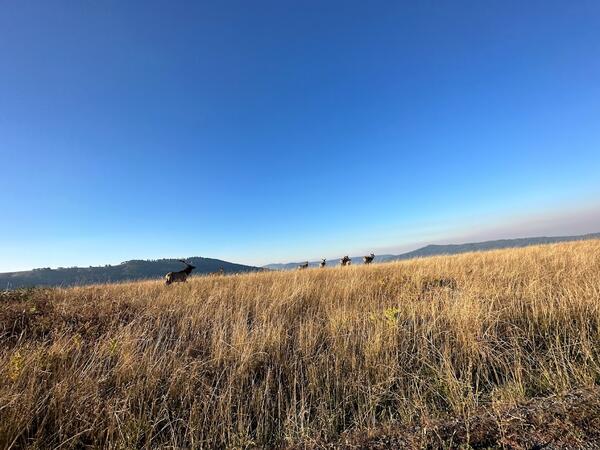
The Roosevelt Elk holds significant cultural, spiritual, and practical importance for the Yurok Tribe. Traditionally, the Yurok people have a deep connection with the natural world, viewing it as a source of life and a realm deeply intertwined with their community’s well-being and cultural identity.
USGS scientist Tylor Rosera analyzes dragonfly larvae samples for mercury as part of the Dragonfly Mercury Project.
USGS scientist Tylor Rosera analyzes dragonfly larvae samples for mercury as part of the Dragonfly Mercury Project.USGS scientist Tylor Rosera analyzes dragonfly larvae samples for mercury as part of the Dragonfly Mercury Project.
USGS scientist Tylor Rosera analyzes dragonfly larvae samples for mercury as part of the Dragonfly Mercury Project.
USGS scientist Tylor Rosera analyzes dragonfly larvae samples for mercury as part of the Dragonfly Mercury Project.USGS scientist Tylor Rosera analyzes dragonfly larvae samples for mercury as part of the Dragonfly Mercury Project.
Analyzing dragonfly larvae samples as part of the Dragonfly Mercury Project.
Analyzing dragonfly larvae samples as part of the Dragonfly Mercury Project.A USGS scientist analyzes dragonfly larvae samples for mercury as part of the Dragonfly Mercury Project.
Analyzing dragonfly larvae samples as part of the Dragonfly Mercury Project.
Analyzing dragonfly larvae samples as part of the Dragonfly Mercury Project.A USGS scientist analyzes dragonfly larvae samples for mercury as part of the Dragonfly Mercury Project.
Photo of green forested area and blue sky overlooking the ocean in Kahanahāiki, Oʻahu on a sunny day.
Photo of misty clouds in a forested area of Alakaʻi Wilderness Preserve, Kauaʻi.
New method to detect white-nose syndrome fungus in bats developed
New method to detect white-nose syndrome fungus in bats developedA new test for white-nose syndrome-causing fungus in bats has been developed using a CRISPR biosensor. If white-nose syndrome-causing fungus is present, the reaction tube will glow under UV light.
New method to detect white-nose syndrome fungus in bats developed
New method to detect white-nose syndrome fungus in bats developedA new test for white-nose syndrome-causing fungus in bats has been developed using a CRISPR biosensor. If white-nose syndrome-causing fungus is present, the reaction tube will glow under UV light.
New method to detect white-nose syndrome fungus in bats developed
New method to detect white-nose syndrome fungus in bats developedA new test for white-nose syndrome-causing fungus in bats has been developed using a CRISPR biosensor. If white-nose syndrome-causing fungus is present, the reaction tube will glow under UV light.
New method to detect white-nose syndrome fungus in bats developed
New method to detect white-nose syndrome fungus in bats developedA new test for white-nose syndrome-causing fungus in bats has been developed using a CRISPR biosensor. If white-nose syndrome-causing fungus is present, the reaction tube will glow under UV light.
The Colorado River, brown from heightened suspended load following rains, flows through Paleoproteroic basement and overlying Cambrian Tapeats Sandstone in the Grand Canyon (Arizona, USA).
Scientist collects water sample in the Grand Canyon
Scientist collects water sample in the Grand CanyonUSGS scientist collects a water-quality sample in the Grand Canyon, Arizona.
Scientist collects water sample in the Grand Canyon
Scientist collects water sample in the Grand CanyonUSGS scientist collects a water-quality sample in the Grand Canyon, Arizona.