U.S. flag

An official website of the United States government

Core Science Systems Mission Area

USGS CSS serves as the primary national civilian mapping agency, including topographic and geologic mapping for Federal and State requirements, national geospatial coordination, satellite operations and remote sensing. Our products and data are necessary to understand, monitor, and detect changes that affect the Nation’s natural and agricultural resources, the economy, public safety, and security.

News

Our Research on a Tire Chemical and its Impact on Fish Featured in LakeLine Magazine

Our Research on a Tire Chemical and its Impact on Fish Featured in LakeLine Magazine

Nighttime Imaging Grows Landsat’s Science Value

Nighttime Imaging Grows Landsat’s Science Value

Landsat 9 Products Impacted by 2025 Safehold Now Available

Landsat 9 Products Impacted by 2025 Safehold Now Available

Publications

Adapting wildfire risk assessment for a Tribal landscape: Mount Baldy and the Fort Apache Reservation in Arizona Adapting wildfire risk assessment for a Tribal landscape: Mount Baldy and the Fort Apache Reservation in Arizona

Context The White Mountain Apache Tribe of the Fort Apache Reservation in Arizona manages their natural and cultural resources within a perpetually wildfire-risky environment. The Tribe’s values also extend beyond those of typical risk assessments to include the importance of cultural activities and sites, various recreational and revenue values, and culturally significant species...
Authors
Aaron Daniel Russell, Todd Hawbaker, Doreen Ethelbah-Gatewood, Lucas Bair, Amanda Renee Carlson, James R. Meldrum, Seth M. Munson

A new inventory and conservation assessment of United States islands A new inventory and conservation assessment of United States islands

To support conservation-focused research and management we developed a new 30-m resolution polygon data layer of the nonlacustrine and nonriverine islands of the United States, with associated attributes describing key physical and conservation geography characteristics. Islands were grouped into a three-tiered hierarchy of island regions (twelve), island provinces (twenty-eight), and...
Authors
Roger Sayre, Madeline T. Martin, Nadia Naji, Kelly B. Sides, Jill Janene Cress, Kevin Butler, Keith Van Graafeiland, Deniz Karagulle, Charlie Frye, Sean Breyer, Dawn Wright, John Klavitter, Dena Spatz, David Will, Gregg Howald, Alex Wegmann, Charlotte K. Stanley, Nick Holmes

The effects of line simplification on planform geometry The effects of line simplification on planform geometry

Data on maps should retain accuracy regardless of scale. Yet, as cartographic lines are generalized, there can be impacts on properties such as topology, density, and planform geometry. Here, we investigate the use of the Scale Specific Sinuosity (S3) metric (Stanislawski et al., 2023) to evaluate the effects of line simplification on planform geometry, which is the bends of streams in...
Authors
Ethan J. Shavers, Larry Stanislawski, Barry J. Kronenfeld, Barbara P. Buttenfield

Science

Las Moras Wash Restoration: Integrated Geomorphic Assessment, Modeling, Monitoring, and Adaptive Management

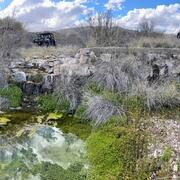
The Las Moras Wash, within the Santa Margarita Ranch, Altar Valley, AZ, exhibits channel incision, gully expansion, head‑cut migration, vegetation loss, and reduced hydrologic connectivity between upper watershed and floodplains.
Las Moras Wash Restoration: Integrated Geomorphic Assessment, Modeling, Monitoring, and Adaptive Management

Las Moras Wash Restoration: Integrated Geomorphic Assessment, Modeling, Monitoring, and Adaptive Management

The Las Moras Wash, within the Santa Margarita Ranch, Altar Valley, AZ, exhibits channel incision, gully expansion, head‑cut migration, vegetation loss, and reduced hydrologic connectivity between upper watershed and floodplains.
Learn More

Fire Science

Wildfires shape landscapes and affect everything from water supplies to wildlife habitats. The USGS studies fire patterns and their effects using remote sensing data to map and characterize wildland fuels, monitor fire risks, model fire behavior, forecast fire danger, and assess post-fire recovery. This work tracks spatial and temporal patterns of ecosystem disturbance including wildland-urban...
Fire Science

Fire Science

Wildfires shape landscapes and affect everything from water supplies to wildlife habitats. The USGS studies fire patterns and their effects using remote sensing data to map and characterize wildland fuels, monitor fire risks, model fire behavior, forecast fire danger, and assess post-fire recovery. This work tracks spatial and temporal patterns of ecosystem disturbance including wildland-urban...
Learn More

Water and Drought

Water sustains communities, agriculture, and ecosystems — and when drought strikes, the effects ripple across all of them. The USGS monitors water availability, surface water extent, and quality at regional, national, and global scales using remote sensing, watershed modeling, and evapotranspiration data. We track vegetation stress, water use, and drought impacts on wildfire risk, invasive species...
Water and Drought

Water and Drought

Water sustains communities, agriculture, and ecosystems — and when drought strikes, the effects ripple across all of them. The USGS monitors water availability, surface water extent, and quality at regional, national, and global scales using remote sensing, watershed modeling, and evapotranspiration data. We track vegetation stress, water use, and drought impacts on wildfire risk, invasive species...
Learn More
Was this page helpful?