



Welcome to the Washington Water Science Center
Washington Water Science Center
The USGS Washington Water Science Center provides water resource information. You’ll find information about Washington’s rivers and streams, as well as groundwater, water quality, and cutting-edge water research. We welcome you to explore our data and scientific research.
Current Washington Water Conditions
Current Washington Water Conditions

Explore real-time Washington streamflow, groundwater, and water-quality conditions and access data with our new interactive map application.
View current water conditions
View current water conditions
Uncrewed Aviation Systems Program
Uncrewed Aviation Systems Program

Data collection provided by uncrewed aviation systems (UAS) enhances the Washington Water Science Center’s (WAWSC) ability to monitor dynamic environmental systems, respond to natural hazards, analyze the impacts of climate change, and assess landscape change.
News
Sediment contaminants in Puget Sound: Implications for ecosystem health and remediation
Sediment contaminants in Puget Sound: Implications for ecosystem health and remediation
Washington Waters Newsletter - Spring 2025
Washington Waters Newsletter - Spring 2025
New data products now available in StreamStats
New data products now available in StreamStats
Publications
Historical ice jams and associated environmental conditions on Osoyoos Lake Historical ice jams and associated environmental conditions on Osoyoos Lake
Ice jams occur regularly at the southern outlet of Osoyoos Lake, which spans the border between the State of Washington and British Columbia, Canada. In recent winters, ice jams caused (1) decreases in downstream discharge that may adversely affect salmon spawning habitat and (2) short-duration lake-level rise that can interfere with lake level management agreements. In response, water...
Estimation of impounded sediment volume in the Similkameen River upstream of Enloe Dam, Okanogan County, Washington Estimation of impounded sediment volume in the Similkameen River upstream of Enloe Dam, Okanogan County, Washington
The Enloe Dam was built in 1920 for hydropower generation and impounds a steep-banked, narrow reach of the Similkameen River in north-central Washington. During the subsequent century, sediment from the Similkameen River watershed, which includes historical mining operations, accumulated within Enloe Dam’s impoundment. Enloe Dam ceased hydropower production in 1958 and is currently under
Lost in translation: Reconciling different streamflow permanence data products Lost in translation: Reconciling different streamflow permanence data products
The objective of this study is to provide a framework to reconcile streamflow permanence products that provide information on whether a stream is perennial or nonperennial. Accurate classification of streams as perennial or nonperennial is important for a variety of land and water resource management decisions. However, resource managers are challenged with how to reconcile different...
Science
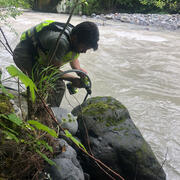
Assessment of bedload monitoring methods
The Issue: The Washington State Department of Transportation (WSDOT) maintains many roads and bridges that either abut or cross dynamic gravel-bedded rivers. The design and maintenance of these structures often requires assessing sediment transport and river channel dynamics. However, the transport of sand and gravel as bedload, and the channel change that results from that transport, remains...
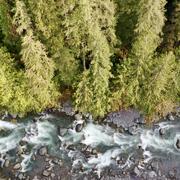
Watersheds and Fluvial Systems Team
The Watersheds and Fluvial Systems Team at the Washington Water Science Center provides reliable science to understand how watersheds, rivers, and streams function—and how they respond to a changing world. We aim to build partnerships that foster informed decision-making and effective resource management throughout the Pacific Northwest region and across the U.S.
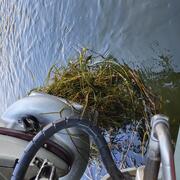
Water Stargrass in the Lower Yakima River
The lower Yakima River faces water resource management challenges resulting from abundant water plant growth, negatively impacting water quality. New U.S. Geological Survey (USGS) research provides a deeper understanding of river conditions, informing resource management to protect this river and the communities it supports.