U.S. flag

An official website of the United States government

Images

Search here for some of our available images.

Filter Total Items: 302
USGS PIT detection antenna, Flag Springs Complex, eastern Nevada
USGS passive integrated transponder (PIT) detection antenna

Passive integrated transponder detection antenna located in the Flag Springs Complex in eastern Nevada. This is the only place on earth where White River spinedace still exist.

White River spinedace

White River spinedace. Photo taken by Summer Burdick, USGS, Klamath Falls Field Station.

White River spinedace. Photo taken by Summer Burdick, USGS, Klamath Falls Field Station.

White River desert sucker

White River desert sucker. Photo taken Wayne E. Kirch Wildlife Management Area, Lund, NV.

White River desert sucker. Photo taken Wayne E. Kirch Wildlife Management Area, Lund, NV.

White River spinedace

White River spinedace. Photo taken Wayne E. Kirch Wildlife Management Area, Lund, NV.

White River spinedace. Photo taken Wayne E. Kirch Wildlife Management Area, Lund, NV.

Researcher holding a crayfish collected in Diablo Lake

A native crayfish collected in Diablo Lake for an investigation into food availability for native fish and limitations to their growth. Crayfish are invertebrate prey for salmonids and provide useful representative stable isotope values for benthic members of the food web.

A native crayfish collected in Diablo Lake for an investigation into food availability for native fish and limitations to their growth. Crayfish are invertebrate prey for salmonids and provide useful representative stable isotope values for benthic members of the food web.

Photograph of the Sanpoil River
Photograph of the Sanpoil River in northeast Washington State

Photograph of the Sanpoil River in northeast Washington State.  The Sanpoil River is upstream of Grand Coulee and is a tributary of the Columbia River.

Juvenile native char in a viewing box
Photo of a juvenile native char in a viewing box at Ross Lake, WA

Researchers placed a juvenile native char into a viewing box to help identify the species. This fish was collected as a part of a food web study on Ross and Diablo Lakes in Washington State in order to evaluate fish growth and limitations to production.

Researchers placed a juvenile native char into a viewing box to help identify the species. This fish was collected as a part of a food web study on Ross and Diablo Lakes in Washington State in order to evaluate fish growth and limitations to production.

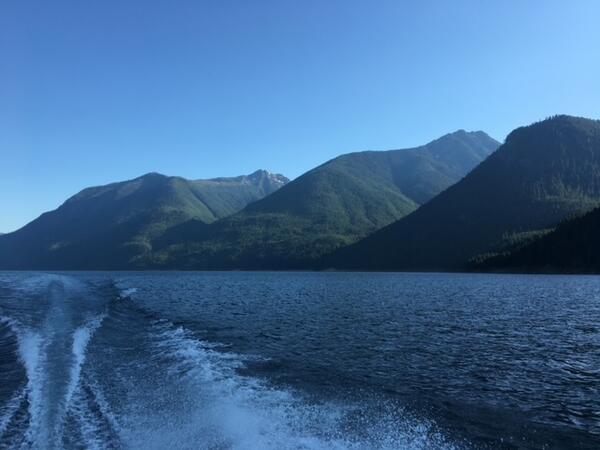
Scenic view of Ross Lake, Washington with boat wake

Evening shot of Ross Lake with boat wake.  Heading back to camp after a day of research. Ross Lake is a large reservoir in the North Cascade mountains of northern Washington state. This photo was taken while conducting food web research to support the Skagit River Hydroelectric Dam FERC relicensing process.

Evening shot of Ross Lake with boat wake.  Heading back to camp after a day of research. Ross Lake is a large reservoir in the North Cascade mountains of northern Washington state. This photo was taken while conducting food web research to support the Skagit River Hydroelectric Dam FERC relicensing process.

Former Lake Mills five years after dam removal
Elwha River flows through newly vegetated areas of former Lake Mills reservoir 5 years after dam removal.

The Elwha River flows through the footprint of the former reservoir Lake Mills. The wide-angle image also shows revegetated uplands dominated by alder trees meeting coniferous forest along the former shoreline of the reservoir.

study map of Shasta Dam
Study Map of Tagged Juvenile Late-Fall Run Chinook Salmon Released Upstream of Shasta Reservoir, California

Stakeholder interests have spurred the reintroduction of the critically endangered populations of Chinook Salmon to tributaries upstream of Shasta Dam, in northern California. We released two groups of acoustically tagged, juvenile hatchery, late-fall Chinook Salmon to determine how juvenile salmon would distribute and survive.

Stakeholder interests have spurred the reintroduction of the critically endangered populations of Chinook Salmon to tributaries upstream of Shasta Dam, in northern California. We released two groups of acoustically tagged, juvenile hatchery, late-fall Chinook Salmon to determine how juvenile salmon would distribute and survive.

Diablo Lake – sampling site
Researchers on their way to sampling site Diablo Lake

Researchers on their way to sampling site on Diablo Lake. Diablo Lake is a reservoir in the North Cascade mountains of northern Washington. Created by Diablo Dam, the lake is located between Ross Lake and Gorge Lake on the Skagit River.

Researchers on their way to sampling site on Diablo Lake. Diablo Lake is a reservoir in the North Cascade mountains of northern Washington. Created by Diablo Dam, the lake is located between Ross Lake and Gorge Lake on the Skagit River.

Photo of the Willamette River, Oregon
Photograph of the Willamette River, Oregon

USGS researchers from the Western Fisheries Research Center, Columbia River Research Laboratory and the Oregon Water Science Center recently completed a study that reviewed existing fisheries datasets and provided an overview of research approaches for estimating habitat availability and carrying capacity of Pacific salmon in the Willamette River Basin.

USGS researchers from the Western Fisheries Research Center, Columbia River Research Laboratory and the Oregon Water Science Center recently completed a study that reviewed existing fisheries datasets and provided an overview of research approaches for estimating habitat availability and carrying capacity of Pacific salmon in the Willamette River Basin.

Fish biologist catches adult Klamath sucker
Fish biologist catches adult suckers as part of a long-term monitoring

Fish biologist Carolyn Malecha with the Klamath Falls Field Station catches adult suckers as part of a long-term monitoring program that estimates survival and recruitment of suckers.

Juga sp. snails
Juga sp. snails
Juga sp. snails
Juga sp. snails

Juga sp. snails, the molluscan intermediate host for Nanophyetus salmincola, populate the bottom of a stream bed in a south Puget Sound watershed.

Juga sp. snails, the molluscan intermediate host for Nanophyetus salmincola, populate the bottom of a stream bed in a south Puget Sound watershed.

Flushing stomach contents from a live resident Chinook salmon

Flushing stomach contents from a live resident Chinook salmon for an investigation of cannibalism and predation impacts.

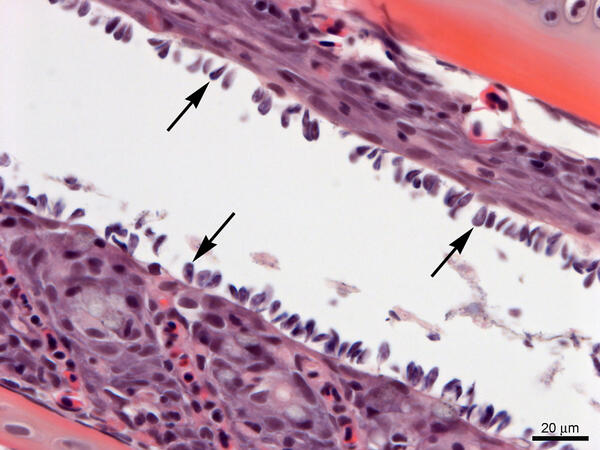
Gills from Lost Rver suckers with a heavy infestation of Ichthyobodo sp. (arrows)
Gills from Lost River Suckers - heavy infestation of Ichthyobodo sp.

Gills from Lost River suckers with a heavy infestation of Ichthyobodo sp. (arrows).  Slide is stained with hematoxylin and eosin.

Herring (top) and juvenile Chinook salmon (bottom)

Herring (top) and juvenile Chinook salmon (bottom) flushed from the stomach of a resident Chinook salmon in Puget Sound.

Photo of scientist at loading gel
Nested polymerase chain reaction (nPCR) for the detection of Rs

Nested polymerase chain reaction (nPCR) for the detection of Renibacterium salmoninarum. Agarose gel electrophoresis is used for size separation and visualization of amplified DNA sequences.

Nested polymerase chain reaction (nPCR) for the detection of Renibacterium salmoninarum. Agarose gel electrophoresis is used for size separation and visualization of amplified DNA sequences.

Spawning Lost River suckers

Lost River suckers congregating to spawn on Sucker Springs in Upper Klamath Lake, Oregon.

WFRC nPCR test for detection of Rs
WFRC nPCR test for detection of Renibacterium salmoninarum

Nested polymerase chain reaction (nPCR) for the detection of Renibacterium salmoninarum. Agarose gel electrophoresis is used for size separation and visualization of amplified DNA sequences.

Nested polymerase chain reaction (nPCR) for the detection of Renibacterium salmoninarum. Agarose gel electrophoresis is used for size separation and visualization of amplified DNA sequences.

WFRC nPCR test for detection of Rs
WFRC nPCR test for detection of Renibacterium salmoninarum

Nested polymerase chain reaction (nPCR) for the detection of Renibacterium salmoninarum. Following two rounds of PCR amplification, samples are pipetted into an agarose gel for electrophoresis.

Nested polymerase chain reaction (nPCR) for the detection of Renibacterium salmoninarum. Following two rounds of PCR amplification, samples are pipetted into an agarose gel for electrophoresis.

Was this page helpful?