



No matter the season, we are out monitoring Colorado waters.
In winter...
In winter...
No matter the season, we are out monitoring Colorado waters.
In spring...
In spring...
No matter the season, we are out monitoring Colorado waters.
In summer...
In summer...
No matter the season, we are out monitoring Colorado waters.
and in the fall.
and in the fall.
Colorado Water Science Center
Welcome to the USGS Colorado Water Science Center! Please use these pages to explore the hydrologic data and scientific investigations we conduct on Colorado water resources.
NOTICE: USGS is improving the way that sample data are stored and served to the public.
Current Conditions
Current Conditions
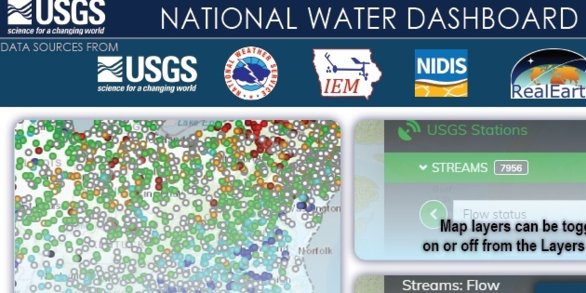
Explore real-time Colorado streamflow, groundwater, and water-quality conditions.
Science Highlight
Science Highlight

Next Generation Water Observing System: Upper Colorado River Basin
The Next Generation Water Observing System provides high-fidelity, real-time data on water quantity, quality, and use to support modern water prediction and decision-support systems that are necessary for informing water operations on a daily basis and decision-making during water emergencies.
News
2025 USGS 'STREAM' Workshop: Science, Technology, Research, and Evaluations for Actionable Management
2025 USGS 'STREAM' Workshop: Science, Technology, Research, and Evaluations for Actionable Management
Media Alert: USGS Dye Tracing Study in Fraser River
Media Alert: USGS Dye Tracing Study in Fraser River
Media Alert: USGS Dye-Tracing Study in Lake Fork Creek to Map Groundwater Flow
Media Alert: USGS Dye-Tracing Study in Lake Fork Creek to Map Groundwater Flow
Publications
A comparison of non-contact methods for measuring turbidity in the Colorado River A comparison of non-contact methods for measuring turbidity in the Colorado River
Monitoring suspended-sediment concentration (SSC) is essential to better understand how sediment transport could adversely affect water availability for human communities and ecosystems. Aquatic remote sensing methods are increasingly utilized to estimate SSC and turbidity in rivers; however, an evaluation of their quantitative performance is limited. This study evaluates the performance...
Groundwater-level elevations in the bedrock aquifers of the Denver Basin aquifer system, Elbert County, Colorado, 2015–23 Groundwater-level elevations in the bedrock aquifers of the Denver Basin aquifer system, Elbert County, Colorado, 2015–23
Water users in Elbert County, Colorado, rely on groundwater from bedrock aquifers in the Denver Basin aquifer system (upper Dawson, lower Dawson, Denver, Arapahoe, and Laramie-Fox Hills aquifers) for approximately half of their water uses. Withdrawals from the bedrocks aquifers have increased to meet the water use needs of expanding regional population growth and development. The U.S...
Prioritizing resource protection and understanding potential susceptibility of springs to surficial changes in a low-temperature geothermal system Prioritizing resource protection and understanding potential susceptibility of springs to surficial changes in a low-temperature geothermal system
Geothermal systems are vulnerable to changes in water budget and composition, requiring science-based management. This study uses a dataset of spring water temperatures, time series of groundwater residence time tracers (tritium and carbon-14), and stable isotopes of water to understand geothermal flow in a low-temperature geothermal system in north west Colorado, United States...
Science
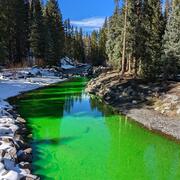
Quantifying groundwater recharge and discharge dynamics in the Upper Colorado River Basin
The Upper Colorado River Basin (UCOL) serves as an important source of water to millions of people, supports irrigation for agriculture, and provides aquatic habitat for a variety of species. Salinity concentrations endanger water supply in the Colorado River Basin, potentially causing hundreds of millions of dollars in annual economic damage because of corrosion of infrastructure, water treatment...
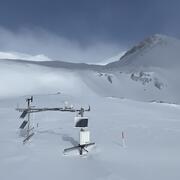
Next Generation Water Observing System (NGWOS) Snow Hydrology Monitoring Network in the Upper Colorado River Basin
Representative observations of snowpack conditions are vital for informing water availability assessments and modeling in snow dominated regions of the western United States. The U.S. Geological Survey (USGS) established a snow hydrology monitoring network in 2021 with the objective of providing high-quality, representative, and publicly available data on snowpack, soil moisture, and...

Agricultural Return Flows in the Upper Gunnison River Basin
Canals and ditches divert water from streams in the Upper Gunnison River Basin, Colorado, to irrigate agricultural fields. In some areas, irrigation water that percolates below the root zone can locally recharge groundwater and later return to streams through the subsurface, which can extend streamflow outside of the snowmelt runoff season. Understanding the timing and quantity of agricultural...