



Paleoscience for Partners: Reconstructing the Past to Prepare for the Future
The Earth in Flux Chart Gallery
A shared initiative between the USGS Water Mission Area and Ecosystems Mission Area to communicate key findings of USGS land change science in innovative ways, and to encourage creativity, exploration, and community in data visualization.
A shared initiative between the USGS Water Mission Area and Ecosystems Mission Area to communicate key findings of USGS land change science in innovative ways, and to encourage creativity, exploration, and community in data visualization.
Coring Expedition to Palmyra Atoll
Helping managers understand pre-human vegetation, climate variability, and sea level changes
Helping managers understand pre-human vegetation, climate variability, and sea level changes
National News Release: Study confirms age of oldest fossil human footprints in North America
Two new lines of evidence support the 21,000 to 23,000-year age estimate of the footprints first described and dated in 2021
Two new lines of evidence support the 21,000 to 23,000-year age estimate of the footprints first described and dated in 2021
The Glacier - Climate Connection
The story of the U.S. Geological Survey Benchmark Glacier Project, one of the longest running studies of glaciers on Earth
The story of the U.S. Geological Survey Benchmark Glacier Project, one of the longest running studies of glaciers on Earth
The National Climate Change Viewer (NCCV)
A tool that helps land managers and decision makers plan for climate change
A tool that helps land managers and decision makers plan for climate change
Ecosystems Land Change Science Program
The Land Change Science Program in the USGS Ecosystems Mission Area strives to advance the understanding of the physical, chemical, and biological components of the Earth system, the causes and consequences of ecosystem and land use change, and the vulnerability and resilience of the Earth system to such changes.


News
A 500-Year Fire History Reveals That Recent High-Severity Wildfires Could Lead to Widespread Forest Loss
A 500-Year Fire History Reveals That Recent High-Severity Wildfires Could Lead to Widespread Forest Loss
Earth Science Matters - Vol. 22, Summer 2026
Earth Science Matters - Vol. 22, Summer 2026
Supercomputer-Powered Research Shows How Yellowstone’s Geyser Basins Evolved
Supercomputer-Powered Research Shows How Yellowstone’s Geyser Basins Evolved
Publications
Simulating past and future refugia for temperate trees in northern Italy Simulating past and future refugia for temperate trees in northern Italy
During the Quaternary, trees responded to the climatic changes of glacial–interglacial cycles with large-scale range shifts. Over cold glacials, temperate tree species contracted their ranges and survived in areas known as refugia. Several studies point to the Euganean Hills (Colli Euganei), in Veneto, northern Italy, as one of the northernmost European refugia of temperate tree species...
Initial condition uncertainty exerts a large and persistent influence on model simulations of ecosystem carbon dynamics in California Initial condition uncertainty exerts a large and persistent influence on model simulations of ecosystem carbon dynamics in California
Uncertainties in terrestrial ecosystem models limit their predictive power. Efforts to reduce projection error have rarely focused on constraining uncertainty in the initial state of the ecosystem, however, despite evidence that matching model initial conditions to real-world observations reduces overall model bias. Here we use an integrated land change and carbon gain-loss model to...
The Python Energy Balance model for Snow and Ice (PEBSI): Application and tradeoff analysis on Gulkana Glacier, Alaska The Python Energy Balance model for Snow and Ice (PEBSI): Application and tradeoff analysis on Gulkana Glacier, Alaska
Glacier energy-balance models offer mechanistic insights into glacier mass balance under a changing climate, yet their considerable data requirements hinder large-scale applications. Here we present the open-source Python Energy Balance model for Snow and Ice (PEBSI), which includes physically based albedo evolution using the Snow, Ice and Aerosol Radiative (SNICAR) model. PEBSI is...
Science

Gulkana Glacier
Gulkana Glacier is located in the high-latitude continental climate regime of Alaska’s Delta Mountains. Glacier observations began at this site in 1966 and continue through present as the northern most USGS Benchmark Glacier.
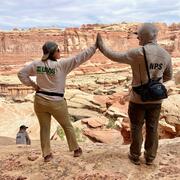
Holding the Ground: Long-Term Science and Partnerships Help Protect Soil Health and Local Economies Across the Colorado Plateau
By combining long-term science with enduring partnerships, USGS is helping decision makers protect soil resources, reduce erosion risks, and steward America's public lands for future generations.
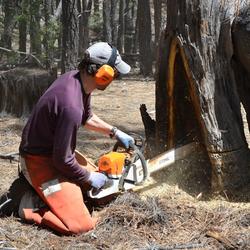
USGS Ecosystems’ Land Change Science Program: Science That Advances National Priorities
The USGS Ecosystems' Land Change Science Program provides trusted, place‑based science to strengthen wildfire resilience, support local preparedness, and protect natural and recreational resources.