
U.S. flag

An official website of the United States government

Landsat Mission Control

The Landsat Multi-Satellite Operations Center ensures Landsat satellites operate smoothly and deliver reliable, high-quality Earth observation data by commanding the satellites, monitoring their health and telemetry, and managing daily acquisition activities.

Return to the Landsat Satellite and Ground-Systems Operations Overview webpage


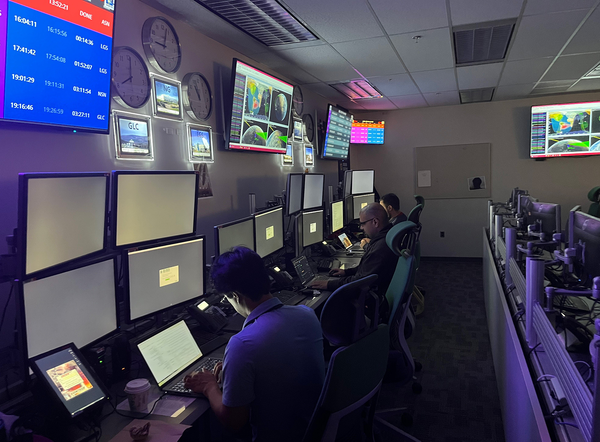
The Landsat Multi-Satellite Operations Center (LMOC) serves as the primary hub for Landsat mission control and is located at the NASA Goddard Space Flight Center campus in Greenbelt, Maryland. A backup operations center is located at the USGS Earth Resources Observation and Science (EROS) Center in Sioux Falls, SD, to ensure continuity of satellite operations if the primary facility is ever unavailable.

Media
a picture of the Landsat Missions Operation Center
The Landsat Multi-Satellite Operation Center, August 2026.

The USGS Landsat Flight Operations Team (FOT) is responsible for a range of activities as they monitor the active Landsat satellites orbiting Earth. Their responsibilities include:
 

Satellite Command and Control

  • Coordinate the generation and transmission of daily commands to operate the spacecraft
  • Direct the satellite’s orbit and orientation using propulsion and attitude control systems
  • Ensure scheduled sensor targeting for data acquisitions
  • Conduct routine spacecraft and orbit maintenance activities

Strategic and Smart Mission Planning

The FOT is responsible for generating command loads (sets of instructions) that tell the spacecraft what to do. New command loads are generated and uploaded to the satellite approximately twice per week. Typical activities in each command load may include:

Mission Planning and Data Coordination

Health and Safety Monitoring

The FOT is on call 24/7 to ensure the health and safety of the Landsat satellites. 

  • Monitor critical systems: power, thermal, and communications
  • Diagnose and resolve anomalies or system failures
  • Monitor conjunction assessments and evaluate potential collision risks involving orbital debris or other satellites
    • If a Landsat satellite is at risk of colliding with another satellite or space debris, the FOT generates a new command load directing the spacecraft to perform a collision-avoidance maneuver. This maneuver adjusts the orbit to reduce the risk of a collision. Although potential hazards are typically identified well in advance, the FOT must occasionally respond on short notice. 

Software and Firmware Updates

  • Develop, test, and upload updates to the onboard satellite systems as needed

End-of-Life and Contingency Planning

  • Plan and execute safe satellite decommissioning
  • Develop contingency procedures for system failures or unexpected events


Was this page helpful?