



Central Midwest Water Science Center
Central Midwest Water Science Center
Central Midwest Water Science Center
Central Midwest Water Science Center
Welcome to the Central Midwest Water Science Center’s (CMWSC) Website. We offer information on streamflow, water quality, water-use, and groundwater data for Illinois, Iowa, and Missouri. We conduct unbiased, scientific hydrologic investigations & research projects to effectively manage CMWSC and our Nation's water resources through joint efforts with our partners.


News
Harvesting Knowledge: A Recap of the USGS-NPS-Tribal Collaboration at Effigy Mounds National Monument
Harvesting Knowledge: A Recap of the USGS-NPS-Tribal Collaboration at Effigy Mounds National Monument
Friday's Findings: Environmental Contaminants and Agricultural Production
Friday's Findings: Environmental Contaminants and Agricultural Production
StreamStats regression equation updates for Illinois
StreamStats regression equation updates for Illinois
Publications
Spatially consistent but temporally divergent changes in nitrate and phosphorus loads and yields in Illinois watersheds, 1997–2022 Spatially consistent but temporally divergent changes in nitrate and phosphorus loads and yields in Illinois watersheds, 1997–2022
Illinois contributes substantial nutrient loads to the Gulf of America, warranting watershed-scale assessment. This study estimated nitrate-nitrogen (nitrate-N) and total phosphorus (TP) loads and yields for 49 Illinois 8-digit hydrologic unit code (HUC8) watersheds draining to the Mississippi River Basin from 1997–2022, comparing recent (2018–2022) to baseline (1997–2011) conditions...
A novel drive-point multilevel system to investigate PFAS and other contaminants of global concern in the hyporheic zone of a wastewater effluent dominated stream A novel drive-point multilevel system to investigate PFAS and other contaminants of global concern in the hyporheic zone of a wastewater effluent dominated stream
Contaminants found in treated wastewater discharged to streams, including pharmaceuticals and per- and polyfluoroalkyl substances (PFAS), are of global concern due to their deleterious effects on aquatic ecosystems and potential impacts to human health. Hyporheic zones have strong potential for contaminant attenuation. Assessing this potential requires collection of physical and...
Selected water-quality data from the Cedar River and Cedar Rapids well fields, Cedar Rapids, Iowa, 2017–22 Selected water-quality data from the Cedar River and Cedar Rapids well fields, Cedar Rapids, Iowa, 2017–22
The Cedar River alluvial aquifer is the source of drinking water in Cedar Rapids, Iowa. Production wells are completed in the alluvial aquifer approximately 40 to 80 feet below land surface. The City of Cedar Rapids and the U.S. Geological Survey have studied the groundwater-flow system and water quality of the aquifer in the vicinity of Cedar Rapids since 1992. Results of these studies...
Science

Assessment of Groundwater and Quality - Cedar River Project
Assessment of Groundwater and Quality: Cedar River Alluvium, Cedar Rapids, Iowa Period of Project: Since 1992 Project Managers: Shannon Meppelink & Emilia Bristow Study Area: Linn County Cooperating Agency: City of Cedar Rapids (Water Division)

From Stream to Spider: How PFAS Move Through Aquatic and Terrestrial Food Webs
Per- and polyfluoroalkyl substances (PFAS) are persistent synthetic chemicals that accumulate in the environment and living organisms. A USGS study examined how different PFAS compounds move through a stream ecosystem and are transferred from aquatic to terrestrial food webs. The findings documented that not all PFAS behave the same once they enter the environment, leading to differences in...
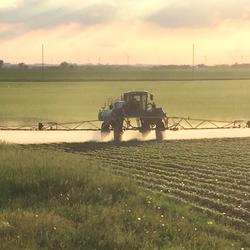
Bioenergy and Pesticides: Lessons from the AltEn Bioenergy Plant
Ethanol production from seed corn, while reducing waste and promoting renewable energy, can have environmental and health implications. A USGS study on a former bioenergy plant that received pesticide-coated seeds used for ethanol production, revealed that the process led to contaminated wastewater and solid residue, resulting in elevated pesticide levels in nearby surface waters even after the...