



OnDemand Topo Maps Officially Join USGS National Map Offerings
The people have spoken! OnDemand Topo maps and topoBuilder were so popular that we're making topoBuilder a permanent offering of the National Map.
USGS National Water Dashboard
Presenting real-time stream, lake and reservoir, precipitation and groundwater data for 13,500+ USGS real-time observation stations across the US
USGS-led study estimates lithium in groundwater that can be used for drinking water
The new estimates can help health researchers determine potential connections between lithium exposure and human health outcomes
Per- and polyfluoroalkyl substances (PFAS) in United States tapwater: Comparison of underserved private-well and public-supply exposures and associated health implications
Tapwater from 716 locations (269 private-wells; 447 public supply) across the US was collected during 2016–2021 including three locations where temporal sampling was conducted. Seventeen PFAS were observed at least once.
The 3D Elevation Program—Supporting Ohio’s Economy
High-quality elevation data are proving to be a resource of great economic value in dealing with many important issues in Ohio.
USGS Fluvial Hazards Primer
The primer highlights methods used in regional and reach-scale assessments of fluvial erosion hazards (FEH).
Why Do We Need a Nowcast?
Real-Time Assessments of Water Quality—A Nowcast for Escherichia coli and Cyanobacterial Toxins
Ohio-Kentucky-Indiana Water Science Center
Welcome to the Ohio-Kentucky-Indiana Water Science Center (OKI WSC) webpage! We work closely with our local, state, federal, and tribal partners to provide unbiased and timely water resource information on streamflow, water quality, water-use, and groundwater data to resource managers and the public. Our Center includes the key water resources of the Ohio River, Lake Erie, and Lake Michigan.
Annual total phosphorus loads to the Great Lakes

Monthly and annual total phosphorus loads were estimated for water years 2014 through 2018 for 23 streamgaged (gaged) sites on tributaries to the Great Lakes.
USGS Kentucky Drought Condition Monitor

The USGS Ohio-Kentucky-Indiana Water Science Center and Kentucky Agricultural Development Board rely upon several parameters to monitor water-supply-drought conditions.
Current Data
This data was formerly known to most as the "Realtime Data" in table format. Although the format has not changed, we now refer to it as "Current Conditions".
News
Three historic USGS streamgages recognized by new World Meteorological Organization designation
Spring 2023 Newsletter
Winter 2022 Newsletter
Publications
Water-withdrawal and groundwater-level fluctuations, physical and infiltration characteristics of Ohio River sediment, and isotope-based estimates of water sources relative to a riverbank filtration system in an alluvial aquifer, Louisville, Kentucky, 200 Water-withdrawal and groundwater-level fluctuations, physical and infiltration characteristics of Ohio River sediment, and isotope-based estimates of water sources relative to a riverbank filtration system in an alluvial aquifer, Louisville, Kentucky, 200
Variability of discharge, nutrients, and Escherichia coli from tile drains in a small agricultural stream, a synoptic study in the School Branch watershed, Hendricks County, Indiana Variability of discharge, nutrients, and Escherichia coli from tile drains in a small agricultural stream, a synoptic study in the School Branch watershed, Hendricks County, Indiana
Computing flow-field distortion coefficients from well-construction and formation properties Computing flow-field distortion coefficients from well-construction and formation properties
Science
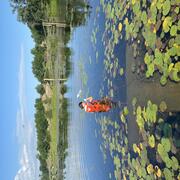
Evaluation of a Eutrophication Beneficial Use Impairment in the Grand Calumet River Area of Concern in Northwest Indiana

Hydrogeologic Mapping and Three-Dimensional Geologic Modeling of Glacial Deposits in a Multicounty Area of Southeastern Michigan, Northeastern Indiana, and Northwestern Ohio
