



USGS Science Collaboration Portal for the Colorado River Basin
Collaboration platform that brings together science, data, and mapping and analytical tools from across the basin
Collaboration platform that brings together science, data, and mapping and analytical tools from across the basin
Colorado River Basin Actionable and Strategic Integrated Science and Technology (ASIST) Initiative
Fostering Innovative Interdisciplinary Science for Characterizing and Adapting to Long-term Drought
Fostering Innovative Interdisciplinary Science for Characterizing and Adapting to Long-term Drought
Colorado River Basin Drought and the 2023 Water Year
Geonarrative presentation comparing 2023 conditions to the long-term drought in the Colorado River Basin
Geonarrative presentation comparing 2023 conditions to the long-term drought in the Colorado River Basin
Great Salt Lake Data and Reports by the USGS
Learn about Water Quantity and Quality and Aquatic Ecology of this National Treasure
Learn about Water Quantity and Quality and Aquatic Ecology of this National Treasure
Colorado River Basin Studies in Utah
Learn about Surface Water, Groundwater Quantities and Quality and Artificial Recharge of Groundwater in the Colorado River Basin in Utah
Learn about Surface Water, Groundwater Quantities and Quality and Artificial Recharge of Groundwater in the Colorado River Basin in Utah
Streamflow in the Upper Rio Grande Basin
USGS Analyses of the Effects of Potential Future Climate Conditions on Streamflows in the Upper Rio Grande Basin
USGS Analyses of the Effects of Potential Future Climate Conditions on Streamflows in the Upper Rio Grande Basin
Next Generation Water Observing System (NGWOS) Study: Upper Colorado River Basin
The USGS NGWOS Program Provides Innovative, High-fidelity, Real-time Data and Insightful Analyses about Water Quantity, Quality, and Use in Selected Watersheds across the U.S.
The USGS NGWOS Program Provides Innovative, High-fidelity, Real-time Data and Insightful Analyses about Water Quantity, Quality, and Use in Selected Watersheds across the U.S.
Rocky Mountain Region
USGS Region 7 Staff support and advise USGS Science Centers that provide numerous stakeholders with vital information about spatial distribution and temporal trends in critical minerals, energy resources, geology, water resources, native plants and wildlife, and hazards posed by earthquakes and landslides in Colorado, New Mexico, Utah, Wyoming and beyond.
USGS Region 7: Upper Colorado Basin (Rocky Mountain)
USGS Region 7: Upper Colorado Basin (Rocky Mountain)

Map Showing USGS/DOI Unified Region 7 and adjoining Regions
Key USGS Region 7 Contact
Key USGS Region 7 Contact
Additional Information about USGS Region 7
Additional Information about USGS Region 7
News
FORT Updates: From Plains to Peaks - Vol. 4 | Issue 2
FORT Updates: From Plains to Peaks - Vol. 4 | Issue 2
New Nationwide Tool Helps Answer: Do We Have Enough Water?
New Nationwide Tool Helps Answer: Do We Have Enough Water?
FORT Updates: From Plains to Peaks - Vol. 4 | Issue 1
FORT Updates: From Plains to Peaks - Vol. 4 | Issue 1
Publications
Assessment of undiscovered conventional oil and gas resources in the Niger Delta Province of Nigeria and Cameroon, 2026 Assessment of undiscovered conventional oil and gas resources in the Niger Delta Province of Nigeria and Cameroon, 2026
Using a geology-based assessment methodology, the U.S. Geological Survey estimated undiscovered, technically recoverable mean conventional resources of 11.4 billion barrels of oil and 88.2 trillion cubic feet of gas in the Niger Delta Province of Nigeria and Cameroon.
Monitoring recreation on federally managed lands and waters—Aspects of visitor use Monitoring recreation on federally managed lands and waters—Aspects of visitor use
Federally managed public lands and waters receive around 1 billion recreational visits each year. Data on these visitors can aid in guiding policy decisions, managing resources effectively, and communicating the economic contributions of lands and waters. This report explores the methods used by agencies to collect data on aspects of recreational visitor use to Federal lands and waters...
USGS Geochron—A database of geochronological and thermochronological dates and data—Technical documentation USGS Geochron—A database of geochronological and thermochronological dates and data—Technical documentation
Geochronological and thermochronological data are essential for constraining the timing and rates of geological processes, supporting geologic mapping, natural hazard assessment, and resource exploration. The U.S. Geological Survey (USGS) Geochron Database is a centralized, relational database that integrates USGS and State geological survey data in accordance with the National Geologic...
Science

Land Treatment Exploration Tool
The Land Treatment Exploration Tool provides a practical resource for managers who are planning restoration and rehabilitation actions on public lands. The tool generates a variety of spatial products while being user friendly for all levels of GIS expertise, even to those with little or no experience.

Gulkana Glacier
Gulkana Glacier is located in the high-latitude continental climate regime of Alaska’s Delta Mountains. Glacier observations began at this site in 1966 and continue through present as the northern most USGS Benchmark Glacier.
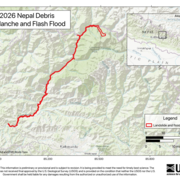
2026 Nepal Debris Avalanche and Flash Flood
On Wednesday morning (local time), 26 August 2026, a catastrophic debris flow and flood was likely triggered by rapid slope failure involving a glacier in Lāṅṭāṇ National Park, Nepal, near the border with China. This debris flow and flooding travelled nearly 100 km and impacted populated areas downstream along the Lende Kholā and Trishuli̇̄ Kholā rivers, including the Rasuwāgaḍhi̇̄ border post...