
U.S. flag

An official website of the United States government

Western Geographic Science Center

The WGSC is responsible for research and applications to understand coupled human-environmental systems in the face of land change and delivering pertinent information to decision makers on the vulnerability and resilience of these systems.  WGSC scientists collaborate with partners to advance the goals of the USGS Core Science Systems and Ecosystems Mission Areas and their programs. 

News

Earth Science Matters - Vol. 21 | Issue 1

Earth Science Matters - Vol. 21 | Issue 1

WGSC cloud-based tidal marsh biomass mapping tool

WGSC cloud-based tidal marsh biomass mapping tool

WGSC a part of the 2025 NOPP Excellence in Partnering Award

WGSC a part of the 2025 NOPP Excellence in Partnering Award

Publications

Earthquake-hazard exposure of residents with potential access and functional needs in the United States Earthquake-hazard exposure of residents with potential access and functional needs in the United States

Earthquake response plans and earthquake early warning (EEW) systems designed for general populations may not consider potential access and functional needs (AFN) of individuals with physical, sensory, cognitive, or social limitations. Previous efforts to map the distribution of these populations have focused on social-vulnerability indices that ignore or oversimply these limitations...
Authors
Nathan J. Wood, Alice Pennaz, Jeanne M. Jones

Preserving and increasing water resources—Natural infrastructure in dryland streams in Baja California Sur, Mexico Preserving and increasing water resources—Natural infrastructure in dryland streams in Baja California Sur, Mexico

The Los Planes watershed of Baja California Sur, Mexico, and its underlying aquifer are experiencing groundwater decline owing to low average annual rainfall (28.1 centimeters per year) and rising water demand from population growth and agricultural activities. This decline in water availability can lead to desertification—a process that changes arable land to desert by degrading soil...
Authors
Alma Lizette Anides Morales, Laura M. Norman, Thomas J. Mack

Land change, fire, and climate weaken carbon sink in the conterminous U.S. Land change, fire, and climate weaken carbon sink in the conterminous U.S.

The land carbon sink of the conterminous United States was evaluated using a bottom-up modeling framework and 30-meter land change data from 1985 to 2020. This cross-scale, cross-landscape, and cross-system approach tracked fractional land cover changes and applied regional model calibration. Results show average terrestrial and aquatic carbon sinks of +110 ± 37 and +19 ± 0.5 teragrams...
Authors
Jinxun Liu, Benjamin M. Sleeter, Zhiliang Zhu, Mark A. Cochrane, Qiang Zhou, Bin Wang, Grant Domke, Paul Selmants, Lisamarie Windham-Myers, Qiuan Zhu, Tamara Wilson, Kristin Byrd, Eric Ward, Terry Sohl, Todd Hawbaker, Zhen Zhang, Christopher Soulard, Kimberly Wickland, Robert G. Striegl

Science

Where Land Meets Sea: USGS Science for Resilient Coastal Habitats

USGS coastal science plays a critical role in supporting the effective, science-based management of coastal ecosystems, where the biodiversity of land and sea meet. It provides managers with the information they need to make sound decisions. Through cutting-edge research, predictive modeling, and decision-support tools, USGS empowers resource managers to make informed, science-based choices. From...
Where Land Meets Sea: USGS Science for Resilient Coastal Habitats

Where Land Meets Sea: USGS Science for Resilient Coastal Habitats

USGS coastal science plays a critical role in supporting the effective, science-based management of coastal ecosystems, where the biodiversity of land and sea meet. It provides managers with the information they need to make sound decisions. Through cutting-edge research, predictive modeling, and decision-support tools, USGS empowers resource managers to make informed, science-based choices. From...
Learn More

New Tools for Modern Land Management Decisions
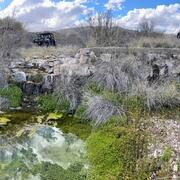
In an era of rapid land use changes, it is imperative that land managers and policymakers have actionable and current information available for decision processes. In this work, we seek to meet these needs through new data products and decision support tools built on digital soil mapping, new vegetation cover maps, agency inventory and monitoring data sets, and cutting-edge analytical frameworks...
New Tools for Modern Land Management Decisions

New Tools for Modern Land Management Decisions

In an era of rapid land use changes, it is imperative that land managers and policymakers have actionable and current information available for decision processes. In this work, we seek to meet these needs through new data products and decision support tools built on digital soil mapping, new vegetation cover maps, agency inventory and monitoring data sets, and cutting-edge analytical frameworks...
Learn More

Reducing Wildfire Risks with Science

Hotter and drier conditions are making wildfires more intense and destructive across the United States. Science from the USGS Ecosystems Land Change Science Program informs local to national reduction of wildfire hazards, which saves money in avoided losses and fire suppression costs, as well as saves human lives.
Reducing Wildfire Risks with Science

Reducing Wildfire Risks with Science

Hotter and drier conditions are making wildfires more intense and destructive across the United States. Science from the USGS Ecosystems Land Change Science Program informs local to national reduction of wildfire hazards, which saves money in avoided losses and fire suppression costs, as well as saves human lives.
Learn More
Was this page helpful?