



Aerial view of backwater habitat for invasive northern pike (Esox lucius) off of Alexander Creek in the Susitna Basin of south-central Alaska.
Images
See our science through the images below.
Filter Total Items: 3605

Invasive Northern Pike Habitat
Aerial view of backwater habitat for invasive northern pike (Esox lucius) off of Alexander Creek in the Susitna Basin of south-central Alaska.

Radiograph of Three Belding's Ground Squirrels
Radiograph of 3 Belding's Ground Squirrels showing the presence of lead pieces (white flecks in the bodies).
Radiograph of 3 Belding's Ground Squirrels showing the presence of lead pieces (white flecks in the bodies).

Northern Pike
Example of a fish species positively impacted by the hydrologic reconnection of a diked wetland to Lake Erie. Northern Pike depend on productive wetland habitats to spawn.
Example of a fish species positively impacted by the hydrologic reconnection of a diked wetland to Lake Erie. Northern Pike depend on productive wetland habitats to spawn.

Whooping Crane Chick
This adolescent chick, hatched and raised at the USGS Patuxent Wildlife Research Center, is one of ten whooping cranes being released in Louisiana in February 2011. It is a milestone for the state and for the birds, which have not lived in the state since the 1950s.
This adolescent chick, hatched and raised at the USGS Patuxent Wildlife Research Center, is one of ten whooping cranes being released in Louisiana in February 2011. It is a milestone for the state and for the birds, which have not lived in the state since the 1950s.

Whooping Crane Chick
This adolescent chick, hatched and raised at the USGS Patuxent Wildlife Research Center, is one of ten whooping cranes being released in Louisiana in February 2011. It is a milestone for the state and for the birds, which have not lived in the state since the 1950s.
This adolescent chick, hatched and raised at the USGS Patuxent Wildlife Research Center, is one of ten whooping cranes being released in Louisiana in February 2011. It is a milestone for the state and for the birds, which have not lived in the state since the 1950s.

Whooping Crane Chick
This adolescent chick, hatched and raised at the USGS Patuxent Wildlife Research Center, is one of ten whooping cranes being released in Louisiana in February 2011. It is a milestone for the state and for the birds, which have not lived in the state since the 1950s.
This adolescent chick, hatched and raised at the USGS Patuxent Wildlife Research Center, is one of ten whooping cranes being released in Louisiana in February 2011. It is a milestone for the state and for the birds, which have not lived in the state since the 1950s.

Whooping Crane Chick
This adolescent chick, hatched and raised at the USGS Patuxent Wildlife Research Center, is one of ten whooping cranes being released in Louisiana in February 2011. It is a milestone for the state and for the birds, which have not lived in the state since the 1950s.
This adolescent chick, hatched and raised at the USGS Patuxent Wildlife Research Center, is one of ten whooping cranes being released in Louisiana in February 2011. It is a milestone for the state and for the birds, which have not lived in the state since the 1950s.

Whooping Crane Chick
This adolescent chick, hatched and raised at the USGS Patuxent Wildlife Research Center, is one of ten whooping cranes being released in Louisiana in February 2011. It is a milestone for the state and for the birds, which have not lived in the state since the 1950s.
This adolescent chick, hatched and raised at the USGS Patuxent Wildlife Research Center, is one of ten whooping cranes being released in Louisiana in February 2011. It is a milestone for the state and for the birds, which have not lived in the state since the 1950s.

Whooping Crane Chick
This adolescent chick, hatched and raised at the USGS Patuxent Wildlife Research Center, is one of ten whooping cranes being released in Louisiana in February 2011. It is a milestone for the state and for the birds, which have not lived in the state since the 1950s.
This adolescent chick, hatched and raised at the USGS Patuxent Wildlife Research Center, is one of ten whooping cranes being released in Louisiana in February 2011. It is a milestone for the state and for the birds, which have not lived in the state since the 1950s.

Whooping Crane Chick
This adolescent chick, hatched and raised at the USGS Patuxent Wildlife Research Center, is one of ten whooping cranes being released in Louisiana in February 2011. It is a milestone for the state and for the birds, which have not lived in the state since the 1950s.
This adolescent chick, hatched and raised at the USGS Patuxent Wildlife Research Center, is one of ten whooping cranes being released in Louisiana in February 2011. It is a milestone for the state and for the birds, which have not lived in the state since the 1950s.

Boa Constrictor
Boa constrictor "in situ" on a tree buttress right after some rain in Puerto Rico.
Boa constrictor "in situ" on a tree buttress right after some rain in Puerto Rico.

Black-bird die-off Investigation
The carcass of a red-winged blackbird from Beebe, AR is being examined by USGS National Wildlife Health Center wildlife pathologist Dr. David E. Green.
The carcass of a red-winged blackbird from Beebe, AR is being examined by USGS National Wildlife Health Center wildlife pathologist Dr. David E. Green.

Black-bird die-off Investigation
The carcass of a red-winged blackbird from Beebe, AR is being examined by USGS National Wildlife Health Center wildlife pathologist Dr. David E. Green.
The carcass of a red-winged blackbird from Beebe, AR is being examined by USGS National Wildlife Health Center wildlife pathologist Dr. David E. Green.

Black-bird die-off Investigation
The carcass of a red-winged blackbird from Beebe, AR is being examined by USGS National Wildlife Health Center wildlife pathologist Dr. David E. Green.
The carcass of a red-winged blackbird from Beebe, AR is being examined by USGS National Wildlife Health Center wildlife pathologist Dr. David E. Green.

Black-bird die-off Investigation
The carcass of a red-winged blackbird from Beebe, AR is being examined by USGS National Wildlife Health Center wildlife pathologist Dr. David E. Green.
The carcass of a red-winged blackbird from Beebe, AR is being examined by USGS National Wildlife Health Center wildlife pathologist Dr. David E. Green.

Black-bird die-off Investigation
The carcass of a red-winged blackbird from Beebe, AR is being examined by USGS National Wildlife Health Center wildlife pathologist Dr. David E. Green.
The carcass of a red-winged blackbird from Beebe, AR is being examined by USGS National Wildlife Health Center wildlife pathologist Dr. David E. Green.

Black-bird die-off Investigation
The carcass of a red-winged blackbird from Beebe, AR is being examined by USGS National Wildlife Health Center wildlife pathologist Dr. David E. Green.
The carcass of a red-winged blackbird from Beebe, AR is being examined by USGS National Wildlife Health Center wildlife pathologist Dr. David E. Green.

Osprey fledgings thrive in almost all parts of Chesapeake Bay
Osprey fledgings thrive in almost all parts of Chesapeake BayThis seven- to eight-week-old osprey fledgling was photographed in a nest at Poplar Island, Maryland. The island in Chesapeake Bay was used as a control site, where toxic chemical residues were low, in a USGS study of chemical contaminants in Bay ospreys’ food chain.
Osprey fledgings thrive in almost all parts of Chesapeake Bay
Osprey fledgings thrive in almost all parts of Chesapeake BayThis seven- to eight-week-old osprey fledgling was photographed in a nest at Poplar Island, Maryland. The island in Chesapeake Bay was used as a control site, where toxic chemical residues were low, in a USGS study of chemical contaminants in Bay ospreys’ food chain.

Iceland Gull
Gulls, such as this Iceland gull, play an important role in moving avian flu viruses across the North Atlantic between Europe and North America.
Gulls, such as this Iceland gull, play an important role in moving avian flu viruses across the North Atlantic between Europe and North America.

Lesser Black-Backed Gull
Gulls, such as this lesser black-backed gull, play an important role in moving avian flu viruses across the North Atlantic between Europe and North America.
Gulls, such as this lesser black-backed gull, play an important role in moving avian flu viruses across the North Atlantic between Europe and North America.
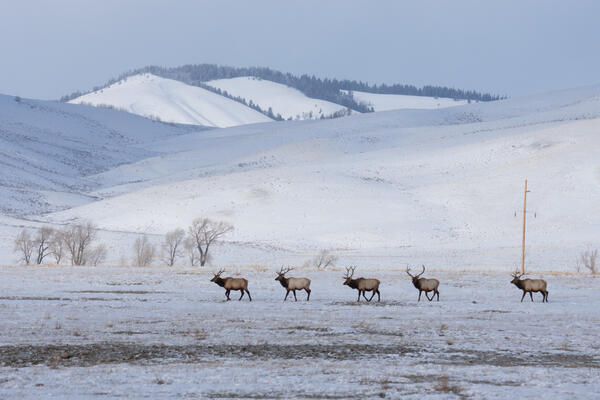
Bull elk group moving near snowy hills
Line of bull elk moving across field with snow-covered Wyoming hills in the background.
Line of bull elk moving across field with snow-covered Wyoming hills in the background.