Helicopter with forward facing stinger magnetometer
Helicopter with forward facing stinger magnetometerAn AS350 helicopter with forward facing stinger magnetometer. Credit: New-Sense Geophysics Limited


Official websites use .gov
A .gov website belongs to an official government organization in the United States.

Secure .gov websites use HTTPS
A lock () or https:// means you’ve safely connected to the .gov website. Share sensitive information only on official, secure websites.

Images from the Geology, Energy and Minerals Mission Area

An AS350 helicopter with forward facing stinger magnetometer. Credit: New-Sense Geophysics Limited
An AS350 helicopter with forward facing stinger magnetometer. Credit: New-Sense Geophysics Limited

Airborne geophysical surveys make use of a boom with sensitive equipment installed on small aircraft.
Airborne geophysical surveys make use of a boom with sensitive equipment installed on small aircraft.

A helicopter with a boom that contains sensitive equipment for conducting airborne geophysical surveys.
A helicopter with a boom that contains sensitive equipment for conducting airborne geophysical surveys.

Survey area for low-flying helicopter soon to be visible in six Montana counties, including Helena, the Elkhorn Mountains, Bull Mountain and the Tobacco Root Mountains.
Survey area for low-flying helicopter soon to be visible in six Montana counties, including Helena, the Elkhorn Mountains, Bull Mountain and the Tobacco Root Mountains.

Helicopter conducting low-level flights. Image courtesy Sander Geophysics Ltd.
Helicopter conducting low-level flights. Image courtesy Sander Geophysics Ltd.

Geologists in the field at Pennington Mountain. The orange instrument is a portable gamma spectrometer. University of Maine-Presque Isle professor Chunzeng Wang (the lead author) is in front, Preston Bass is carrying the meter.
Geologists in the field at Pennington Mountain. The orange instrument is a portable gamma spectrometer. University of Maine-Presque Isle professor Chunzeng Wang (the lead author) is in front, Preston Bass is carrying the meter.

Open pit rare earth element mine at Mountain Pass, California. Stepped sides of the pit and access for mining vehicles are shown.
Open pit rare earth element mine at Mountain Pass, California. Stepped sides of the pit and access for mining vehicles are shown.
Open pit rare earth element mine at Mountain Pass, California. Stepped sides of the pit and access for mining vehicles are shown.
Open pit rare earth element mine at Mountain Pass, California. Stepped sides of the pit and access for mining vehicles are shown.

A low-flying helicopter towing a geophysical device collects scientific data on groundwater and geology. Information collected during these surveys can help with studying critical mineral resources, natural hazards and groundwater potential.
A low-flying helicopter towing a geophysical device collects scientific data on groundwater and geology. Information collected during these surveys can help with studying critical mineral resources, natural hazards and groundwater potential.

A helicopter rigged with an airborne geophysical survey collecting equipment. Information collected during these surveys can help with studying critical mineral resources, natural hazards and groundwater potential. A cow is here too.
A helicopter rigged with an airborne geophysical survey collecting equipment. Information collected during these surveys can help with studying critical mineral resources, natural hazards and groundwater potential. A cow is here too.
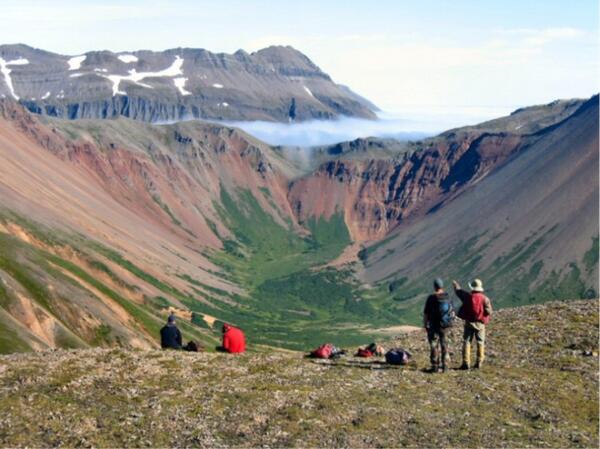
Photo of several students conducting geologic mapping field work as part of an EDMAP student project.
Photo of several students conducting geologic mapping field work as part of an EDMAP student project.

Geologist Alisha Ellis kneels in the marsh grass while collecting sediment samples in Mississippi.
Geologist Alisha Ellis kneels in the marsh grass while collecting sediment samples in Mississippi.

Landsat 9 is the latest in a prestigious line of satellites that have been watching our planet for nearly 50 years. They have monitored changes on land and made that information freely available to users around the world.
Landsat 9 is the latest in a prestigious line of satellites that have been watching our planet for nearly 50 years. They have monitored changes on land and made that information freely available to users around the world.

Geologist, Sue Karl, at Graphite Creek Deposit on the Seward Peninsula, Alaska. She is making field observations and measurements about the flake graphite deposit and the surrounding host rocks. These observations were used in developing a model of flake graphite genesis. Graphite is a critical mineral which the US depends entirely on imports.
Geologist, Sue Karl, at Graphite Creek Deposit on the Seward Peninsula, Alaska. She is making field observations and measurements about the flake graphite deposit and the surrounding host rocks. These observations were used in developing a model of flake graphite genesis. Graphite is a critical mineral which the US depends entirely on imports.

A geologist, George Case, stands in front of an adit, an entrance to an underground mine, in the Graphite Creek Deposit on the Seward Peninsula, Alaska.
A geologist, George Case, stands in front of an adit, an entrance to an underground mine, in the Graphite Creek Deposit on the Seward Peninsula, Alaska.

Scenic view of the Seward Peninsula, Alaska. Photo taken from a ridge above Graphite Creek, looking northwest towards the Imruk Basin. This area of the Seward Peninsula holds the largest graphite deposit in the US known as the Graphite Creek Deposit.
Scenic view of the Seward Peninsula, Alaska. Photo taken from a ridge above Graphite Creek, looking northwest towards the Imruk Basin. This area of the Seward Peninsula holds the largest graphite deposit in the US known as the Graphite Creek Deposit.

View of the Kigluaik Mountains gneiss dome which is the location of the Graphite Creek Deposit. The rocks of the gneiss dome were metamorphosed to as high as granulite facies during the middle Cretaceous (ca. 100 – 90 Ma), forming flake graphite ore in the process.
View of the Kigluaik Mountains gneiss dome which is the location of the Graphite Creek Deposit. The rocks of the gneiss dome were metamorphosed to as high as granulite facies during the middle Cretaceous (ca. 100 – 90 Ma), forming flake graphite ore in the process.

The 26th annual Mineral Commodity Summaries report from the U.S. Geological Survey National Minerals Information Center is the earliest comprehensive source of 2020 mineral production data for the world.
The 26th annual Mineral Commodity Summaries report from the U.S. Geological Survey National Minerals Information Center is the earliest comprehensive source of 2020 mineral production data for the world.

The United States continues to rely on foreign sources for some raw and processed mineral materials, including some critical minerals. This map shows the countries that supply mineral commodities for which the United States was more than 50% net import reliant in 2020.
The United States continues to rely on foreign sources for some raw and processed mineral materials, including some critical minerals. This map shows the countries that supply mineral commodities for which the United States was more than 50% net import reliant in 2020.

The Kukpowruk River cuts through folded Cretaceous rocks in the central North Slope. These rocks were assessed by the USGS in 2017 and lie above the rocks assessed in the USGS 2021 Western North Slope assessment.
The Kukpowruk River cuts through folded Cretaceous rocks in the central North Slope. These rocks were assessed by the USGS in 2017 and lie above the rocks assessed in the USGS 2021 Western North Slope assessment.

Jurassic rocks exposed in thurst-faulted structures near the southern limit of Western North Slope. In the subsurface farther north, these rocks may be reservoir rocks for natural gas.
Jurassic rocks exposed in thurst-faulted structures near the southern limit of Western North Slope. In the subsurface farther north, these rocks may be reservoir rocks for natural gas.