



Stibnite (Sb2S3) is the predominant ore mineral of antimony. Antimony compounds help prevent skin burns, increase battery life, and refine glass used for cellphones. A surprising 83% of antimony consumed stateside is imported—mostly from China—leaving the US susceptible to supply disruption.
Images
Images from the Geology, Energy and Minerals Mission Area
Filter Total Items: 565

Stibnite
Stibnite (Sb2S3) is the predominant ore mineral of antimony. Antimony compounds help prevent skin burns, increase battery life, and refine glass used for cellphones. A surprising 83% of antimony consumed stateside is imported—mostly from China—leaving the US susceptible to supply disruption.

Rutile
Mineral: Rutile
Primary Commodity: Titanium
Primary Commodity Uses: The vast majority of titanium is used in whiteners in the form of titanium oxide. Titanium metal makes up a comparatively small amount of the use for titanium, but as a metal it is used in metal coatings and medical implants.
Mineral: Rutile
Primary Commodity: Titanium
Primary Commodity Uses: The vast majority of titanium is used in whiteners in the form of titanium oxide. Titanium metal makes up a comparatively small amount of the use for titanium, but as a metal it is used in metal coatings and medical implants.

Chromite
Mineral: Chromite
Mineral Origin: Owings Mills, MD
Primary Commodity: Chromium
Primary Commodity Uses: Chromium mostly goes into stainless steel and other alloys, as well as in color pigments.
Mineral: Chromite
Mineral Origin: Owings Mills, MD
Primary Commodity: Chromium
Primary Commodity Uses: Chromium mostly goes into stainless steel and other alloys, as well as in color pigments.

Bertrandite
Mineral: Bertrandite (in carbonate clasts that have been largely replaced by fluorite (purple) that contains submicroscopic bertrandite)
Mineral Origin: Spor Mountain, UT
Primary Commodity: Beryllium
Mineral: Bertrandite (in carbonate clasts that have been largely replaced by fluorite (purple) that contains submicroscopic bertrandite)
Mineral Origin: Spor Mountain, UT
Primary Commodity: Beryllium

Torrs of the Ruby Batholith
Scintillometer and torrs of the Melozitna granite in the Ruby batholith. This granite contains abundant monazite and high levels of thorium and rare earth elements. This area is part of the Bureau of Land Management's Central Yukon Planning Area, which USGS did a mineral assessment of in 2015.
Scintillometer and torrs of the Melozitna granite in the Ruby batholith. This granite contains abundant monazite and high levels of thorium and rare earth elements. This area is part of the Bureau of Land Management's Central Yukon Planning Area, which USGS did a mineral assessment of in 2015.
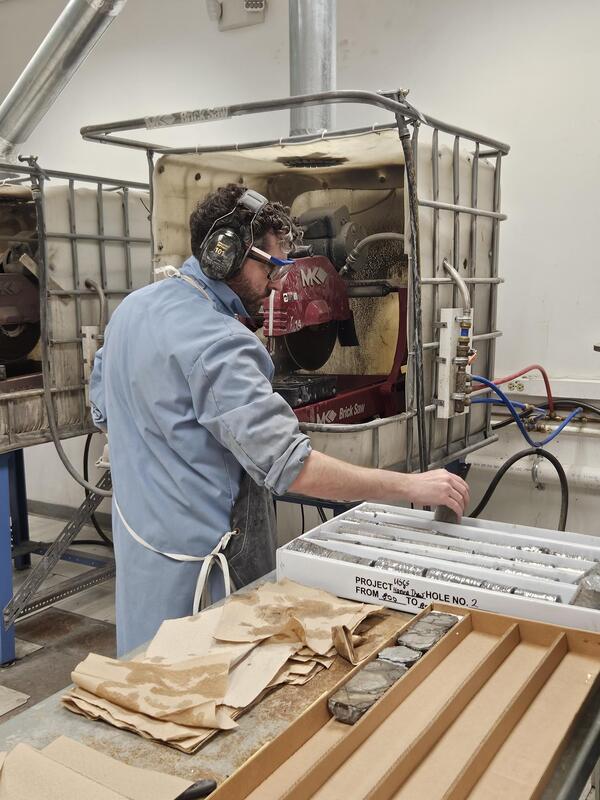
Scientist at the Core Research Center slabs rock cores
Scientist at the Core Research Center slabs rock coresA USGS scientist at the Core Research Center cuts a rock core with a saw and places the cores into boxes.
Scientist at the Core Research Center slabs rock cores
Scientist at the Core Research Center slabs rock coresA USGS scientist at the Core Research Center cuts a rock core with a saw and places the cores into boxes.

Loading Coal in the Trapper Mine
Coal is loaded into trucks at the Trapper Mine in northwest Colorado.
Coal is loaded into trucks at the Trapper Mine in northwest Colorado.

Pyrite and Quartz
A sample of pyrite and quartz. Iron pyrite, also known as Fool's Gold due to its resemblance to gold, often occurs in quartz veins. Pyrite is an important source of sulfur dioxide, which is primarily used to create sulfuric acid, an important industrial acid.
A sample of pyrite and quartz. Iron pyrite, also known as Fool's Gold due to its resemblance to gold, often occurs in quartz veins. Pyrite is an important source of sulfur dioxide, which is primarily used to create sulfuric acid, an important industrial acid.

Bastnaesite Sample
A sample of bastnaesite, one of the principal mineral sources of rare-earth elements. Rare-earth elements are essential components in most modern electronics.
A sample of bastnaesite, one of the principal mineral sources of rare-earth elements. Rare-earth elements are essential components in most modern electronics.

Native Gold
A sample of native gold. Gold has been treasured since ancient times for its beauty and permanence. Most of the gold that is fabricated today goes into the manufacture of jewelry, but it also performs critical functions in computers, communications equipment, spacecraft, jet aircraft engines, and a host of other products.
A sample of native gold. Gold has been treasured since ancient times for its beauty and permanence. Most of the gold that is fabricated today goes into the manufacture of jewelry, but it also performs critical functions in computers, communications equipment, spacecraft, jet aircraft engines, and a host of other products.

Azurite and Malachite
A sample of azurite, the blue mineral, and malachite, the green mineral. Both azurite and malachite are copper minerals that were once used as pigments but are now mostly valued as collectors minerals. They do serve as good indicators of copper deposits that can be developed.
A sample of azurite, the blue mineral, and malachite, the green mineral. Both azurite and malachite are copper minerals that were once used as pigments but are now mostly valued as collectors minerals. They do serve as good indicators of copper deposits that can be developed.

Elbaite
Elbaite is one of the best-known members of the tourmaline mineral family, particularly for its high-quality gemstones. Read more about the tourmaline mineral family here.
Elbaite is one of the best-known members of the tourmaline mineral family, particularly for its high-quality gemstones. Read more about the tourmaline mineral family here.

Epidote and Quartz
Epidote is a silicate mineral used mostly as a semiprecious gemstone.
Sample provided by Carlin Green, USGS. Sample originated from Prince of Wales Island, Alaska, and is 6.0cm in size.
Epidote is a silicate mineral used mostly as a semiprecious gemstone.
Sample provided by Carlin Green, USGS. Sample originated from Prince of Wales Island, Alaska, and is 6.0cm in size.

Pyrrohtite
Pyrrhotite is an iron sulfide mineral related to iron pyrite, which is one of the minerals known as Fool's Gold. Pyrrhotite, although not one of the Fool's Gold minerals, is sometimes called magnetic pyrite as it is weakly magnetic. It is most valued as a collectors mineral.
Pyrrhotite is an iron sulfide mineral related to iron pyrite, which is one of the minerals known as Fool's Gold. Pyrrhotite, although not one of the Fool's Gold minerals, is sometimes called magnetic pyrite as it is weakly magnetic. It is most valued as a collectors mineral.

Sample of Apophyllite and Prehnite
These two minerals are apophyllite and prehnite. Both apophyllite, the clear crystals, and prehnite, the green mineral, are primarily prized as collectors minerals.
Sample provided by Carlin Green, USGS. Sample originated from Virginia Crushed Stone Quarry, Virginia, and is 4.6cm in size.
These two minerals are apophyllite and prehnite. Both apophyllite, the clear crystals, and prehnite, the green mineral, are primarily prized as collectors minerals.
Sample provided by Carlin Green, USGS. Sample originated from Virginia Crushed Stone Quarry, Virginia, and is 4.6cm in size.

Rutile
This is a sample of rutile, one of the primary mineral sources of titanium. While as a metal, titanium is well known for corrosion resistance and for its high strength-to-weight ratio, approximately 95% of titanium is consumed in the form of titanium dioxide (TiO2), a white pigment used in paints, paper, and plastics.
This is a sample of rutile, one of the primary mineral sources of titanium. While as a metal, titanium is well known for corrosion resistance and for its high strength-to-weight ratio, approximately 95% of titanium is consumed in the form of titanium dioxide (TiO2), a white pigment used in paints, paper, and plastics.

Augelite and Quartz
A sample of augelite and quartz. Augelite is an aluminum phosphate mineral, primarily prized for collecting rather than as a source for its industrial mineral components.
Sample provided by Carlin Green, USGS. Sample originated from Mundo Nuevo Mine, Peru, and is 3.7cm in size.
A sample of augelite and quartz. Augelite is an aluminum phosphate mineral, primarily prized for collecting rather than as a source for its industrial mineral components.
Sample provided by Carlin Green, USGS. Sample originated from Mundo Nuevo Mine, Peru, and is 3.7cm in size.

Axinite
This is a sample of axinite with iron, making it ferroaxinite. Axinite is primarily used as a collectors mineral.
Sample provided by Carlin Green, USGS. Sample originated from Puiva Mount, Russia, and is 3.0cm in size.
This is a sample of axinite with iron, making it ferroaxinite. Axinite is primarily used as a collectors mineral.
Sample provided by Carlin Green, USGS. Sample originated from Puiva Mount, Russia, and is 3.0cm in size.

Clinozoisite
This sample is clinozoisite, a calcium aluminum silicate mineral. It is mostly prized as a collectors mineral rather than a source of its industrial mineral commodities.
Sample provided by Carlin Green, USGS. Sample originated from Hachupa, Pakistan, and is 6.0cm in size.
This sample is clinozoisite, a calcium aluminum silicate mineral. It is mostly prized as a collectors mineral rather than a source of its industrial mineral commodities.
Sample provided by Carlin Green, USGS. Sample originated from Hachupa, Pakistan, and is 6.0cm in size.

Torbernite
Torbernite is a copper phosphate mineral that contains uranium, making it somewhat radioactive. Although it can be used as a uranium ore, it's more valued as a collectors mineral. It can be used as a good indicator of uranium deposits, however.
Torbernite is a copper phosphate mineral that contains uranium, making it somewhat radioactive. Although it can be used as a uranium ore, it's more valued as a collectors mineral. It can be used as a good indicator of uranium deposits, however.

Sample of Cerussite
This sample is of the mineral cerussite, once an important source of lead for paints and pigments. With the phasing out of lead-based paints, cerussite is now mostly valued as a collectors mineral.
Sample provided by Carlin Green, USGS. Sample originated from Mibladen, Morocco, and is 5.6cm in size.
This sample is of the mineral cerussite, once an important source of lead for paints and pigments. With the phasing out of lead-based paints, cerussite is now mostly valued as a collectors mineral.
Sample provided by Carlin Green, USGS. Sample originated from Mibladen, Morocco, and is 5.6cm in size.