U.S. flag

An official website of the United States government

Images

Images related to natural hazards.

Filter Total Items: 7286
Aerial View of the Quito International Airport During an Eruption o...
Quito Intl. Airport During an Eruption of Reventador

Quito's international airport was covered with 3-5 mm of ash from the 3 November 2002 eruption of Reventador Volcano, located ~60 miles to the east of the Ecuadorean capital. The airport was closed for 8 days while clean up took place.

Quito's international airport was covered with 3-5 mm of ash from the 3 November 2002 eruption of Reventador Volcano, located ~60 miles to the east of the Ecuadorean capital. The airport was closed for 8 days while clean up took place.

Scientist from the USGS collects a gas sample into an evacuated/vac...

Scientist from the USGS collects a gas sample into an evacuated/vacuum flas from a steam vent near the Shoshone Geyser Basin.

image related to volcanoes. See description
Kīlauea summit
Kīlauea summit
Kīlauea summit

Collapse of Kīlauea's caldera floor has exposed South Sulphur Bank, prominent in the mid-19th century but covered as lava flows filled the caldera. The flat top of the white deposit shows how high the caldera fill reached. As the caldera floor dropped in mid-June 2018, South Sulphur Bank was again exposed.

Collapse of Kīlauea's caldera floor has exposed South Sulphur Bank, prominent in the mid-19th century but covered as lava flows filled the caldera. The flat top of the white deposit shows how high the caldera fill reached. As the caldera floor dropped in mid-June 2018, South Sulphur Bank was again exposed.

Obsidian Cliff, Yellowstone National Park....
Obsidian Cliff, YNP.

Obsidian Cliff exposes the interior of a thick rhyolite lava flow erupted about 180,000 years ago. The vertical columns are cooling fractures that formed as the thick lava flow cooled and crystallized. The flow consists of obsidian, a dark volcanic glass.

Obsidian Cliff exposes the interior of a thick rhyolite lava flow erupted about 180,000 years ago. The vertical columns are cooling fractures that formed as the thick lava flow cooled and crystallized. The flow consists of obsidian, a dark volcanic glass.

Interferogram image made from InSAR monitoring, showing 1995-2001 ground uplift.
Interferogram image made from InSAR monitoring, showing 1995-2001 ground uplift in the Three Sisters.

About 130 mm (5 inches) of peak uplift from 1995 to 2001 is shown in this interferogram in the Three Sisters Wilderness. Magma accumulating at about 7 km (about 4.5 mi) depth is the likely cause of uplift. The area of uplift, about 20 km (12 miles) in diameter, is almost entirely within the wilderness area.

About 130 mm (5 inches) of peak uplift from 1995 to 2001 is shown in this interferogram in the Three Sisters Wilderness. Magma accumulating at about 7 km (about 4.5 mi) depth is the likely cause of uplift. The area of uplift, about 20 km (12 miles) in diameter, is almost entirely within the wilderness area.

Image: Landslide Sampling
Landslide Sampling
Landslide Sampling
Landslide Sampling

Scientist Jonathan Godt samples a landslide headscarp in Alameda County, CA.

Scientist Jonathan Godt samples a landslide headscarp in Alameda County, CA.

Sherman Crater, to the left of the true summit, at Mount Baker, Was...
Sherman Crater, to left of the true summit, at Mount Baker, WA
Glacier Peak eruption history for the past 15,000 years....
Glacier Peak eruption history for the past 15,000 years.

Known eruptive episodes at Glacier Peak during the past 15,000 years. Each episode (depicted by a single icon) represents many individual eruptions. The ages of these episodes, in calendar years before present are corrected from dates based on a radiocarbon time scale.

Known eruptive episodes at Glacier Peak during the past 15,000 years. Each episode (depicted by a single icon) represents many individual eruptions. The ages of these episodes, in calendar years before present are corrected from dates based on a radiocarbon time scale.

Colorful image showing the geomorphology of the Puerto Rico Trench and surrounding terrain
Morphology and color-shaded bathymetry of the Puerto Rico Trench

Morphology and color-shaded bathymetry of the northeastern Caribbean region. Digital data courtesy of Troy Holcombe and Lisa Taylor, National Geophysical Data Center, Boulder, Colorado.

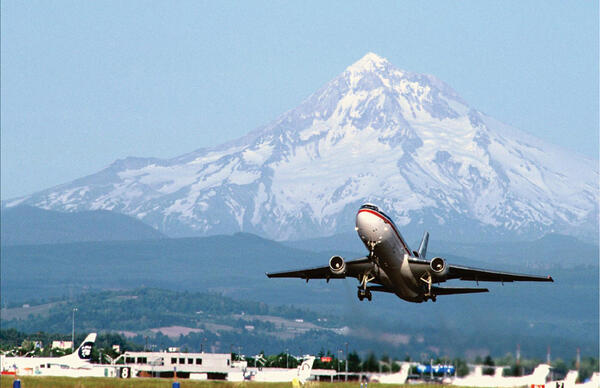
Airplane taking off with snow covered volcano in the background.
Mount Hood lies approximately 70 km (45 mi) from Portland International Airport. Volcanic Ash from eruptions can damage aircraft engines.
Timeline for eruptions at Mount Baker during the Holocene (12,000 y...
Timeline for eruptions at Mount Baker during Holocene
Deposit of the largest lahar from Mount Baker, Washington, exposed ...
Deposit of the largest lahar from Mount Baker, WA, exposed near con...

Note the protruding logs and branches from living trees that were knocked down and carried by the lahar. Ice axe, 3 ft, shows scale. Lahars are the greatest hazard at Mount Baker.

Flat underwater surface with many rocks tucked in close to each other; bright stripes of tape on rod that is touching bottom.
Cook Islands manganese nodules

A bed of manganese nodules from deep offshore of the Cook Islands; photo sourced from Hein et al., 2015, taken during a Japanese research cruise in the year 2000. Nodules range from about 2 to 10 centimeters across.

A bed of manganese nodules from deep offshore of the Cook Islands; photo sourced from Hein et al., 2015, taken during a Japanese research cruise in the year 2000. Nodules range from about 2 to 10 centimeters across.

Graphic depicting the distribution of Yellowstone ash across the U....
Map of volcanic ash fall as a result of eruptions from Yellowstone,...

Map of volcanic ashfall. Areas of the United States that once were covered by volcanic ash from Yellowstone's giant eruptions 2 million and 630,000 years ago, compared with ashfall from the 760,000-year-old Long Valley caldera eruptions at Mammoth Lakes, California, and the 1980 eruption of Mount St. Helens, Washington.

Map of volcanic ashfall. Areas of the United States that once were covered by volcanic ash from Yellowstone's giant eruptions 2 million and 630,000 years ago, compared with ashfall from the 760,000-year-old Long Valley caldera eruptions at Mammoth Lakes, California, and the 1980 eruption of Mount St. Helens, Washington.

Craters of the Moon, Idaho, Landsat 7 true-color image viewed from ...

Craters of the Moon, Idaho, Landsat 7 true-color image viewed from the east. Pioneer Mountain Range along the western border. Image created by NASA EArth Observatory.

Image: Flooded marsh
Flooded marsh
Flooded marsh
Flooded marsh

The marsh of Water Conservation Area 3 as seen looking north of I-75
(Alligator Alley). Spatterdock are seen in the foreground.

The marsh of Water Conservation Area 3 as seen looking north of I-75
(Alligator Alley). Spatterdock are seen in the foreground.

Image: Flooded marsh
Flooded marsh
Flooded marsh
Flooded marsh

Flooded marshes of Water Conservation Area 3 (WCA-3), seen north of I-75
(Alligator Alley).

Flooded marshes of Water Conservation Area 3 (WCA-3), seen north of I-75
(Alligator Alley).

Cartoon depicting an earthquake along a subduction zone with big starburst symbol, shows how ocean water is displaced upward.
Earthquake starts tsunami

An earthquake along a subduction zone happens when the leading edge of the overriding plate breaks free and springs seaward, raising the sea floor and the water above it. This uplift starts a tsunami. Meanwhile, the bulge behind the leading edge collapses, thinning the plate and lowering coastal areas.

An earthquake along a subduction zone happens when the leading edge of the overriding plate breaks free and springs seaward, raising the sea floor and the water above it. This uplift starts a tsunami. Meanwhile, the bulge behind the leading edge collapses, thinning the plate and lowering coastal areas.

Cutaway views showing the internal structure of the Earth. Left: To...

Cutaway views showing the internal structure of the Earth. Left: To scale drawing shows that Earth's crust is very thin. Right: Not to scale, more detail of three main layers (crust, mantle, core).

Cutaway views showing the internal structure of the Earth. Left: To scale drawing shows that Earth's crust is very thin. Right: Not to scale, more detail of three main layers (crust, mantle, core).

Was this page helpful?