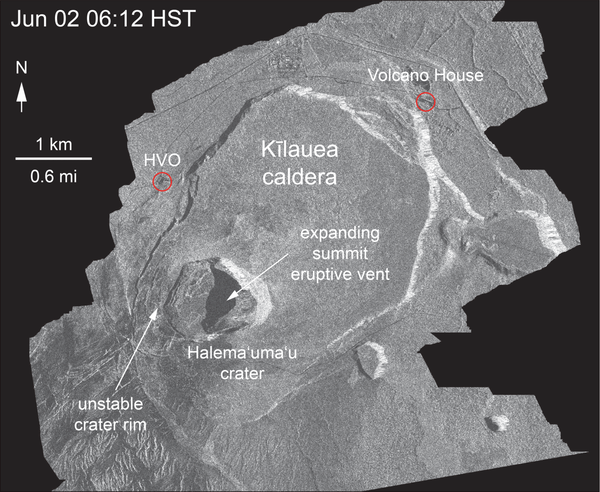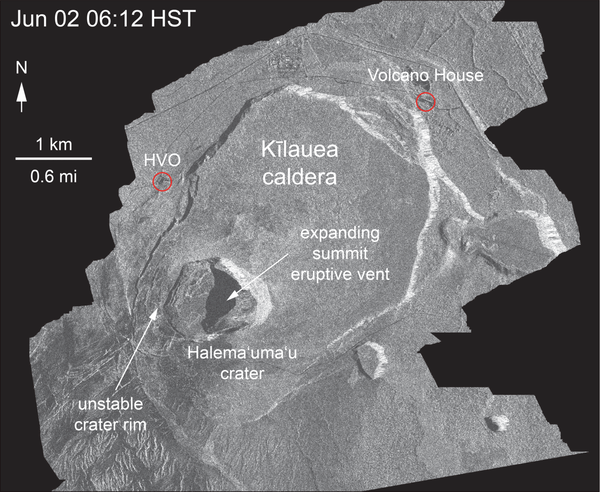
The International Charter for Space and Major Disasters (https://disasterscharter.org/) is a means for space agencies around the world to help with disaster monitoring by providing satellite data to responders and scientists on the ground.
Images
Images related to natural hazards.
The International Charter for Space and Major Disasters (https://disasterscharter.org/) is a means for space agencies around the world to help with disaster monitoring by providing satellite data to responders and scientists on the ground.
The vigorous lava fountain at Fissure 8 reached heights of 45 m (150 ft) as shown in this image taken around 9:30 AM.
This view, looking south at Kīlauea's lower East Rift Zone, was captured during HVO's 6:00 a.m. HST helicopter overflight today.
This fish-eye view of the lava delta filling the former Kapoho Bay shows that while the delta margin nearest the ocean has cooled somewhat, the lava flow front is still very hot and producing laze (lava haze). Laze is a local hazard composed of acidic gases and volcanic glass fragments and should be avoided.
This thermal map shows the fissure system and lava flows as of 12:30 pm on Wednesday, June 6. The flow from Fissure 8 remains active, with the flow front entering the ocean at Kapoho. The black and white area is the extent of the thermal map.
Views from HVO's helicopter overflight at 1PM HST, show the remains of the Kapoho Beach Lots subdivision and the fissure 8 flow front. The northern flow margin in this area was unchanged from HVO's morning flight and appeared to have stopped advancing at the time of the flight.
Robust fissure 8 lava channels and ocean entry plume
Robust fissure 8 lava channels and ocean entry plumeThis view, looking south at Kīlauea's lower East Rift Zone, was captured during HVO's 6:00 a.m. HST helicopter overflight today. It shows continued fountaining of fissure 8 and the lava flow channel fed by it. Lava continues to flow quickly in these braided channels; the flow margins are currently stable and have not experienced any breakouts since June 5.
Robust fissure 8 lava channels and ocean entry plume
Robust fissure 8 lava channels and ocean entry plumeThis view, looking south at Kīlauea's lower East Rift Zone, was captured during HVO's 6:00 a.m. HST helicopter overflight today. It shows continued fountaining of fissure 8 and the lava flow channel fed by it. Lava continues to flow quickly in these braided channels; the flow margins are currently stable and have not experienced any breakouts since June 5.
Kīlauea LERZ lava flows and fissures, June 6, 12:00 p.m.
Kīlauea LERZ lava flows and fissures, June 6, 12:00 p.m.Map as of 12:00 p.m. (noon) HST, June 6, 2018. Given the dynamic nature of Kīlauea's lower East Rift Zone eruption, with changing vent locations, fissures starting and stopping, and varying rates of lava effusion, map details shown here are accurate as of the date/time noted. Shaded purple areas indicate lava flows erupted in 1840, 1955, 1960, and 2014-2015.
Kīlauea LERZ lava flows and fissures, June 6, 12:00 p.m.
Kīlauea LERZ lava flows and fissures, June 6, 12:00 p.m.Map as of 12:00 p.m. (noon) HST, June 6, 2018. Given the dynamic nature of Kīlauea's lower East Rift Zone eruption, with changing vent locations, fissures starting and stopping, and varying rates of lava effusion, map details shown here are accurate as of the date/time noted. Shaded purple areas indicate lava flows erupted in 1840, 1955, 1960, and 2014-2015.
Morning view of Halema'uma'u and the Kīlauea Caldera from the Kīlauea overlook. Heavy steam dominates the view, and strong winds are blowing the plume to the southwest.
Lava fountaining continues at fissure 8, although overnight crews reported reduced heights of 40-50 m (130-164 ft). The fountain has built a 35 m (115 ft) high cone, and an actively-growing spatter rampart on its eastern side.
HVO scientists captured this aerial view of a much-changed Halema‘uma‘u during their overflight of the summit this afternoon.
Fissure 8 lava flow front had completely filled Kapoho Bay.
Fissure 8 lava flow front had completely filled Kapoho Bay.As of the morning of June 5, the fissure 8 lava flow front had completely filled Kapoho Bay.
Fissure 8 lava flow front had completely filled Kapoho Bay.
Fissure 8 lava flow front had completely filled Kapoho Bay.As of the morning of June 5, the fissure 8 lava flow front had completely filled Kapoho Bay.
Kīlauea LERZ lava flows and fissures, June 5, 10:00 a.m.
Kīlauea LERZ lava flows and fissures, June 5, 10:00 a.m.Map as of 10:00 a.m. HST, June 5, 2018. Given the dynamic nature of Kīlauea's lower East Rift Zone eruption, with changing vent locations, fissures starting and stopping, and varying rates of lava effusion, map details shown here are accurate as of the date/time noted. Shaded purple areas indicate lava flows erupted in 1840, 1955, 1960, and 2014-2015.
Kīlauea LERZ lava flows and fissures, June 5, 10:00 a.m.
Kīlauea LERZ lava flows and fissures, June 5, 10:00 a.m.Map as of 10:00 a.m. HST, June 5, 2018. Given the dynamic nature of Kīlauea's lower East Rift Zone eruption, with changing vent locations, fissures starting and stopping, and varying rates of lava effusion, map details shown here are accurate as of the date/time noted. Shaded purple areas indicate lava flows erupted in 1840, 1955, 1960, and 2014-2015.
Aerial view into Halema‘uma‘u. Explosions and collapse have enlarge...
Aerial view into Halema‘uma‘u. Explosions and collapse have enlarge...HVO scientists captured this aerial view of a much-changed Halema‘uma‘u during their overflight of the summit on June 5, 2018. Explosions and collapse within Halema‘uma‘u have enlarged the crater (foreground) that previously hosted the summit lava lake, and the far rim of Halema‘uma‘u has dropped with continued summit deflation.
Aerial view into Halema‘uma‘u. Explosions and collapse have enlarge...
Aerial view into Halema‘uma‘u. Explosions and collapse have enlarge...HVO scientists captured this aerial view of a much-changed Halema‘uma‘u during their overflight of the summit on June 5, 2018. Explosions and collapse within Halema‘uma‘u have enlarged the crater (foreground) that previously hosted the summit lava lake, and the far rim of Halema‘uma‘u has dropped with continued summit deflation.
As of the morning of June 5, the fissure 8 lava flow front had completely filled Kapoho Bay.
A pair of video cameras overlook the coast along a beach on Whidbey Island, Island County at the northern boundary of Puget Sound in western Washington. View looks west out into the Strait of Juan de Fuca.
View of ongoing rockfalls on the southern walls of the summit crater and ground
View of ongoing rockfalls on the southern walls of the summit crater and groundView of ongoing rockfalls on the southern walls of the summit crater and ground cracks just to the north of Halema‘uma‘u.
View of ongoing rockfalls on the southern walls of the summit crater and ground
View of ongoing rockfalls on the southern walls of the summit crater and groundView of ongoing rockfalls on the southern walls of the summit crater and ground cracks just to the north of Halema‘uma‘u.
A nodal seismometer can be easily deployed for a month in a closely...
A nodal seismometer can be easily deployed for a month in a closely...A nodal seismometer can be easily deployed for a month in a closely spaced array of tens of instruments. Arrays have been installed at Yellowstone National Park to map subsurface of geyser basins.
A nodal seismometer can be easily deployed for a month in a closely...
A nodal seismometer can be easily deployed for a month in a closely...A nodal seismometer can be easily deployed for a month in a closely spaced array of tens of instruments. Arrays have been installed at Yellowstone National Park to map subsurface of geyser basins.