



Prediction and Modeling
Prediction and Modeling
Filter Total Items: 58

Data Science for Water Resources
Data scientists in the USGS Water Resources Mission Area make sense of large environmental and operational datasets by applying various modeling, statistical, and visualization techniques to generate actionable information.

Hydrologic and Erosion Responses of Burned Watersheds
The enhanced probability of catastrophic wildfires has increased our need to understand the risk of floods, erosion, and debris and contaminant transport in burned watersheds. This project investigates the relation between rainfall intensity and peak discharge; erosion and deposition processes; and water-quality impacts to minimize the loss of life and property resulting from post-wildfire floods.

Surge, Wave, and Tide Hydrodynamics (SWaTH) Network
During large coastal storms, the storm surge and waves are the main cause of destruction and landscape change, transporting saline water, sediment, and debris inland. The USGS, in collaboration with stakeholders, has constructed a national Surge, Wave, and Tide Hydrodynamics (SWaTH) Network for the Atlantic, Eastern Pacific, and Central Pacific. SWaTH monitors and documents the height, extent, and...
Providing Major Storm and Short-Term Flood Event Data
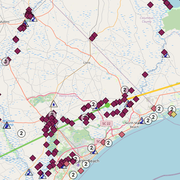
During major storms or other short-term events, the USGS collects streamflow and additional data to help document high-water events. This data is uploaded to the Short-Term Network (STN) for long-term archival and served out to the public through the Flood Event Viewer (FEV) which provides convenient, map-based access to downloadable event-based data.

USGS Cooperative Matching Funds
USGS Cooperative Matching Funds (CMF) support joint projects with our state, regional, tribal, and local partners to provide reliable, impartial, and timely information needed to understand and manage the Nation's water resources.

Focus Area Studies
Focus Area Studies were stakeholder-driven assessments of water availability in river basins with known or potential conflict. They contributed toward ongoing assessments of water availability in large watersheds, provided opportunities to test and improve approaches to water availability assessment, and informed the National Water Census with local information. These studies focused on key water...

NASA-USGS National Blue Carbon Monitoring System
The NASA-USGS National Blue Carbon Monitoring System project will evaluate the relative uncertainty of iterative modeling approaches to estimate coastal wetland (marsh and mangrove) C stocks and fluxes based on changes in wetland distributions, using nationally available datasets (Landsat) and as well as finer scale satellite and field derived data in six sentinel sites.

Acid Rain
The USGS has been at the forefront of studying the impacts of acid rain for decades. How does acid rain form? What does it do to the landscape? Can it burn you like battery acid? Keep reading to find out more...

Large Oil Spills
Oil spills, such as the 2010 Deepwater Horizon Oil Spill, are impactful environmental disasters that have long lasting effects to the landscape, native species, and inhabitants who depend on the area. The USGS explores the adverse effect that large-scale oil spills have on the environment and helps responders prepare for environmental recovery and rehabilitation.

Linking Selenium Sources to Ecosystems: Local and Global Perspectives
The sources, biogeochemistry, and ecotoxicology of selenium (Se) combine to produce a widespread potential for ecological risk such as deformities in birds and fish. Linking the understanding of source characteristics to a mechanistic, biodynamic dietary model of Se exposure on an ecosystem-scale improves the prediction of Se effects and its potential remediation.

Regional Groundwater Availability Studies
Regional groundwater availability studies enable information about groundwater to be integrated and consistent, so that this resource can be analyzed and understood on an aquifer–wide scale. These studies provide decision–makers with a better understanding of the status and trends in the Nation's groundwater availability.

Historical Flooding
The USGS provides practical, unbiased information about the Nation's rivers and streams that is crucial in mitigating hazards associated with floods. This site provides information about the USGS activities, data, and services provided during regional high-flow events, such as hurricanes or multi-state flooding events. The USGS response to these events is typically managed by the National Flood...