



Stormwater
Stormwater
Filter Total Items: 22

Surge, Wave, and Tide Hydrodynamics (SWaTH) Network
During large coastal storms, the storm surge and waves are the main cause of destruction and landscape change, transporting saline water, sediment, and debris inland. The USGS, in collaboration with stakeholders, has constructed a national Surge, Wave, and Tide Hydrodynamics (SWaTH) Network for the Atlantic, Eastern Pacific, and Central Pacific. SWaTH monitors and documents the height, extent, and...
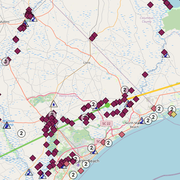
Providing Major Storm and Short-Term Flood Event Data
During major storms or other short-term events, the USGS collects streamflow and additional data to help document high-water events. This data is uploaded to the Short-Term Network (STN) for long-term archival and served out to the public through the Flood Event Viewer (FEV) which provides convenient, map-based access to downloadable event-based data.

Emerging Contaminants
Emerging contaminants, or contaminants of emerging concern, can refer to many different kinds of chemicals, including medicines, personal care or household cleaning products, lawn care and agricultural products, among others. These chemicals make it into our Nation's lakes and rivers and have a detrimental affect on fish and other aquatic species. That have also been shown to bioaccumulate up the...

Agricultural Contaminants
About 40 percent of the land in the United States is used for agriculture, and agriculture supplies a major part of the our food, feed, and fiber needs. Agricultural chemicals move into and through every component of the hydrologic system, including air, soil, soil water, streams, wetlands, and groundwater.

Historical Flooding
The USGS provides practical, unbiased information about the Nation's rivers and streams that is crucial in mitigating hazards associated with floods. This site provides information about the USGS activities, data, and services provided during regional high-flow events, such as hurricanes or multi-state flooding events. The USGS response to these events is typically managed by the National Flood...

National Field Manual for the Collection of Water-Quality Data (NFM)
The National Field Manual for the Collection of Water-Quality Data (NFM) provides documented methods and protocols for USGS field personnel who collect water-quality data. The NFM provides detailed, comprehensive, and citable procedures for sampling water resources, processing samples for analysis of water quality, measuring field parameters, and specialized procedures.

Urban Waters Federal Partnership—Bronx and Harlem River Watersheds (New York, N.Y.)
The Harlem and Bronx Rivers provide ecological and social resources in an intensively urban area. Connecting people to rivers requires clean water—the USGS is helping to assess the efficacy of green infrastructure to improve the quality of stormwater that flows into the rivers.

Urban Waters Federal Partnership—Little Calumet River (Northwest Indiana)
The USGS works with a wide range of cooperators to investigate many aspects of water quality. The newly integrated USGS Ohio-Kentucky-Indiana Water Science Center is assisting in furthering urban water-quality research in Northwest Indiana.

Urban Waters Federal Partnership—Patapsco Watershed (Baltimore, Md. region)
Several watersheds in the Baltimore region have elevated PCB loads in tidal waters. Local jurisdictions are responsible for reducing PCB loading from their watersheds. The USGS is embarking on a pilot study in the Patapsco watershed that will help determine sources of PCBs and will demonstrate innovative monitoring and analysis techniques for more efficient use of mitigation resouces.

Sediment-Associated Contaminants
Stream, river, and lake bed sediment are reservoirs for many contaminants. These contaminants include some “legacy” contaminants, like DDT, PCBs, and chlordane, and chemicals currently in use, like the insecticide bifenthrin and many flame retardants. Learn about techniques used to study sediment-associated contaminants and their importance to aquatic biota.