



1,000 Cameras and Counting
Growing network of webcams supports water science and safety
Growing network of webcams supports water science and safety
New Nationwide Tool Helps Answer: Do We Have Enough Water?
Resource can help water managers make informed decisions about supply, demand, and future growth.
Resource can help water managers make informed decisions about supply, demand, and future growth.
USGS Investigates Groundwater Drought Metrics Across the United States
Hot Spots and Cold Snaps
Daily stream temperature data across the U.S. from 1979-2021
Daily stream temperature data across the U.S. from 1979-2021
Water Resources Mission Area
Water information is fundamental to national and local economic well-being, protection of life and property, and effective management of the Nation’s water resources. The USGS works with partners to monitor, assess, conduct targeted research, and deliver information on a wide range of water resources and conditions including streamflow, groundwater, water quality, and water use and availability.
Message from the Associate Director
Message from the Associate Director

Learn more about the Mission Area from the Associate Director for Water Resources.
Water Data for the Nation
Water Data for the Nation

Water data collected at approximately 1.9 million sites across all 50 states.
News
1,000 Cameras and Counting
1,000 Cameras and Counting
New Nationwide Tool Helps Answer: Do We Have Enough Water?
New Nationwide Tool Helps Answer: Do We Have Enough Water?
USGS Investigates Groundwater Drought Metrics Across the United States
USGS Investigates Groundwater Drought Metrics Across the United States
Publications
Refinement of a framework for Moving Aircraft River Velocimetry (MARV) and application to particle tracking along Alaskan rivers Refinement of a framework for Moving Aircraft River Velocimetry (MARV) and application to particle tracking along Alaskan rivers
Information on river velocities enhances understanding flood hazards, evaluating habitat conditions, and predicting the transport of floating materials. In this follow-up study, we used data from two new sites, one with a more complex morphology and the other with a lower suspended sediment concentration, to provide further evidence that Moving Aircraft River Velocimetry (MARV) can yield...
Riverine pesticide trends in the United States: Assessing a decade of national-scale monitoring Riverine pesticide trends in the United States: Assessing a decade of national-scale monitoring
Pesticides in freshwater systems can compromise water availability by degrading water quality, with implications for human health and aquatic life. Despite recognition of the need for national-scale monitoring and analysis, few studies have documented long-term trends in surface water pesticide contamination across the US. This study addresses that need by analyzing temporal trends and...
Evaluating approximations of river channel shape using a national cross section database Evaluating approximations of river channel shape using a national cross section database
Many hydrologic applications require basic information on the size and shape of river channels, but measuring cross section (XS) geometry in the field or via remote sensing can be costly and often provides only partial coverage. Given these challenges, we capitalized upon an existing data set of 46,971 XS from gaging stations to evaluate various approximations of channel shape. After...
Science

Water Quality
The USGS, in partnership with multiple other groups, is learning about water-quality conditions across time and space in terminal lakes across the Great Basin. This effort is part of the Saline Lake Ecosystems Integrated Water Availability Assessment.
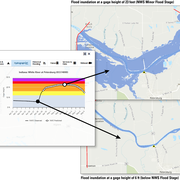
Flood Inundation Mapping Science
When planning for a flood, there are three key questions that must be answered: What areas will be flooded? How deep will the floodwaters get? When will the flood arrive? A flood inundation map library is a set of maps that together show where flooding may occur – and how deep it may be - over a range of potential flooding scenarios in a stream or river.
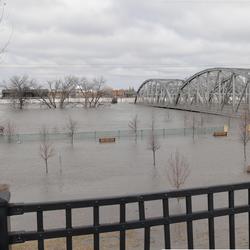
Flood Inundation Mapping (FIM) Program
The USGS Flood Inundation Mapping (FIM) Program helps communities protect lives and property by providing tools and information to help them understand their local flood risks and make cost-effective mitigation decisions.