



This is our office.
These are our coworkers.
This is our rush hour.
This is our happy hour.
Dive in to learn more.
Northern Rocky Mountain Science Center
Welcome to the Northern Rocky Mountain Science Center (NOROCK), one of the nation’s key laboratories to study the ecosystems and species of the Northern Rockies. Since 2000, our scientists have tackled critical issues that matter to natural resource managers and the American people.
Featured Research
Featured Research

READI-Net—A network of robotic environmental DNA samplers to enhance the early detection of aquatic biological threats
Featured Research
Featured Research

NOROCK is developing drought early warning systems for fisheries and water management
NOROCK Quick Links
NOROCK Quick Links
Check out our most up-to-date data & science, and learn about any upcoming NOROCK opportunities .
News
Environmental DNA monitoring leads to early detection of invasive zebra mussel DNA in the Colorado River, Utah
Environmental DNA monitoring leads to early detection of invasive zebra mussel DNA in the Colorado River, Utah
Predicting chronic wasting disease spread in North American deer and understanding the role of deer movement
Predicting chronic wasting disease spread in North American deer and understanding the role of deer movement
IGBST Public Notifications and Resources
IGBST Public Notifications and Resources
Publications
Applying automated avalanche terrain mapping to wildlife ecology: A case study of Dall's sheep in southcentral Alaska Applying automated avalanche terrain mapping to wildlife ecology: A case study of Dall's sheep in southcentral Alaska
Avalanche hazard has been studied extensively in the context of human risk, but its role in alpine wildlife ecology remains poorly understood. Long-term telemetry studies have revealed that avalanches are an important source of mortality for some mountain ungulates. Investigating the processes underlying these events is challenging because avalanche activity and snowpack conditions are...
Tracking water in snow: Bridging sensor and and model simulations Tracking water in snow: Bridging sensor and and model simulations
Forecasting wet slab avalanches remains one of the most demanding challenges in operational avalanche forecasting. A key obstacle is the difficulty of observing and quantifying liquid water content (LWC) and tracking its infiltration into the snowpack. Field measurements are labor-intensive, highly variable in space, and often influenced by user application or sensor design — making them
Climate-driven shifts in snowpack conditions favorable for wet snow avalanches: Insights from snow cover model simulations Climate-driven shifts in snowpack conditions favorable for wet snow avalanches: Insights from snow cover model simulations
Forecasting wet snow avalanches remains a major challenge due to their temporal and spatial variability. Long-term climate trends are producing more variable and extreme weather, creating conditions outside historical experience, and increasing forecasting uncertainties. To assess how climate change affects the frequency and timing of wet snow avalanches, we examined the long-term...
Science

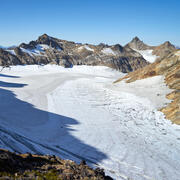
Gulkana Glacier
Gulkana Glacier is located in the high-latitude continental climate regime of Alaska’s Delta Mountains. Glacier observations began at this site in 1966 and continue through present as the northern most USGS Benchmark Glacier.
Glaciers and Landscape Change
Mountain glaciers are dynamic reservoirs of frozen water, deeply interconnected with their surrounding ecosystems. Glacier change in North America has major societal impacts, including to water resources, natural hazard risk, tourism disruption, fisheries, and global sea level change. Understanding and quantifying precise connections between changing glaciers, the surrounding landscape and climate...

Bighorn Sheep and Mountain Goat Research in Western National Park Units
Mountain goat and bighorn sheep are iconic symbols of many national lands in the West and are economically important as big game species on some public lands and as tourist attractions in and around national parks. Both species have limited distributions that can be difficult to observe and face multiple stressors including disease, increasing recreation in remote areas, and shifting weather...