U.S. flag

An official website of the United States government

Images

Images related to Yellowstone Volcano Observatory.

Filter Total Items: 716
Hot springs waters measured on Yellowstone Lake floor

Hot spring waters with relatively high dissolved element concentrations on the floor of West Thumb, Yellowstone Lake. Image acquired by the Global Foundation for Ocean Exploration ROV Yogi on August 7, 2018.

Hot spring waters with relatively high dissolved element concentrations on the floor of West Thumb, Yellowstone Lake. Image acquired by the Global Foundation for Ocean Exploration ROV Yogi on August 7, 2018.

A barren plain with some colorful water marking occasional springs amidst white ground. Trees in the distance. Blue sky.
100 Spring Plain in Norris Geyser Basin, Yellowstone National Park

100 Spring Plain in Norris Geyser Basin, Yellowstone National Park.  The area is frequently flooded and impassable. Photo taken by Lauren Harrison in August 2018.

Vertical outcrop of basaltic rock partially covered in moss and dirt with forest in the background
Pinehaven Basalt, Idaho

The Pinehaven Basalt, which erupted in Henrys Fork Caldera, southeast Idaho, about 35,000 years ago.  Photo by Brandi Lawler, University of Wyoming, August 6, 2018.

The Pinehaven Basalt, which erupted in Henrys Fork Caldera, southeast Idaho, about 35,000 years ago.  Photo by Brandi Lawler, University of Wyoming, August 6, 2018.

Fishing Cone, West Thumb

Fishing cone, a hot springs on the floor of Yellowstone Lake. The hot spring rim sits at lake level.

Fishing cone, a hot springs on the floor of Yellowstone Lake. The hot spring rim sits at lake level.

Thermally-deformed sensor recovered from the floor of Yellowstone Lake

Sensor (top), deformed battery/electronics package (bottom), and titanium sheath (left) following recovery from vent location A in teh Deep Hole area on the floor of Yellowstone Lake.

Sensor deployed in the Deep Hole, Yellowstone Lake floor

Sensor deployed in the Deep Hole, east of Stevenson Island to monitor long-term temperature and chemical variations in an active vent. Image acquired by the Global Foundation for Ocean Exploration ROV Yogi on August 4, 2018.

Sensor deployed in the Deep Hole, east of Stevenson Island to monitor long-term temperature and chemical variations in an active vent. Image acquired by the Global Foundation for Ocean Exploration ROV Yogi on August 4, 2018.

Sensor data logger recovered from floor of Yellowstone Lake

A sensor data logger recovered from the floor of Yellowstone Lake in the Deep Hole area in 2018 shows signs of melting due to unexpectedly high temperatures in sediments up to ~3 ft (1 m) away from an active hydrothermal vent. Image acquired by the Global Foundation for Ocean Exploration ROV Yogi on August 4, 2018.

A sensor data logger recovered from the floor of Yellowstone Lake in the Deep Hole area in 2018 shows signs of melting due to unexpectedly high temperatures in sediments up to ~3 ft (1 m) away from an active hydrothermal vent. Image acquired by the Global Foundation for Ocean Exploration ROV Yogi on August 4, 2018.

Chemical/temperature sensor on the floor of Yellowstone Lake

Sensor (left) and battery/electronics package (right) at vent location A in the Deep Hole area of Yellowstone Lake.  Photo was taken immediately before recovery from the lake floor. Notice the battery/electronics package slightly submerged in sediment.

Sensor (left) and battery/electronics package (right) at vent location A in the Deep Hole area of Yellowstone Lake.  Photo was taken immediately before recovery from the lake floor. Notice the battery/electronics package slightly submerged in sediment.

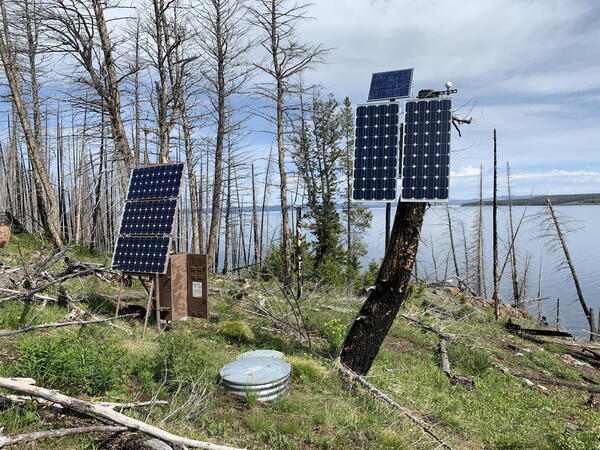
Spectogram and wind data from stations on Stevenson Island Yellowstone

Spectrogram and wind data from stations on Stevenson Island for June 30, 2018. Warm colors in the spectrogram correspond to stronger seismic energy compared to cool colors. The ~1-second-period lake-generated microseism (outlined by the black box) that was generated on this day is correlated with elevated wind speeds (red circles) as a storm passed by overnight.

Spectrogram and wind data from stations on Stevenson Island for June 30, 2018. Warm colors in the spectrogram correspond to stronger seismic energy compared to cool colors. The ~1-second-period lake-generated microseism (outlined by the black box) that was generated on this day is correlated with elevated wind speeds (red circles) as a storm passed by overnight.

River Styx, Mammoth Hot Springs, Yellowstone National Park

River Styx, Mammoth Hot Springs, Yellowstone National Park. This thermal feature is actually a subterranean hot water creek that likely collects water discharged from Mammoth Hot Spring pools that, after cooling and outflowing from vents, tends to disappear back underground through the porous travertine.

River Styx, Mammoth Hot Springs, Yellowstone National Park. This thermal feature is actually a subterranean hot water creek that likely collects water discharged from Mammoth Hot Spring pools that, after cooling and outflowing from vents, tends to disappear back underground through the porous travertine.

Lower Geyser Basin, with Fountain and Clepsydra Geysers in eruption

View of Lower Geyser Basin, with Fountain and Clepsydra Geysers in eruption, looking south towards Fountain Paint Pots. The vegetation in the photo is indicative of vegetation throughout much of Lower Geyser Basin—open grassland maintained by hot ground with patches of lodgepole pine.

View of Lower Geyser Basin, with Fountain and Clepsydra Geysers in eruption, looking south towards Fountain Paint Pots. The vegetation in the photo is indicative of vegetation throughout much of Lower Geyser Basin—open grassland maintained by hot ground with patches of lodgepole pine.

A nodal seismometer can be easily deployed for a month in a closely...

A nodal seismometer can be easily deployed for a month in a closely spaced array of tens of instruments. Arrays have been installed at Yellowstone National Park to map subsurface of geyser basins.

Looking down into a barren valley with some hot springs. Trees in the foreground and background. Mountain in the far back.
Looking west over The Gap subbasin of Norris Geyser Basin, Yellowstone National Park

Looking west over The Gap subbasin of Norris Geyser Basin, Yellowstone National Park, from a vantage point on the Ragged Hills. The mountain in the distance is Mt. Holmes. Photo taken in June 2018 by Lauren Harrison. 

Time series of vertical displacements during April–October 2017 at four GPS stations on the north side of Yellowstone Lake

Time series of vertical displacements during April–October 2017 at four GPS stations (LAK1, LAK2, LKWY, and SEDG) on the north side of Yellowstone Lake. Downward trends indicate subsidence and upward trends show uplift. Uplift “spikes” in late September are related to inclement weather and do not show true deformation. Error bars are one standard deviation.

Time series of vertical displacements during April–October 2017 at four GPS stations (LAK1, LAK2, LKWY, and SEDG) on the north side of Yellowstone Lake. Downward trends indicate subsidence and upward trends show uplift. Uplift “spikes” in late September are related to inclement weather and do not show true deformation. Error bars are one standard deviation.

Roadcut exposure of Huckleberry Ridge Tuff and Mesa Falls Tuff along U.S. Route 20 between Ashton and Island Park, Idaho
Four scientists in safety vests in a grassy meadow with occasional bounders setting up geophysical equipment
Field crew setting up a magnetotelluric site in Yellowstone National Park

Field crew from Oregon State University and University of Wisconsin-Madison install a magnetotelluric site within Yellowstone National Park. 

Changes in snow conditions at a gravity station in Yellowstone 2017

Changes in snow conditions at a gravity station in Yellowstone National Park in 2017. Each photo is taken from about the same location in May, July, August, and October of that year. The red circle in the May photograph shows the location of the gravity station in this area, which is near Craig Pass, a few miles southeast of Old Faithful.

Changes in snow conditions at a gravity station in Yellowstone National Park in 2017. Each photo is taken from about the same location in May, July, August, and October of that year. The red circle in the May photograph shows the location of the gravity station in this area, which is near Craig Pass, a few miles southeast of Old Faithful.

Map of Yellowstone gravity stations measured in 2017

Map of gravity stations measured in 2017 in Yellowstone National Park. Yellow lines are roads, dashed line marks the caldera boundary, black line outlines Yellowstone National Park, green circles note resurgent domes, and red dots are gravity stations.

Map of gravity stations measured in 2017 in Yellowstone National Park. Yellow lines are roads, dashed line marks the caldera boundary, black line outlines Yellowstone National Park, green circles note resurgent domes, and red dots are gravity stations.

Hydrotherm example
Hydrotherm program output example

Example Hydrotherm output. Hydrotherm is a three-dimensional simulation of multiphase groundwater flow and heat transport in the temperature range of 0 to 1200 degrees Celsius and the pressure range of 1 to 1000 MPa.

Example Hydrotherm output. Hydrotherm is a three-dimensional simulation of multiphase groundwater flow and heat transport in the temperature range of 0 to 1200 degrees Celsius and the pressure range of 1 to 1000 MPa.

The head of an immature wetsalts tiger beetle at the entrance to the burrow it dug
Head of an immature wetsalts tiger beetle at the entrance to the burrow it dug
Steam-driven vents on the floor of Yellowstone Lake in the Deep Hole,

Steam-driven vents on the floor of Yellowstone Lake in the Deep Hole, east of Stevenson Island. Image acquired by the Global Foundation for Ocean Exploration ROV Yogi in August 2017.

Steam-driven vents on the floor of Yellowstone Lake in the Deep Hole, east of Stevenson Island. Image acquired by the Global Foundation for Ocean Exploration ROV Yogi in August 2017.

Was this page helpful?