U.S. flag

An official website of the United States government

Images

Images related to Yellowstone Volcano Observatory.

Filter Total Items: 704
Huckleberry Ridge Tuff fall deposits at Mount Everts, Yellowstone

View of ripples caused by wind winnowing of the Huckleberry Ridge Tuff fall deposits at Mount Everts. Other layers below show evidence for rain and hail landing with the falling ash. Scale in centimeters and inches.

View of ripples caused by wind winnowing of the Huckleberry Ridge Tuff fall deposits at Mount Everts. Other layers below show evidence for rain and hail landing with the falling ash. Scale in centimeters and inches.

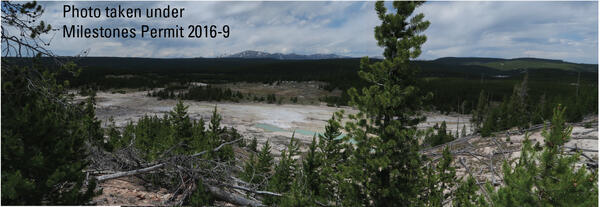
A geyser basin and hill in the distance, with pine trees in the foreground, under a mostly cloudy sky
Image of Biscuit Basin (visible between the trees) captured by the YVO mobile webcam on June 17, 2012
View north along U.S. Route 20 from near Ashton, ID, at the margin of the Huckleberry Ridge Tuff in the distance

Google maps photo taken just north of Ashton, ID, along U.S. Route 20. The photo was taken looking north towards Island Park, ID. The forested ridge in the distance marks the margin of a caldera that formed 2.08 million years ago, when the Huckleberry Ridge Tuff erupted.

black bulbous rock sample on white tubing resting on a barren, pale, sandy surface
Sulfur “cinder” from Cinder Pool in Norris Geyser Basin, Yellowstone National Park

Sulfur “cinder” attached to a sampling tube that was extracted from Cinder Pool in Norris Geyser Basin.  The “cinder” is sulfur that existed as a molten layer at the bottom of the pool and was carried upward by gas and solidified.  The black color is due to the presence of finely dispersed pyrite.

Sulfur “cinder” attached to a sampling tube that was extracted from Cinder Pool in Norris Geyser Basin.  The “cinder” is sulfur that existed as a molten layer at the bottom of the pool and was carried upward by gas and solidified.  The black color is due to the presence of finely dispersed pyrite.

Mud Geyser, Yellowstone

Steam rises from the Mud Geyser fumarole on the northeast side of the Mud Volcano thermal area in Yellowstone National Park. Gas that discharges from Mud Geyser has the most magmatic character of any sampled feature in Yellowstone.

Steam rises from the Mud Geyser fumarole on the northeast side of the Mud Volcano thermal area in Yellowstone National Park. Gas that discharges from Mud Geyser has the most magmatic character of any sampled feature in Yellowstone.

Looking west from the intersection of U.S. Route 20 and Old Hwy 47, in Idaho, at lava flows associated with the Henrys Fork caldera

Google Maps photo taken at the intersection of U.S. Route 20 and Old Hwy 47 in Idaho, looking west. The tops of Moonshine Mountain and Silver Lake dome, rhyolite lava flows located inside the caldera, are indicated with a dashed black line.

Two elk standing in from of burned trees, with a lake shoreline in the distance under a cloudy sky
Image of elk captured by the YVO mobile webcam on June 25, 2010

Image of elk captured by the YVO mobile webcam on June 25, 2010, when it was positioned atop Lake Butte with a view of the north side of Yellowstone Lake.

Cross section through the trunk of a Yellowstone lodgepole pine

Cross section through the trunk of a lodgepole pine tree from Cooking Hillside near Mud Volcano, Yellowstone National Park.  The earliest date for this tree is 1916 and it died in 1990. Spongy white-gray areas are foam insulation that was injected into the sample to reinforce the structure of the wood.

Cross section through the trunk of a lodgepole pine tree from Cooking Hillside near Mud Volcano, Yellowstone National Park.  The earliest date for this tree is 1916 and it died in 1990. Spongy white-gray areas are foam insulation that was injected into the sample to reinforce the structure of the wood.

Grey’s Landing Ignimbrite in Idaho part of Yellowstone Hotspot

The Grey’s Landing Ignimbrite in Idaho (Dr. Thomas Knott, of the University of Leicester, England, gives the scale of the cliff). The entire cliff (and more not seen!) would have been deposited in a matter of moments as it welded to the land surface during a super eruption about 8.7 million years ago.

The Grey’s Landing Ignimbrite in Idaho (Dr. Thomas Knott, of the University of Leicester, England, gives the scale of the cliff). The entire cliff (and more not seen!) would have been deposited in a matter of moments as it welded to the land surface during a super eruption about 8.7 million years ago.

Geysers on the south pole of Saturn's moon Enceladus

This two-image mosaic is one of the highest resolution views acquired by the Cassini spacecraft during its imaging survey of the geyser basin capping the southern hemisphere of Saturn's moon Enceladus. 

This two-image mosaic is one of the highest resolution views acquired by the Cassini spacecraft during its imaging survey of the geyser basin capping the southern hemisphere of Saturn's moon Enceladus. 

Blue pools surrounded by beige and reddish mud and otherwise mostly barren ground. Pine trees and a lake are in the distance.
Overview of central West Thumb Geyser Basin

Overview of central West Thumb Geyser Basin.  USGS photo by Pat Shanks, 2009. 

Photo of the Madison Museum, Yellowstone National Park

Photo of the Madison Museum, built in 1930 and designed by Herbert Maier. This structure exemplifies the National Park Rustic style, using natural materials and artisan craftmanship that are intended to blend buildings into the surrounding environment, “suggesting the smallness of man in relation to nature” (Herbert Maier).

Photo of the Madison Museum, built in 1930 and designed by Herbert Maier. This structure exemplifies the National Park Rustic style, using natural materials and artisan craftmanship that are intended to blend buildings into the surrounding environment, “suggesting the smallness of man in relation to nature” (Herbert Maier).

Ken Pierce providing geology lesson during field trip
Ken Pierce providing geology lesson during field trip Jackson Hole

Ken Pierce, at the Curtis Canyon Overlook in Jackson Hole, leading the 2003 INQUA (International Union of Quaternary Research) field trip, one of his many geologic field trips about the Greater Yellowstone Geoecosystem. 

Ken Pierce, at the Curtis Canyon Overlook in Jackson Hole, leading the 2003 INQUA (International Union of Quaternary Research) field trip, one of his many geologic field trips about the Greater Yellowstone Geoecosystem. 

Ken Pierce in the field with a large glacial erratic
Ken Pierce in the field with large glacial erratic

Ken Pierce in the field with a large glacial erratic in the Clarks Fork moraines taking detailed notes and annotating a map in progress.

Ken Pierce in the field with a large glacial erratic in the Clarks Fork moraines taking detailed notes and annotating a map in progress.

Bob Fournier measuring the gas-to-water ratio (gas/steam) at drill site Y2 in Yellowstone National Park

Bob Fournier measuring the gas-to-water ratio (gas/steam) at drill site Y2, near Hot Lake on Firehole Lake Drive in Lower Geyser Basin, Yellowstone National Park, in the late 1960s.  USGS Photo.

View from a mountain of a treed area with a canyon in the middle ground and mountains in the distance. Sky is mostly cloudy.
Yellowstone caldera viewed from Mount Washburn

Yellowstone caldera viewed from Mount Washburn.  The caldera is the low-lying area extending from the foothills of Mount Washburn in the foreground to the rugged mountains on the horizon.  The incised valley of the Yellowstone River stretches from left to right in the middle distance.  Steep valley walls are illuminated by sunlight in the center.&nbsp

Yellowstone caldera viewed from Mount Washburn.  The caldera is the low-lying area extending from the foothills of Mount Washburn in the foreground to the rugged mountains on the horizon.  The incised valley of the Yellowstone River stretches from left to right in the middle distance.  Steep valley walls are illuminated by sunlight in the center.&nbsp

Hydrothermal explosion at Biscuit Basin in Yellowstone National Par...
Hydrothermal explosion at Biscuit Basin in YNP. These types of even...

Hydrothermal explosion at Biscuit Basin in Yellowstone National Park. These types of events are the most likely explosive hazard from the Yellowstone Volcano.

Schematic illustration of waterfall formation

Schematic illustration of waterfall formation in which a hard rock that is more resistant to erosion is atop a softer rock that is less resistant to erosion. Source: Wikimedia (https://commons.wikimedia.org/wiki/File:WaterfallCreationDiagram.svg).

Installing geophysical boreholes in Yellowstone

UNAVCO engineers drilling a borehole for instrument installation (left). Aerial view of borehole casing used to protect instruments from the elements found below the surface (right).

UNAVCO engineers drilling a borehole for instrument installation (left). Aerial view of borehole casing used to protect instruments from the elements found below the surface (right).

Was this page helpful?