



Publications
Scientific reports, journal articles, and information products produced by USGS Pacific Coastal and Marine Science Center scientists.
USGS Pubs Warehouse
USGS Pubs Warehouse

Browse the USGS Publications Warehouse to broaden your search with enhanced filtering.
Sound Waves Newsletter
Sound Waves Newsletter
Browse issues of the Sound Waves newsletter, featuring coastal and marine research news from across the USGS.
Filter Total Items: 1433
Late-Quaternary surface displacements on accretionary wedge splay faults in the Cascadia Subduction Zone: Implications for megathrust rupture Late-Quaternary surface displacements on accretionary wedge splay faults in the Cascadia Subduction Zone: Implications for megathrust rupture
Because splay faults branch at a steep dip angle from the plate-boundary décollement in an accretionary wedge, their coseismic displacement can potentially result in larger tsunamis with distinct characteristics compared to megathrust-only fault ruptures, posing an enhanced hazard to coastal communities. Elsewhere, there is evidence of coseismic slip on splay faults during many of the...
Authors
Anna Ledeczi, Madeleine C. Lucas, Harold Tobin, Janet Watt, Nathaniel C. Miller
Methane seeps on the U.S. Atlantic margin: An updated inventory and interpretative framework Methane seeps on the U.S. Atlantic margin: An updated inventory and interpretative framework
Since the discovery of >570 methane flares on the northern U.S. Atlantic margin between Cape Hatteras and Georges Bank in the last decade, the acquisition of thousands of kilometers of additional water column imaging data has provided greater coverage at water depths between the outer continental shelf and the lower continental slope. The additional high-resolution data reveal >1400 gas...
Authors
Carolyn D. Ruppel, Adam Skarke, Nathaniel C. Miller, Maleen Kidiwela, Jared W. Kluesner, Wayne E. Baldwin
Tropical or extratropical cyclones: What drives the compound flood hazard, impact, and risk for the United States Southeast Atlantic coast? Tropical or extratropical cyclones: What drives the compound flood hazard, impact, and risk for the United States Southeast Atlantic coast?
Subtropical coastlines are impacted by both tropical and extratropical cyclones. While both may lead to substantial damage to coastal communities, it is difficult to determine the contribution of tropical cyclones to coastal flooding relative to that of extratropical cyclones. We conduct a large-scale flood hazard and impact assessment across the subtropical Southeast Atlantic Coast of...
Authors
Kees Nederhoff, Tim Leijnse, Kai Alexander Parker, Jennifer Anne Thomas, Andrea O’Neill, Maarten van Ormondt, Robert T. McCall, Li H. Erikson, Patrick L. Barnard, Amy C. Foxgrover, Wouter Klessens, Norberto C. Nadal-Caraballo, Chris Massey
Current and projected flood exposure for Alaska coastal communities Current and projected flood exposure for Alaska coastal communities
Globally, coastal communities experience flood hazards that are projected to worsen from climate change and sea level rise. The 100-year floodplain or record flood are commonly used to identify risk areas for planning purposes. Remote communities often lack measured flood elevations and require innovative approaches to estimate flood elevations. This study employs observation-based...
Authors
Richard Michael Buzard, Christopher V. Maio, Li H. Erikson, Jacquelyn R. Overbeck, Nicole E. M. Kinsman, Benjamin M. Jones
Evaluation of the characteristics, discharge, and water quality of selected springs at Fort Irwin National Training Center, San Bernardino County, California Evaluation of the characteristics, discharge, and water quality of selected springs at Fort Irwin National Training Center, San Bernardino County, California
Eight springs and seeps at Fort Irwin National Training Center were described and categorized by their general characteristics, discharge, geophysical properties, and water quality between 2015 and 2017. The data collected establish a modern (2017) baseline of hydrologic conditions at the springs. Two types of springs were identified: (1) precipitation-fed upland springs (Cave, Desert...
Authors
Jill N. Densmore, Drew C. Thayer, Meghan C. Dick, Peter W. Swarzenski, Lyndsay B. Ball, Celia Z. Rosecrans, Cordell Johnson
Seismic attenuation and stress on the San Andreas Fault at Parkfield: Are we critical yet? Seismic attenuation and stress on the San Andreas Fault at Parkfield: Are we critical yet?
The Parkfield transitional segment of the San Andreas Fault (SAF) is characterized by the production of frequent quasi-periodical M6 events that break the very same asperity. The last Parkfield mainshock occurred on 28 September 2004, 38 years after the 1966 earthquake, and after the segment showed a ∼22 years average recurrence time. The main reason for the much longer interevent period...
Authors
Luca Malagnini, Robert M. Nadeau, Thomas E. Parsons
Improved efficient physics-based computational modeling of regional wave-driven coastal flooding for reef-lined coastlines Improved efficient physics-based computational modeling of regional wave-driven coastal flooding for reef-lined coastlines
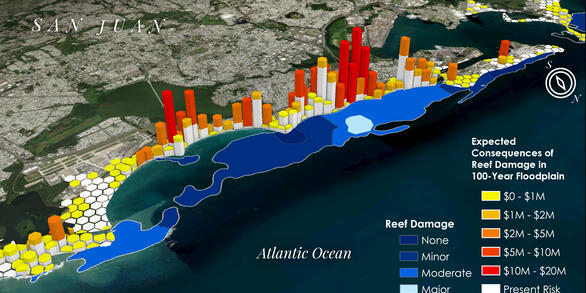
Coastal flooding affects low-lying communities worldwide and is expected to increase with climate change, especially along reef-lined coasts, where wave-driven flooding is particularly prevalent. However, current regional modeling approaches are either insufficient or too computationally expensive to accurately assess risks in these complex environments. This study introduces and...
Authors
Camila Gaido-Lassarre, Kees Nederhoff, Curt D. Storlazzi, Borja Reguero, Michael W. Beck
The value of marsh restoration for flood risk reduction in an urban estuary The value of marsh restoration for flood risk reduction in an urban estuary
The use of nature-based solutions (NBS) for coastal climate adaptation has broad and growing interest, but NBS are rarely assessed with the same rigor as traditional engineering solutions or with respect to future climate change scenarios. These gaps pose challenges for the use of NBS for climate adaptation. Here, we value the flood protection benefits of stakeholder-identified marsh...
Authors
Rae M. Taylor-Burns, Chris Lowrie, Babak Tehranirad, Jeremy Lowe, Li H. Erikson, Patrick L. Barnard, Borja G. Reguero, Michael W. Beck
Vulnerability to sea-level rise varies among estuaries and habitat types: Lessons learned from a network of surface elevation tables in Puget Sound Vulnerability to sea-level rise varies among estuaries and habitat types: Lessons learned from a network of surface elevation tables in Puget Sound
Estuarine systems that provide valuable ecosystem services to society and important foraging and rearing habitat for fish and wildlife species continue to undergo degradation. In Puget Sound, WA, as much as 70–80% of historic estuarine habitat has been lost to anthropogenic development, and continued losses are expected through the end of the twenty-first century due to rising sea levels...
Authors
Melanie J. Davis, Katrina L. Poppe, John M. Rybczyk, Eric E. Grossman, Isa Woo, Joshua W. Chamberlin, Michelle Totman, Todd Zackey, Frank Leonetti, Suzanne Shull, Susan E.W. De La Cruz
Database and time series of nearshore waves along the Alaskan coast from the United States-Canada border to the Bering Sea Database and time series of nearshore waves along the Alaskan coast from the United States-Canada border to the Bering Sea
Alaska’s Arctic coast has some of the highest coastal erosion rates in the world, primarily driven by permafrost thaw and increasing wave energy. In the Arctic, a warming climate is driving sea ice cover to decrease in space and time. A lack of long-term observational wave data along Alaska’s coast challenges the ability of engineers, scientists, and planners to study and address threats...
Authors
Anita C. Engelstad, Li H. Erikson, Borja G. Reguero, Ann E. Gibbs, Kees Nederhoff
Consumer isoscapes reveal heterogeneous food webs in deep-sea submarine canyons and adjacent slopes Consumer isoscapes reveal heterogeneous food webs in deep-sea submarine canyons and adjacent slopes
The deep sea is the largest biome on earth, but one of the least studied despite its critical role in global carbon cycling and climate buffering. Deep-sea organisms largely rely on particulate organic matter from the surface ocean for energy – these organisms in turn play critical roles in energy transport, transformation, storage, and sequestration of carbon. Within the deep sea...
Authors
Amanda Demopoulos, Brian J. Smith, Jill Bourque, Jason Chaytor, Jennifer McClain Counts, Nancy G. Prouty, Steve W. Ross, Sandra Brooke, Gerard Duineveld, Furu Mienis
A comprehensive assessment of submarine landslides and mass wasting processes offshore southern California A comprehensive assessment of submarine landslides and mass wasting processes offshore southern California
It is critical to characterize submarine landslide hazards near dense coastal populations, especially in areas with active faults, which can trigger slope failure, subsequent tsunamis, and damage seabed infrastructure during earthquake shaking. Offshore southern California, numerous marine geophysical surveys have been conducted over the past decade, and high-resolution bathymetric and...
Authors
M. Walton, James E. Conrad, Antoinette Gabrielle Papesh, Daniel S. Brothers, Jared W. Kluesner, Mary McGann, Peter Dartnell