



Publications
Scientific reports, journal articles, and information products produced by USGS Pacific Coastal and Marine Science Center scientists.
USGS Pubs Warehouse
USGS Pubs Warehouse

Browse the USGS Publications Warehouse to broaden your search with enhanced filtering.
Sound Waves Newsletter
Sound Waves Newsletter
Browse issues of the Sound Waves newsletter, featuring coastal and marine research news from across the USGS.
Filter Total Items: 1466
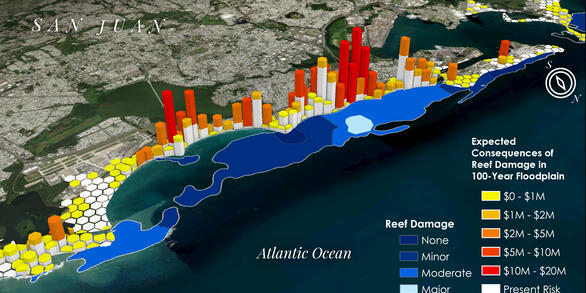
Assessing the effect of coral reef restoration location on coastal flood hazard along the San Juan Coastline, Puerto Rico Assessing the effect of coral reef restoration location on coastal flood hazard along the San Juan Coastline, Puerto Rico
Coastal resilience has become a pressing global issue due to the growing vulnerability of coastlines to the effects of climate change. Nature-based solutions have emerged as a promising approach to coastal protection to not only enhance coastal resilience, but also restore critical ecosystems. Coral reef restoration has the potential to provide ecosystem services benefits; however, there...
Authors
Ramin Familkhalili, Curt D. Storlazzi, Michael Nemeth, Shay Viehman
U.S. Geological Survey global seabed mineral resources U.S. Geological Survey global seabed mineral resources
The U.S. Geological Survey (USGS) provides science and data on seabed mineral resources and ecosystems, as well as on the potential hazards associated with extraction. The Nation relies on minerals for infrastructure, technology, manufacturing, and energy production. Critical minerals are essential to the economic and national security of the United States and have a supply chain...
Evaluating five shoreline change models against 40 years of field survey data at an embayed sandy beach Evaluating five shoreline change models against 40 years of field survey data at an embayed sandy beach
Robust and reliable models are needed to understand how coastlines will evolve over the coming decades, driven by both natural variability and climate change. This study evaluated how accurately five popular ‘reduced-complexity’ models replicate multi-decadal shoreline change at Narrabeen-Collaroy Beach, a sandy embayment in Sydney, Australia. Measured shoreline positions derived from
Authors
Oxana Repina, Rafael C. Carvalho, Giovanni Coco, Jose Antolínez, Iñaki de Santiago, Mitchell D. Harley, Camilo Jaramillo, Kristen D. Splinter, Sean Vitousek, Colin D. Woodroffe
Wave driven cross shore and alongshore transport reveal more extreme projections of shoreline change in island environments Wave driven cross shore and alongshore transport reveal more extreme projections of shoreline change in island environments
Coastal erosion, intensified by sea level rise, poses significant threats to coastal communities in Hawaiʻi and similar island communities. This study projects long-term shoreline change on the Hawaiian Island of O‘ahu using the data-assimilated CoSMoS-COAST shoreline change model. CoSMoS-COAST models four key shoreline processes: (1) Alongshore transport, (2) Recession due to sea level...
Authors
Richelle Moskvichev, Anna Mikkelsen, Tiffany Anderson, Sean Vitousek, Joel Nicolow, Charles Fletcher
Submarine canyon sediment transport and accumulation during sea level highstand: Interactive seasonal regimes in the head of Astoria Canyon, WA Submarine canyon sediment transport and accumulation during sea level highstand: Interactive seasonal regimes in the head of Astoria Canyon, WA
The majority of submarine canyons on Earth today do not directly intersect littoral or fluvial sediment sources, yet these systems are rarely studied. The shelf-incised head of Astoria Canyon receives sediment from the nearby Columbia River and is subject to energetic forcing from shelf and slope processes, making it an ideal site to evaluate the modern activity of canyons in high-stand...
Authors
E. Lahr, A. Ogston, Jenna C. Hill, H. Glover, Kurt J. Rosenberger
A 700-year rupture sequence of great eastern Aleutian earthquakes from tsunami modeling of stratigraphic records A 700-year rupture sequence of great eastern Aleutian earthquakes from tsunami modeling of stratigraphic records
Great Aleutian underthrusting earthquakes produced destructive tsunamis impacting Hawaiʻi in 1946 and 1957. Prior modeling of the 1957 tsunami deposit and runup records on eastern Aleutian and Hawaiian Islands jointly with tide-gauge observations across the Pacific Ocean constrained a rupture model with shallow slip up to 26 m along 600 km of the plate boundary. Here we implement this...
Authors
Yoshiki Yamazaki, Kwok Fai Cheung, Thorne Lay, SeanPaul La Selle, Robert C. Witter, Bruce E. Jaffe
Decadal-scale effects of a dam removal on channel geomorphology, sediment and large wood on the Elwha River, Washington, USA Decadal-scale effects of a dam removal on channel geomorphology, sediment and large wood on the Elwha River, Washington, USA
The removal of Glines Canyon Dam on the Elwha River in western Washington, USA, from 2011 to 2014 introduced a 20-Mt pulse of stored sediment and logs into the downstream channel. We used terrestrial laser scanning, high-resolution orthoimages, and surveys of large wood (LW) and sediment grain-size distribution to quantify changes to the channel and LW in four different geomorphic...
Authors
Lisa Ely, Alyssa DeMott, Bryon J. Free, Andrew C. Ritchie
Letter to Editor regarding “Potential impact of the 2023 Lahaina wildfire on the marine environment: Modeling the transport of ash-laden benzo[a]pyrene and pentachlorophenol” by Downs et al. (2024) https://doi.org/10.1016/j.scitotenv.2024.176346 Letter to Editor regarding “Potential impact of the 2023 Lahaina wildfire on the marine environment: Modeling the transport of ash-laden benzo[a]pyrene and pentachlorophenol” by Downs et al. (2024) https://doi.org/10.1016/j.scitotenv.2024.176346
No abstract available.
Authors
Curt D. Storlazzi, Renee K. Takesue, Alicia Hendrix
Did the Aleutian Basin form by plate capture or backarc basin opening? Did the Aleutian Basin form by plate capture or backarc basin opening?
The origin of the Aleutian Basin is unresolved because its crust is deeply buried beneath sediments. It has been interpreted as forming in the Eocene when the Beringian convergent margin jumped seaward to south of the Aleutian arc, thereby capturing a large sector of Cretaceous Pacific crust. Alternatively, it may have formed by backarc spreading. We present new magnetic and seismic...
Authors
Robert J. Stern, David W. Scholl, Matthew A. Malkowski, Kylara M. Martin, Ginger Barth, Daniel S. Scheirer
Developing a probabilistic tsunami hazard assessment framework for Pacific sources: USGS Powell Center meeting summary Developing a probabilistic tsunami hazard assessment framework for Pacific sources: USGS Powell Center meeting summary
Multi-organizational principal investigators formed a U.S. Geological Survey (USGS) Powell Center Working Group (WG), Tsunami Source Standardization for Hazards Mitigation in the United States, to develop a comprehensive series of sources capable of generating tsunamis that could impact U.S. state and territory coastal areas using probabilistic tsunami hazard analysis (PTHA). PTHA...
Authors
Jason R. Patton, Stephanie L Ross, Marie C. Eble, Christodoulos Kyriakopoulos, Patrick J. Lynett, DmitriyJ. Nicolsky, Kenneth Ryan, Hong Kie Thio, Rick I. Wilson, Baoning Wu
Characterizing sedimentary organic carbon in a hydrothermal spreading center, the Escanaba Trough Characterizing sedimentary organic carbon in a hydrothermal spreading center, the Escanaba Trough
Sediments in critical marine mineral environments are of wide importance due to their preservation of both marine minerals and organic carbon (OC) stocks. However, OC storage and cycling is often overlooked in mineral system studies. This work characterizes sedimentary OC within the Escanaba Trough, a hydrothermal sulfide system off the coast of northern California. By utilizing ROV...
Authors
Hope Lee Ianiri, Pamela L. Campbell‐Swarzenski, Amy Gartman, Nancy G. Prouty
Shoreline seasonality of California’s beaches Shoreline seasonality of California’s beaches
We report on remote sensing techniques developed to characterize seasonal shoreline cycles from satellite-derived shoreline measurements. These techniques are applied to 22-yr of shoreline measurements for over 777 km of beach along California's 1,700-km coast, for which the general understanding is that shorelines exhibit winter-narrow and summer-recovery seasonality. We find that...
Authors
Jonathan A. Warrick, Daniel D. Buscombe, Kilian Vos, Hannah Kenyon, Andrew C. Ritchie, Mitchell D. Harley, Catherine N. Janda, Jess L'Heureux, Sean Vitousek