Gigantic chunks of perafrost coastal bluffs tumbled down onto the beach along Barter Island on the North Slope of Alaska. A USGS scientist drives past them, seeking good locations to place instruments and markers that will be used in photographic analysis.
All Multimedia
Access all multimedia to include images, video, audio, webcams, before-after imagery, and more. Filter and explore with filtering options to refine search.
Gigantic chunks of perafrost coastal bluffs tumbled down onto the beach along Barter Island on the North Slope of Alaska. A USGS scientist drives past them, seeking good locations to place instruments and markers that will be used in photographic analysis.
Along the stretch of coastal bluffs of Barter Island, North Slope of Alaska, a new drainage gully developed between September 2018 and September 2019. USGS scientists have been measuring permafrost degradation, coastal erosion, and flooding hazards on and around Barter Island for the last decade.
A global positioning system (GPS) sits on a tripod and is used to accurately pinpoint the center of a target that itself is used for photo rectification with aerial photos.
USGS scientists measure biological soil crust cover in the study grassland.
Large blocks of failed coastal bluff on Barter Island
Large blocks of failed coastal bluff on Barter IslandLarge blocks of coastal bluff tumble down onto the beach of Barter Island, on the North Slope of Alaska.
Large blocks of failed coastal bluff on Barter Island
Large blocks of failed coastal bluff on Barter IslandLarge blocks of coastal bluff tumble down onto the beach of Barter Island, on the North Slope of Alaska.
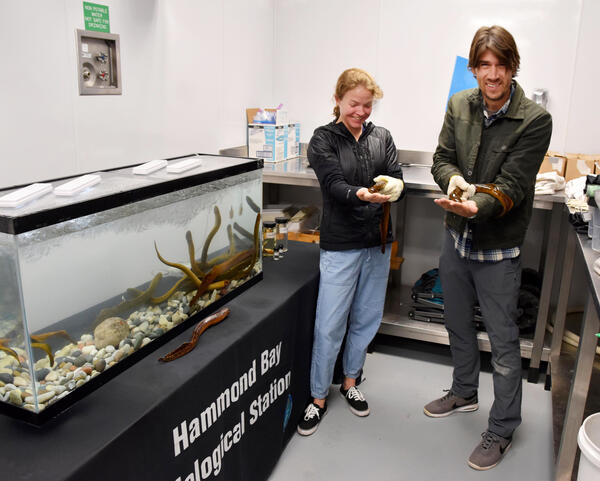
Live Sea Lamprey at the Hammond Bay Biological Station
Live Sea Lamprey at the Hammond Bay Biological StationNational Geographic photographer, Keith Ladzinski (right), and assistant, Angie Payne (left), hold live sea lamprey while visiting the GLSC’s Hammond Bay Biological Station during September 2019. An interview of Keith aired on Good Morning America on November 21, 2020, which included footage from their visit to the station. GLSC communications associate, Dr.
Live Sea Lamprey at the Hammond Bay Biological Station
Live Sea Lamprey at the Hammond Bay Biological StationNational Geographic photographer, Keith Ladzinski (right), and assistant, Angie Payne (left), hold live sea lamprey while visiting the GLSC’s Hammond Bay Biological Station during September 2019. An interview of Keith aired on Good Morning America on November 21, 2020, which included footage from their visit to the station. GLSC communications associate, Dr.
Example of a low-oblique photograph taken with an unmanned aerial system (UAS), or drone, of the coastal bluffs of Barter Island on North Slope of Alaska. The photographs from different time periods can be compared, using a technique called structure-from-motion photogrammetry, to measure changes in the coastal bluffs.
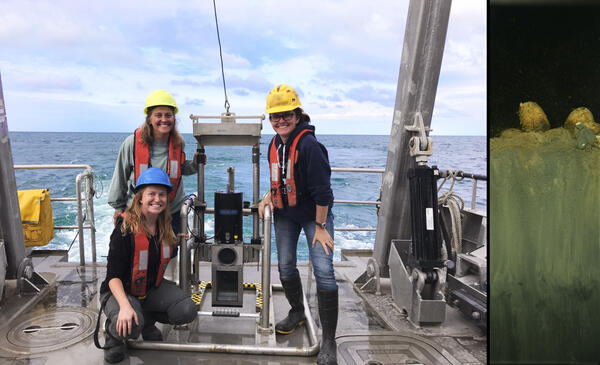
(Left) EPA and Kent State University scientists (left-to-right), Dr. Janet Nestlerode, Taylor Michael, and Dr. Elizabeth Hinchey, on the R/V Muskie with the SPI cam. (Right) High-resolution image of a cross-section of the sediment including the sediment water interface to ~25 cm below surface from a site in the central basin of Lake Erie.
Example of a high-oblique photograph taken with an unmanned aerial system (UAS), or drone, of the coastal bluffs of Barter Island on North Slope of Alaska. The photographs from different time periods can be compared, using a technique called structure-from-motion photogrammetry, to measure changes in the coastal bluffs.
Cordell Johnson holds his hand next to a polar bear's footprint.
USGS scientist Chelsea Stalk stands on a floating sled that enables sub‐bottom surveying in shallow water, nearshore, and shore‐face environments. The sled is equipped with an EdgeTech SB‐512i CHIRP system and single‐beam sonar. This equipment is used to collect seismic sub‐bottom profiles and single‐beam bathymetry.
Example of a thermal photograph of Barter Island's bluffs, on the North Slope of Alaska. Two USGS scientists stand waving on the right side of the photo. Lighter areas are warmer, darker areas are colder. Thermal photography makes it easy to detect areas of permafrost, or the lack thereof.
An remotely piloted aircraft (RPA) or drone, equipped with a camera, sits on the Arctic tundra awaiting a radio signal that tells it to fly.
Using unique methods to measure nearshore and coastal geology
Using unique methods to measure nearshore and coastal geologyUSGS scientists use specialized equipment to measure sediment dynamics in nearshore and coastal systems. Access by boat is limited in these areas, so personal watercraft are equipped with GPS and echosounders to collect bathymetric data. Seismic sleds are pulled along transects from the beach across the water to measure changes in sediment type below the water.
Using unique methods to measure nearshore and coastal geology
Using unique methods to measure nearshore and coastal geologyUSGS scientists use specialized equipment to measure sediment dynamics in nearshore and coastal systems. Access by boat is limited in these areas, so personal watercraft are equipped with GPS and echosounders to collect bathymetric data. Seismic sleds are pulled along transects from the beach across the water to measure changes in sediment type below the water.
Setting sail from Woods Hole, MA to Cape Cod Bay aboard the R/V Warren Jr. USGS scientific staff will define the geologic framework of Cape Cod Bay to aid the state of Massachusetts in management and assessment of resources and hazards.
Horiba Aqaulog - simultaneously measures absorbance spectra and fluorescence Excitation-Emission Matrices
Powell150 1869-2019: John Wesley Powell's Legacy of USGS Exploration
Powell150 1869-2019: John Wesley Powell's Legacy of USGS ExplorationIn 2019, the USGS Youth & Education in Science (YES) team marked the 150th anniversary of the first John Wesley Powell expedition down ~1000 miles of the Green & Colorado rivers with a national-scale educational project known as "Powell150." Educational resources about the science along the rivers and a social media campaign around the theme of exploration w
Powell150 1869-2019: John Wesley Powell's Legacy of USGS Exploration
Powell150 1869-2019: John Wesley Powell's Legacy of USGS ExplorationIn 2019, the USGS Youth & Education in Science (YES) team marked the 150th anniversary of the first John Wesley Powell expedition down ~1000 miles of the Green & Colorado rivers with a national-scale educational project known as "Powell150." Educational resources about the science along the rivers and a social media campaign around the theme of exploration w
Research Physical Scientist Dean Gesch shares an overview of USGS/EROS surveying efforts in the mangrove forests of Pohnpei.
Video close-up of the fumaroles on the north side of Halema‘uma‘u
Video close-up of the fumaroles on the north side of Halema‘uma‘uThis sequence captured on August 31 begins with a close-up of the fumaroles on the north side of Halema‘uma‘u, then shows a broader view of the crater with the water pond at the bottom and a close-up of steaming and ripples on the water surface. USGS video by M. Patrick, 08-31-2019.
Video close-up of the fumaroles on the north side of Halema‘uma‘u
Video close-up of the fumaroles on the north side of Halema‘uma‘uThis sequence captured on August 31 begins with a close-up of the fumaroles on the north side of Halema‘uma‘u, then shows a broader view of the crater with the water pond at the bottom and a close-up of steaming and ripples on the water surface. USGS video by M. Patrick, 08-31-2019.
USGS wildlife biologist piloting an UAS for use in walrus survey
USGS wildlife biologist piloting an UAS for use in walrus surveyUSGS wildlife biologist, Anthony Fischbach, piloting an unmanned aerial system (UAS) for use in surveying walruses while they rest on shore. The UAS is flown above 300 feet altitude such that it enables survey data collection with minimal risk to the walruses.
USGS wildlife biologist piloting an UAS for use in walrus survey
USGS wildlife biologist piloting an UAS for use in walrus surveyUSGS wildlife biologist, Anthony Fischbach, piloting an unmanned aerial system (UAS) for use in surveying walruses while they rest on shore. The UAS is flown above 300 feet altitude such that it enables survey data collection with minimal risk to the walruses.
This timelapse video covers about 30 minutes of activity at the water pond in Halema‘uma‘u at the summit of Kīlauea. Water appears to be flowing into the pond from several locations, including the southern boundary (right side in this image). A small amount of material is also seen floating on the surface at the eastern end of the pond (top of image).