



A USGS field crew captures fish during a boat electrofishing survey
All Multimedia
Access all multimedia to include images, video, audio, webcams, before-after imagery, and more. Filter and explore with filtering options to refine search.
Filter Total Items: 24981

Electrofishing on Eighteenmile Creek, NY
A USGS field crew captures fish during a boat electrofishing survey

Impounded water above beaver dam on the Wrench Creek
Impounded water above beaver dam on the Wrench CreekImpounded water above beaver dam on the Wrench Creek, Noatak National Preserve
Impounded water above beaver dam on the Wrench Creek
Impounded water above beaver dam on the Wrench CreekImpounded water above beaver dam on the Wrench Creek, Noatak National Preserve

Introduction to the Slope-Conveyance Method
This video provides an introduction to the slope-conveyance method of indirect measurement. Theory and background are described as well as high-water mark and cross-section placement.
This video provides an introduction to the slope-conveyance method of indirect measurement. Theory and background are described as well as high-water mark and cross-section placement.

CMHRP investigations help protect natural and cultural resources
CMHRP investigations help protect natural and cultural resourcesThe CMHRP has been conducting scientific investigations at Fire Island in order to protect natural and cultural resources.
CMHRP investigations help protect natural and cultural resources
CMHRP investigations help protect natural and cultural resourcesThe CMHRP has been conducting scientific investigations at Fire Island in order to protect natural and cultural resources.

GCMRC sediment monitoring application landing page
GCMRC sediment monitoring application landing pageImage screen shot of GCMRC sediment monitoring application
GCMRC sediment monitoring application landing page
GCMRC sediment monitoring application landing pageImage screen shot of GCMRC sediment monitoring application

Littlefield Creek middle study site
Littlefield Creek middle study site

PCMSC research vessel Parke Snavely departs for deployment
PCMSC research vessel Parke Snavely departs for deploymentThe PCMSC research vessel R/V Parke Snavely heads out of the Vallejo Marina on June 11, 2019 to deploy instrument frames in Grizzly Bay for the ERO19 study.
PCMSC research vessel Parke Snavely departs for deployment
PCMSC research vessel Parke Snavely departs for deploymentThe PCMSC research vessel R/V Parke Snavely heads out of the Vallejo Marina on June 11, 2019 to deploy instrument frames in Grizzly Bay for the ERO19 study.

Photos before and after Hurricane Sandy opened a breach on Fire Island
Photos before and after Hurricane Sandy opened a breach on Fire IslandUSGS researchers have been monitoring changes in a breach in the island that occurred during Hurricane Sandy (modified from Hapke et al., 2017).
Photos before and after Hurricane Sandy opened a breach on Fire Island
Photos before and after Hurricane Sandy opened a breach on Fire IslandUSGS researchers have been monitoring changes in a breach in the island that occurred during Hurricane Sandy (modified from Hapke et al., 2017).

Tribal Resources for Climate Change Vulnerability Assessments
Tribal Resources for Climate Change Vulnerability AssessmentsTribes have been actively engaged in efforts to anticipate and respond to climate impacts on their natural and cultural resources.
Tribal Resources for Climate Change Vulnerability Assessments
Tribal Resources for Climate Change Vulnerability AssessmentsTribes have been actively engaged in efforts to anticipate and respond to climate impacts on their natural and cultural resources.

A tent is pitched on a ledge overlooking the Green River.
A tent is pitched on a ledge overlooking the Green River.This was our final campsite before we left the river, approximately 9 miles upstream of Sand Wash. The scenery was beginning to transition from the flat and expansive Uinta basin to the high canyon walls that were upcoming in Desolation-Gray.
A tent is pitched on a ledge overlooking the Green River.
A tent is pitched on a ledge overlooking the Green River.This was our final campsite before we left the river, approximately 9 miles upstream of Sand Wash. The scenery was beginning to transition from the flat and expansive Uinta basin to the high canyon walls that were upcoming in Desolation-Gray.

Fernhill Sample Site 18
View of lake at Fernhill Natural Treatment Wetlands.
View of lake at Fernhill Natural Treatment Wetlands.

Six rafts are parked by the river's edge, getting loaded down with sup
Six rafts are parked by the river's edge, getting loaded down with supWe camped on a 20-30 ft. tall hill our last night, so shuttling kitchen gear up and down from the rafts was no easy task.
Six rafts are parked by the river's edge, getting loaded down with sup
Six rafts are parked by the river's edge, getting loaded down with supWe camped on a 20-30 ft. tall hill our last night, so shuttling kitchen gear up and down from the rafts was no easy task.

Sunrise in canyon country from our last campsite
Early morning panorama of cliffs that signal the start of Desolation Canyon. This was our last, and probably most spectacular, campsite of this section of Uinta Basin. It was approximately 9 miles from our take-out at Sand Wash.
Early morning panorama of cliffs that signal the start of Desolation Canyon. This was our last, and probably most spectacular, campsite of this section of Uinta Basin. It was approximately 9 miles from our take-out at Sand Wash.
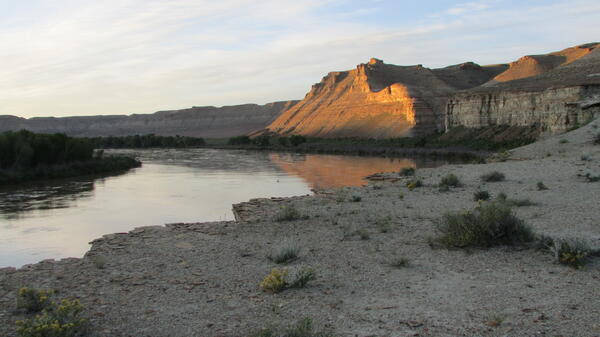
Sunrise lights the bluffs as this expedition leg nears its end.
Sunrise lights the bluffs as this expedition leg nears its end.On our last day of the expedition the landscape was dominated by the Green River Formation, famous for its fish fossils (although none were found in camp).
Sunrise lights the bluffs as this expedition leg nears its end.
Sunrise lights the bluffs as this expedition leg nears its end.On our last day of the expedition the landscape was dominated by the Green River Formation, famous for its fish fossils (although none were found in camp).

The last sunrise from my tent illuminates the nearby cliffs
The last sunrise from my tent illuminates the nearby cliffsThe final morning view from my text as the sun rose from the east and illuminated cliffs on the west. This trip was so wonderful and exceeded all of our expectations, it was hard to go back to reality.
The last sunrise from my tent illuminates the nearby cliffs
The last sunrise from my tent illuminates the nearby cliffsThe final morning view from my text as the sun rose from the east and illuminated cliffs on the west. This trip was so wonderful and exceeded all of our expectations, it was hard to go back to reality.

Tripod preparation for ERO19
Lukas Winkler-Prins checks on the frame setup on June 10, 2019. This tripod has an RBR CTD, an RBR bursting pressure sensor, an RBR optical backscatter sensor, a LISST-200X, an altimeter, and two Nortek ADVs + Seapoint optical backscatter sensors, which will reveal information about water temperature and salinity, wave height and period, total s
Lukas Winkler-Prins checks on the frame setup on June 10, 2019. This tripod has an RBR CTD, an RBR bursting pressure sensor, an RBR optical backscatter sensor, a LISST-200X, an altimeter, and two Nortek ADVs + Seapoint optical backscatter sensors, which will reveal information about water temperature and salinity, wave height and period, total s

USGS Cascades Volcano Observatory staff, June 2019
USGS Cascades Volcano Observatory staff, June 2019USGS Cascades Volcano Observatory staff, June 2019
USGS Cascades Volcano Observatory staff, June 2019
USGS Cascades Volcano Observatory staff, June 2019USGS Cascades Volcano Observatory staff, June 2019

USGS scientist rowing a raft on the Green River.
Although we were all hoping it would never end, the final day on the river was a bittersweet reminder of the amazing experiences we had in the Uinta Basin.
Although we were all hoping it would never end, the final day on the river was a bittersweet reminder of the amazing experiences we had in the Uinta Basin.

USGS scientist sitting on a raft on the Green River
USGS scientist sitting on a raft on the Green RiverNicholas Hammond is soaking up the views on his last day on the river. Photograph taken by Ben Capelin (SCREE).
USGS scientist sitting on a raft on the Green River
USGS scientist sitting on a raft on the Green RiverNicholas Hammond is soaking up the views on his last day on the river. Photograph taken by Ben Capelin (SCREE).

Water ponds in Halema‘uma‘u now joined
During field observations on August 8, HVO scientists noted that all three ponds are now joined, indicating that the water at the bottom of Halema‘uma‘u continues to slowly rise. Rangefinder measurements also suggested continued pond deepening.
During field observations on August 8, HVO scientists noted that all three ponds are now joined, indicating that the water at the bottom of Halema‘uma‘u continues to slowly rise. Rangefinder measurements also suggested continued pond deepening.

A properly rigged cataraft on the banks of the Green River
A properly rigged cataraft on the banks of the Green RiverA properly rigged cataraft on the banks of the Green River in the Uintah Basin
A properly rigged cataraft on the banks of the Green River
A properly rigged cataraft on the banks of the Green RiverA properly rigged cataraft on the banks of the Green River in the Uintah Basin