



The world's largest continuous hops-growing region by area is Hallertau, just north of Munich. More than 80 percent of Germany's hops come from this 42,000-acre stretch of fertile loess soil.
Images
Explore our planet through photography and imagery, including climate change and water all the way back to the 1800s when the USGS was surveying the country by horse and buggy.
Filter Total Items: 21345

A World of Hops
The world's largest continuous hops-growing region by area is Hallertau, just north of Munich. More than 80 percent of Germany's hops come from this 42,000-acre stretch of fertile loess soil.

Underwater image of fish captured by a fyke net
An underwater image of fish captured by a fyke net near Kaktovik, Alaska, Beaufort Sea, USA. The small silver fish with dark backs are young-of-year (age-0) Arctic cisco (Coregonus autumnalis) and the flatfish are Arctic flounder (Liopsetta glacialis).
An underwater image of fish captured by a fyke net near Kaktovik, Alaska, Beaufort Sea, USA. The small silver fish with dark backs are young-of-year (age-0) Arctic cisco (Coregonus autumnalis) and the flatfish are Arctic flounder (Liopsetta glacialis).

USGS, Las Cruces Field Office
U.S. Geological Survey, New Mexico Water Science Center - Las Cruces Field Office location
U.S. Geological Survey, New Mexico Water Science Center - Las Cruces Field Office location

Continuous water-quality monitor
Photograph showing a continuous water-quality monitor at the Salmon River near East Hampton, Connecticut.
Photograph showing a continuous water-quality monitor at the Salmon River near East Hampton, Connecticut.

What was happening at Kīlauea ten years ago?
This perched lava channel, which was as much as 150 feet (45 meters) above the ground, carried lava downslope from the Pu‘u ‘Ō‘ō Fissure D vent during episode 58 of Kīlauea Volcano's ongoing East Rift Zone eruption. The channel was the main path for lava between July and November 2007. Episode 58 continued until early March 2011.
This perched lava channel, which was as much as 150 feet (45 meters) above the ground, carried lava downslope from the Pu‘u ‘Ō‘ō Fissure D vent during episode 58 of Kīlauea Volcano's ongoing East Rift Zone eruption. The channel was the main path for lava between July and November 2007. Episode 58 continued until early March 2011.

Charcoal collected from under the base of a pāhoehoe flow, Hawaii
Charcoal collected from under the base of a pāhoehoe flow, HawaiiCharcoal collected from under the base of a pāhoehoe flow in a black sooty zone over orange ash. The black sooty zone represents the region where the vegetation was converted to charcoal. The hammer is approximately 13 inches long. USGS photo by F. Trusdell.
Charcoal collected from under the base of a pāhoehoe flow, Hawaii
Charcoal collected from under the base of a pāhoehoe flow, HawaiiCharcoal collected from under the base of a pāhoehoe flow in a black sooty zone over orange ash. The black sooty zone represents the region where the vegetation was converted to charcoal. The hammer is approximately 13 inches long. USGS photo by F. Trusdell.

Cyanobacteria - Scytonema (blue green algae)
Microscopic view of blue green algae sample. Some algae produce toxins that threaten the health and safety of living things that come in direct contact. Cyanobacteria - Scytonema (blue green algae)
Microscopic view of blue green algae sample. Some algae produce toxins that threaten the health and safety of living things that come in direct contact. Cyanobacteria - Scytonema (blue green algae)

GeoGirls_Sediment1
GeoGirls collect water samples and flow measurements to model the transport of volcanic sediments.
GeoGirls collect water samples and flow measurements to model the transport of volcanic sediments.
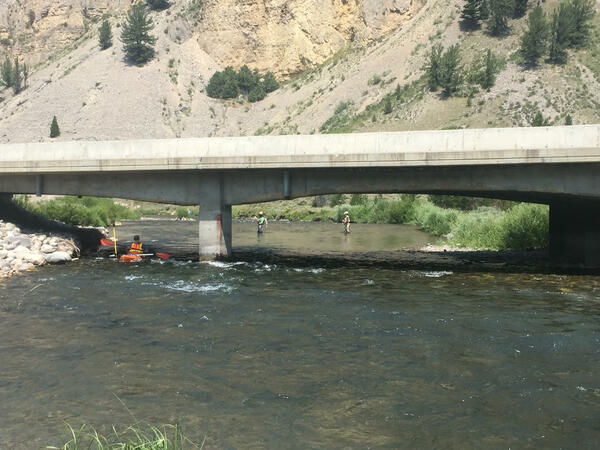
Measuring cross-sectional depth and water surface of Gallatin River
Measuring cross-sectional depth and water surface of Gallatin RiverUsing kayak to measure cross-sectional depth and water surface of Gallatin River
Measuring cross-sectional depth and water surface of Gallatin River
Measuring cross-sectional depth and water surface of Gallatin RiverUsing kayak to measure cross-sectional depth and water surface of Gallatin River

A glimpse of the microbial world's hidden beauty
To collect, identify and document these single-celled algae called desmids, USGS biologist Barry H. Rosen has traveled by airboat into the interior of Florida’s Loxahatchee National Wildlife Refuge, where decaying marsh grasses created a mosaic of peat soils and the soft, slightly acidic water where desmids grow.
To collect, identify and document these single-celled algae called desmids, USGS biologist Barry H. Rosen has traveled by airboat into the interior of Florida’s Loxahatchee National Wildlife Refuge, where decaying marsh grasses created a mosaic of peat soils and the soft, slightly acidic water where desmids grow.

A natural marvel in a single cell
This single-celled freshwater algae wasa collected as part of the first-ever study of the green algae family called desmids in Florida’s Loxahatchee National Wildlife Refuge, in the northern Everglades. USGS biologist Barry H.
This single-celled freshwater algae wasa collected as part of the first-ever study of the green algae family called desmids in Florida’s Loxahatchee National Wildlife Refuge, in the northern Everglades. USGS biologist Barry H.

Akilik River stream sampling
Hiking up a stream from the Akilik River drainage to set minnow traps for fish sampling. This is a stream type at the Boreal-Arctic transition of the Brooks Range, Noatak National Park and Preserve, Kobuk Valley National Park.
Hiking up a stream from the Akilik River drainage to set minnow traps for fish sampling. This is a stream type at the Boreal-Arctic transition of the Brooks Range, Noatak National Park and Preserve, Kobuk Valley National Park.

Beaufort Sea coastline on Arey Island with eroding cliff near Kaktovik
Beaufort Sea coastline on Arey Island with eroding cliff near KaktovikEroding coastline of the Beaufort Sea on Arey Island near Kaktovik.
Beaufort Sea coastline on Arey Island with eroding cliff near Kaktovik
Beaufort Sea coastline on Arey Island with eroding cliff near KaktovikEroding coastline of the Beaufort Sea on Arey Island near Kaktovik.

Beaufort Sea coastline on Arey Island with flock of birds
Beaufort Sea coastline on Arey Island with flock of birdsFlock of birds over Arey Island near Kaktovik on the coastline of the Beaufort Sea.
Beaufort Sea coastline on Arey Island with flock of birds
Beaufort Sea coastline on Arey Island with flock of birdsFlock of birds over Arey Island near Kaktovik on the coastline of the Beaufort Sea.

Fourhorn sculpin captured near Kaktovik, Alaska
Fourhorn sculpin (Myoxocephalus quadricornis) captured near Kaktovik, Alaska
Fourhorn sculpin (Myoxocephalus quadricornis) captured near Kaktovik, Alaska

Fyke net set in Kaktovik Lagoon with Kaktovik, AK in the background
Fyke net set in Kaktovik Lagoon with Kaktovik, AK in the backgroundFyke net set in Kaktovik Lagoon with the town of Kaktovik, Alaska in the background
Fyke net set in Kaktovik Lagoon with Kaktovik, AK in the background
Fyke net set in Kaktovik Lagoon with Kaktovik, AK in the backgroundFyke net set in Kaktovik Lagoon with the town of Kaktovik, Alaska in the background

Iiwi banding 2
Measuring the wing length of a banded Iiwi
Measuring the wing length of a banded Iiwi

Iiwi with transmitter
Iiwi with small radio transmitter attached to help track the bird's movement through the forest
Iiwi with small radio transmitter attached to help track the bird's movement through the forest

Sampling a stream from the Akilik River drainage
Sampling a stream from the Akilik River drainage in the Boreal-Arctic transition of the Brooks Range in Noatak National Park and Preserve, Kobuk Valley National Park. This is part of the Hydro-Ecoloy of Arctic Thawing (HEAT) project.
Sampling a stream from the Akilik River drainage in the Boreal-Arctic transition of the Brooks Range in Noatak National Park and Preserve, Kobuk Valley National Park. This is part of the Hydro-Ecoloy of Arctic Thawing (HEAT) project.

Sampling the Imelyak River in the Brooks Range
Sampling the Imelyak River in the Boreal-Arctic transition of the Brooks Range in Noatak National Park and Preserve, Kobuk Valley National Park. This is part of the Hydro-Ecology of Arctic Thawing (HEAT) project.
Sampling the Imelyak River in the Boreal-Arctic transition of the Brooks Range in Noatak National Park and Preserve, Kobuk Valley National Park. This is part of the Hydro-Ecology of Arctic Thawing (HEAT) project.

Shocking Fish at McDonald's Branch
USGS Scientists, Jonathan Kennen, Molly Schreiner, and John Cohl, shocking and collecting fish in the McDonald's Branch in Byrne State Forrest for NAWQA studies.
USGS Scientists, Jonathan Kennen, Molly Schreiner, and John Cohl, shocking and collecting fish in the McDonald's Branch in Byrne State Forrest for NAWQA studies.