U.S. flag

An official website of the United States government

Images

Volcano Hazard Program images.

Filter Total Items: 6294
An even larger crack, shown here, arcs across the parking lot and b...
lava fountain with lava flow
Kīlauea Volcano — Lava Fountain and Flow (Fissure 8)

View of the fissure 8 lava fountain and lava channel that travels to the ocean, a distance of about 12.5 km (7.8 mi). Photo taken during this morning's overflight at about 6:30 a.m. HST.

Large rocks on the roadway
Kīlauea Volcano — Ballistic Blocks

With careful consideration and planning to avoid ongoing volcanic hazards as much as possible, an HVO scientist who has been studying the behavior of Kīlauea's summit for decades, briefly visited the parking area for the former Halema‘uma‘u overlook (closed since 2008) on June 5 to make direct observations of and gather data from the effects of recent explosions wit

With careful consideration and planning to avoid ongoing volcanic hazards as much as possible, an HVO scientist who has been studying the behavior of Kīlauea's summit for decades, briefly visited the parking area for the former Halema‘uma‘u overlook (closed since 2008) on June 5 to make direct observations of and gather data from the effects of recent explosions wit

crack in parking lot
Kīlauea Volcano — Crack in Parking Lot

The median between two areas of the parking lot has been warped and broken by cracks. Ash accumulation in the parking area was generally not more than 4 cm (1.5 in) thick.

The median between two areas of the parking lot has been warped and broken by cracks. Ash accumulation in the parking area was generally not more than 4 cm (1.5 in) thick.

Crack in road
Kīlauea Volcano — Halema`uma`u Parking Lot

The Halema‘uma‘u parking lot is sliced into blocks by cracks. These cracks, first noted in a very early stage on May 13, now are the dominant features of the parking lot. The cracks, which are circumferential to Halema‘uma‘u, warp and offset the pavement and curbing, as seen here. The crack responsible for warping this curbstone is visible on both sides of it.

The Halema‘uma‘u parking lot is sliced into blocks by cracks. These cracks, first noted in a very early stage on May 13, now are the dominant features of the parking lot. The cracks, which are circumferential to Halema‘uma‘u, warp and offset the pavement and curbing, as seen here. The crack responsible for warping this curbstone is visible on both sides of it.

Large rocks on the parking lot
Kīlauea Volcano — Large Rocks on Parking Lot

Many large blocks appeared to be in depressions in the ash, but upon closer examination, it was concluded that wind had winnowed ash from around the blocks, creating a false impression that the depressions were made by impact.

Many large blocks appeared to be in depressions in the ash, but upon closer examination, it was concluded that wind had winnowed ash from around the blocks, creating a false impression that the depressions were made by impact.

animated gif of crater
Kīlauea Volcano — Satellite Radar of Crater Slumping

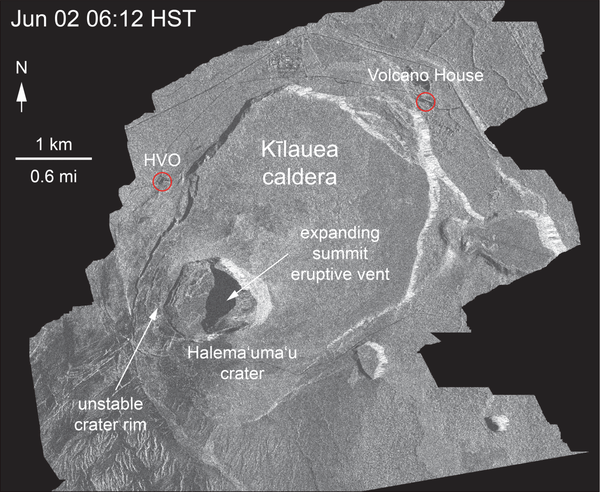
This animated GIF shows a sequence of radar amplitude images that were acquired by the Italian Space Agency's Cosmo-SkyMed satellite system. The images illustrate changes to the caldera area of Kīlauea Volcano that occurred between May 5 and June 6 at 6:00 a.m. HST.

This animated GIF shows a sequence of radar amplitude images that were acquired by the Italian Space Agency's Cosmo-SkyMed satellite system. The images illustrate changes to the caldera area of Kīlauea Volcano that occurred between May 5 and June 6 at 6:00 a.m. HST.

Kīlauea lower East Rift Zone lava flows and fissures, June 6, 12:00...
Kīlauea LERZ lava flows and fissures, June 6, 12:00 p.m.

Map as of 12:00 p.m. (noon) HST, June 6, 2018. Given the dynamic nature of Kīlauea's lower East Rift Zone eruption, with changing vent locations, fissures starting and stopping, and varying rates of lava effusion, map details shown here are accurate as of the date/time noted. Shaded purple areas indicate lava flows erupted in 1840, 1955, 1960, and 2014-2015.

Map as of 12:00 p.m. (noon) HST, June 6, 2018. Given the dynamic nature of Kīlauea's lower East Rift Zone eruption, with changing vent locations, fissures starting and stopping, and varying rates of lava effusion, map details shown here are accurate as of the date/time noted. Shaded purple areas indicate lava flows erupted in 1840, 1955, 1960, and 2014-2015.

Satellite images of Kilauea
Kīlauea Volcano — Satellite Imagery Fissure 8

The International Charter for Space and Major Disasters (https://disasterscharter.org/) is a means for space agencies around the world to help with disaster monitoring by providing satellite data to responders and scientists on the ground.

The International Charter for Space and Major Disasters (https://disasterscharter.org/) is a means for space agencies around the world to help with disaster monitoring by providing satellite data to responders and scientists on the ground.

Aerial of lower east rift zone
Kīlauea Volcano — Lower East Rift Zone

This view, looking south at Kīlauea's lower East Rift Zone, was captured during HVO's 6:00 a.m. HST helicopter overflight today.

Robust fissure 8 lava channels and ocean entry plume ...
Robust fissure 8 lava channels and ocean entry plume

This view, looking south at Kīlauea's lower East Rift Zone, was captured during HVO's 6:00 a.m. HST helicopter overflight today. It shows continued fountaining of fissure 8 and the lava flow channel fed by it. Lava continues to flow quickly in these braided channels; the flow margins are currently stable and have not experienced any breakouts since June 5.

This view, looking south at Kīlauea's lower East Rift Zone, was captured during HVO's 6:00 a.m. HST helicopter overflight today. It shows continued fountaining of fissure 8 and the lava flow channel fed by it. Lava continues to flow quickly in these braided channels; the flow margins are currently stable and have not experienced any breakouts since June 5.

Thermal map of fissure system and lava flows...
Thermal map of fissure system and lava flows

This thermal map shows the fissure system and lava flows as of 12:30 pm on Wednesday, June 6. The flow from Fissure 8 remains active, with the flow front entering the ocean at Kapoho. The black and white area is the extent of the thermal map.

This thermal map shows the fissure system and lava flows as of 12:30 pm on Wednesday, June 6. The flow from Fissure 8 remains active, with the flow front entering the ocean at Kapoho. The black and white area is the extent of the thermal map.

Fish eye lens view of Kapoho Bay
Kīlauea Volcano — Lava Delta at Kapoho Bay

This fish-eye view of the lava delta filling the former Kapoho Bay shows that while the delta margin nearest the ocean has cooled somewhat, the lava flow front is still very hot and producing laze (lava haze). Laze is a local hazard composed of acidic gases and volcanic glass fragments and should be avoided.

This fish-eye view of the lava delta filling the former Kapoho Bay shows that while the delta margin nearest the ocean has cooled somewhat, the lava flow front is still very hot and producing laze (lava haze). Laze is a local hazard composed of acidic gases and volcanic glass fragments and should be avoided.

Laze plume from former Kapoho Bay
Kīlauea Volcano — Laze Plume in Former Kapoho Bay

A robust laze (lava haze) plume rises from the northern side of the fissure 8 lava flow margins in the former Kapoho Bay.

aerial showing lava filled in Kapoho Bay
Kīlauea Volcano — Kapoho Beach Lots

Views from HVO's helicopter overflight at 1PM HST, show the remains of the Kapoho Beach Lots subdivision and the fissure 8 flow front. The northern flow margin in this area was unchanged from HVO's morning flight and appeared to have stopped advancing at the time of the flight.

Views from HVO's helicopter overflight at 1PM HST, show the remains of the Kapoho Beach Lots subdivision and the fissure 8 flow front. The northern flow margin in this area was unchanged from HVO's morning flight and appeared to have stopped advancing at the time of the flight.

Kīlauea Volcano — Lava Fountaining (Fissure 8)

The vigorous lava fountain at Fissure 8 reached heights of 45 m (150 ft) as shown in this image taken around 9:30 AM.

Plume from crater
Kīlauea Volcano — Halema`uma`u Explosion (June 6)

On June 6, at 4:07 p.m. HST, an explosion within Halema‘uma‘u sent an ash and gas plume to a height of about 10,000 feet above sea level.

Kīlauea lower East Rift Zone lava flows and fissures, June 5, 10:00...
Kīlauea LERZ lava flows and fissures, June 5, 10:00 a.m.

Map as of 10:00 a.m. HST, June 5, 2018. Given the dynamic nature of Kīlauea's lower East Rift Zone eruption, with changing vent locations, fissures starting and stopping, and varying rates of lava effusion, map details shown here are accurate as of the date/time noted. Shaded purple areas indicate lava flows erupted in 1840, 1955, 1960, and 2014-2015.

Map as of 10:00 a.m. HST, June 5, 2018. Given the dynamic nature of Kīlauea's lower East Rift Zone eruption, with changing vent locations, fissures starting and stopping, and varying rates of lava effusion, map details shown here are accurate as of the date/time noted. Shaded purple areas indicate lava flows erupted in 1840, 1955, 1960, and 2014-2015.

Morning view of Halema'uma'u crater on June 5...
Morning view of Halema'uma'u crater on June 6

Morning view of Halema'uma'u and the Kīlauea Caldera from the Kīlauea overlook. Heavy steam dominates the view, and strong winds are blowing the plume to the southwest.

Morning view of Halema'uma'u and the Kīlauea Caldera from the Kīlauea overlook. Heavy steam dominates the view, and strong winds are blowing the plume to the southwest.

Aerial view into Halema‘uma‘u. Explosions and collapse have enlarge...

HVO scientists captured this aerial view of a much-changed Halema‘uma‘u during their overflight of the summit on June 5, 2018. Explosions and collapse within Halema‘uma‘u have enlarged the crater (foreground) that previously hosted the summit lava lake, and the far rim of Halema‘uma‘u has dropped with continued summit deflation.

HVO scientists captured this aerial view of a much-changed Halema‘uma‘u during their overflight of the summit on June 5, 2018. Explosions and collapse within Halema‘uma‘u have enlarged the crater (foreground) that previously hosted the summit lava lake, and the far rim of Halema‘uma‘u has dropped with continued summit deflation.

plume rising from the crater
Kīlauea Volcano — Halema‘uma‘u Crater

Morning view of Halema'uma'u and the Kīlauea Caldera from the Kīlauea overlook. Heavy steam dominates the view, and strong winds are blowing the plume to the southwest.

Morning view of Halema'uma'u and the Kīlauea Caldera from the Kīlauea overlook. Heavy steam dominates the view, and strong winds are blowing the plume to the southwest.

Was this page helpful?