



This thermal map shows the fissure system and lava flows as of 12:30 pm on Monday, June 4 The flow from Fissure 8 remains active, with the flow front entering the ocean in Kapoho Bay over the past day. The black and white area is the extent of the thermal map.
Images
Volcano Hazard Program images.
Filter Total Items: 6279

Thermal map of fissure system and lava flows
This thermal map shows the fissure system and lava flows as of 12:30 pm on Monday, June 4 The flow from Fissure 8 remains active, with the flow front entering the ocean in Kapoho Bay over the past day. The black and white area is the extent of the thermal map.

Kīlauea Volcano — Kapoho Bay Ocean Entry
Video from helicopter overflight of Kīlauea Volcano's lower East Rift Zone on June 4, 2018, shows lava from fissure 8 entering the ocean at Kapoho Bay. View to the north.
Video from helicopter overflight of Kīlauea Volcano's lower East Rift Zone on June 4, 2018, shows lava from fissure 8 entering the ocean at Kapoho Bay. View to the north.

Thermal map of fissure system and lava flows
This thermal map shows the fissure system and lava flows as of 12:30 pm on Sunday, June 3. The flow from Fissure 8 continues to advance and had a wide flow front advancing towards the ocean in Kapoho. The black and white area is the extent of the thermal map.
This thermal map shows the fissure system and lava flows as of 12:30 pm on Sunday, June 3. The flow from Fissure 8 continues to advance and had a wide flow front advancing towards the ocean in Kapoho. The black and white area is the extent of the thermal map.

Thirty Days of Activity at Kīlauea Volcano
Learn more at https://volcanoes.usgs.gov/volcanoes/kilauea/status.html

Steamboat Geyser in the water-phase of an eruption, Jun 4, 2019
Steamboat Geyser in the water-phase of an eruption, Jun 4, 2019Steamboat Geyser in the water-phase of an eruption on June 4, 2018, Norris Geyser Basin, Yellowstone National Park.
Steamboat Geyser in the water-phase of an eruption, Jun 4, 2019
Steamboat Geyser in the water-phase of an eruption, Jun 4, 2019Steamboat Geyser in the water-phase of an eruption on June 4, 2018, Norris Geyser Basin, Yellowstone National Park.

Steamboat Geyser in the steam-phase of an eruption, Jun 4, 2019
Steamboat Geyser in the steam-phase of an eruption, Jun 4, 2019Steamboat Geyser in the steam-phase of an eruption on June 4, 2018, Norris Geyser Basin, Yellowstone National Park.
Steamboat Geyser in the steam-phase of an eruption, Jun 4, 2019
Steamboat Geyser in the steam-phase of an eruption, Jun 4, 2019Steamboat Geyser in the steam-phase of an eruption on June 4, 2018, Norris Geyser Basin, Yellowstone National Park.

Kīlauea Volcano — Advancing Lava Flow
Overflight photo at 7AM HST from offshore looking up the flowfront. Nearly all of the front was active and advancing/spreading.
Overflight photo at 7AM HST from offshore looking up the flowfront. Nearly all of the front was active and advancing/spreading.
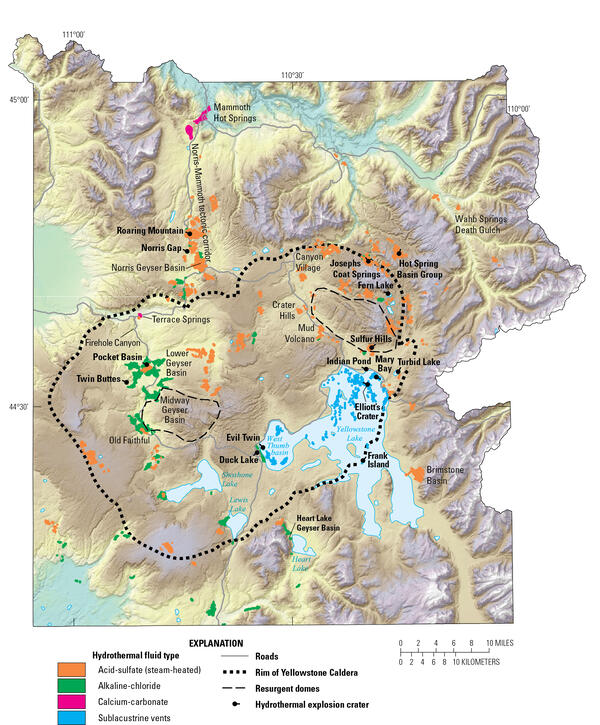
Map showing the location of active thermal areas
Large hydrothermal explosion craters shown with black dot and leader plus associated breccia deposits in Yellowstone National Park (locations from
Large hydrothermal explosion craters shown with black dot and leader plus associated breccia deposits in Yellowstone National Park (locations from

Kīlauea Volcano — Advancing Flow
Photo from 7AM helicopter overflight, hovering offshore and looking up the flowfront. Nearly all of the front was active and advancing; advance rates were estimated at an average of 250 feet/hour (76 m/hr), and as of 7AM the flow was 500 yards (457 m) from the ocean.
Photo from 7AM helicopter overflight, hovering offshore and looking up the flowfront. Nearly all of the front was active and advancing; advance rates were estimated at an average of 250 feet/hour (76 m/hr), and as of 7AM the flow was 500 yards (457 m) from the ocean.

Thermal map of fissure system and lava flows
This thermal map shows the fissure system and lava flows as of 5:30 pm on Friday, June 1. The flow from Fissure 8 continues to advance in a northeast direction and the front was roughly 9.5 km (5.9 miles) from the vent at Fissure 8. The black and white area is the extent of the thermal map.
This thermal map shows the fissure system and lava flows as of 5:30 pm on Friday, June 1. The flow from Fissure 8 continues to advance in a northeast direction and the front was roughly 9.5 km (5.9 miles) from the vent at Fissure 8. The black and white area is the extent of the thermal map.

Thermal map of fissure system and lava flows
This thermal map shows the fissure system and lava flows as of 6:45 am on Saturday, June 2. The flow from Fissure 8 continues to advance in a northeast direction and the front was roughly 10.1 km (6.3 miles) from the vent at Fissure 8. The black and white area is the extent of the thermal map.
This thermal map shows the fissure system and lava flows as of 6:45 am on Saturday, June 2. The flow from Fissure 8 continues to advance in a northeast direction and the front was roughly 10.1 km (6.3 miles) from the vent at Fissure 8. The black and white area is the extent of the thermal map.
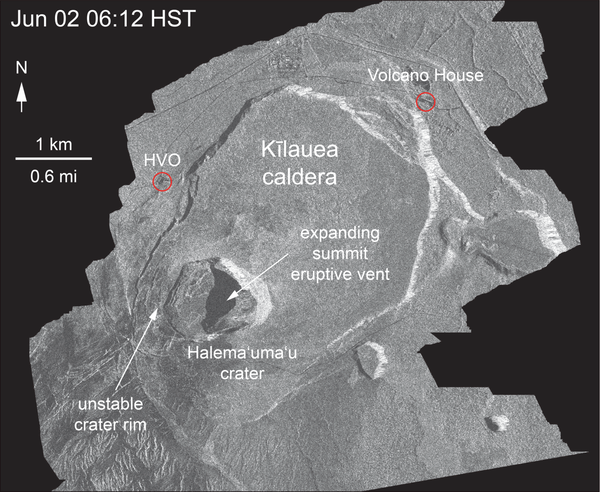
Slumping of west rim of Halema‘uma‘u
This animated GIF shows a sequence of radar amplitude images that were acquired by the Italian Space Agency's Cosmo-SkyMed satellite system. The images illustrate changes to the caldera area of Kīlauea Volcano that occurred between May 5 and June 2 at 6:00 p.m. HST.
This animated GIF shows a sequence of radar amplitude images that were acquired by the Italian Space Agency's Cosmo-SkyMed satellite system. The images illustrate changes to the caldera area of Kīlauea Volcano that occurred between May 5 and June 2 at 6:00 p.m. HST.

Kīlauea LERZ lava flows and fissures, June 3, 11:00 a.m.
Kīlauea LERZ lava flows and fissures, June 3, 11:00 a.m.Map as of 11:00 a.m. HST, June 3, 2018. Given the dynamic nature of Kīlauea's lower East Rift Zone eruption, with changing vent locations, fissures starting and stopping, and varying rates of lava effusion, map details shown here are accurate as of the date/time noted. Shaded purple areas indicate lava flows erupted in 1840, 1955, 1960, and 2014-2015.
Kīlauea LERZ lava flows and fissures, June 3, 11:00 a.m.
Kīlauea LERZ lava flows and fissures, June 3, 11:00 a.m.Map as of 11:00 a.m. HST, June 3, 2018. Given the dynamic nature of Kīlauea's lower East Rift Zone eruption, with changing vent locations, fissures starting and stopping, and varying rates of lava effusion, map details shown here are accurate as of the date/time noted. Shaded purple areas indicate lava flows erupted in 1840, 1955, 1960, and 2014-2015.
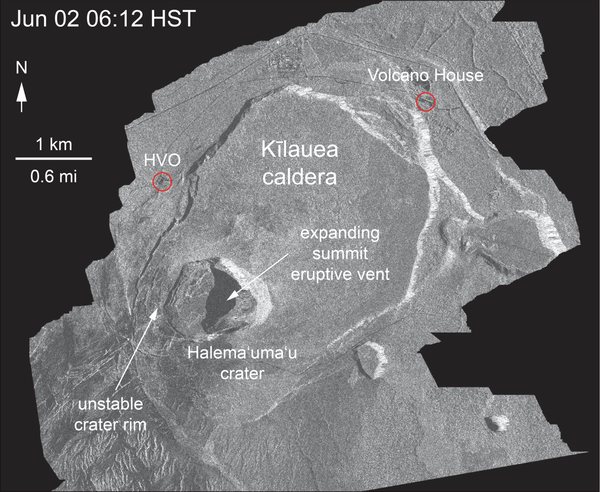
Kīlauea Volcano — Halema‘uma‘u Crater Slumping Animation
Kīlauea Volcano — Halema‘uma‘u Crater Slumping AnimationThis animated GIF shows a sequence of radar amplitude images that were acquired by the Italian Space Agency's Cosmo-SkyMed satellite system. The images illustrate changes to the caldera area of Kīlauea Volcano that occurred between May 5 and June 2 at 6:00 p.m. HST.
Kīlauea Volcano — Halema‘uma‘u Crater Slumping Animation
Kīlauea Volcano — Halema‘uma‘u Crater Slumping AnimationThis animated GIF shows a sequence of radar amplitude images that were acquired by the Italian Space Agency's Cosmo-SkyMed satellite system. The images illustrate changes to the caldera area of Kīlauea Volcano that occurred between May 5 and June 2 at 6:00 p.m. HST.

Kīlauea Volcano — Summit Plume

Kīlauea Volcano — Lava Near Four Corners
Northern edge of the fissure 8 flow front on the night of June 1, as it approached the intersection of Highways 132 and 137, known as "Four Corners."
Northern edge of the fissure 8 flow front on the night of June 1, as it approached the intersection of Highways 132 and 137, known as "Four Corners."

Kīlauea Volcano — Overflight of Fissure 8 Advancement
Kīlauea Volcano — Overflight of Fissure 8 AdvancementUSGS scientists on HVO's overflight this morning (June 2) captured this image of the fissure 8 flow front as it advanced west along Highway 132. Around the time of this photo, 7:15 a.m.
Kīlauea Volcano — Overflight of Fissure 8 Advancement
Kīlauea Volcano — Overflight of Fissure 8 AdvancementUSGS scientists on HVO's overflight this morning (June 2) captured this image of the fissure 8 flow front as it advanced west along Highway 132. Around the time of this photo, 7:15 a.m.

East side of the fissure 8 flow on the "lighthouse road" (east of t...
East side of the fissure 8 flow on the "lighthouse road" (east of t...East side of the fissure 8 flow on the "lighthouse road" (east of the Four Corners intersection). The ‘A‘ā flow was about 5 m (16 ft) thick when this photo was taken around 2:00 p.m. HST.
East side of the fissure 8 flow on the "lighthouse road" (east of t...
East side of the fissure 8 flow on the "lighthouse road" (east of t...East side of the fissure 8 flow on the "lighthouse road" (east of the Four Corners intersection). The ‘A‘ā flow was about 5 m (16 ft) thick when this photo was taken around 2:00 p.m. HST.

Kīlauea Volcano — Documenting Flows
An HVO geologist documents the fissure 8 flow southeast of Four Corners (the intersection of Highways 132 and 137).
An HVO geologist documents the fissure 8 flow southeast of Four Corners (the intersection of Highways 132 and 137).

Kīlauea Volcano — Lava Flowing into Green Lake

Kīlauea Volcano — `A`ā Flow
East side of the fissure 8 flow on the "lighthouse road" (east of the Four Corners intersection). The ‘a‘ā flow was about 5 m (16 ft) thick when this photo was taken around 2:00 p.m. HST.
East side of the fissure 8 flow on the "lighthouse road" (east of the Four Corners intersection). The ‘a‘ā flow was about 5 m (16 ft) thick when this photo was taken around 2:00 p.m. HST.