U.S. flag

An official website of the United States government

Images

Volcano Hazard Program images.

Filter Total Items: 6273
USGS Hawaiian Volcano Observatory, Kīlauea Volcano, Hawaii...
USGS HVO, Kīlauea, Hawaii

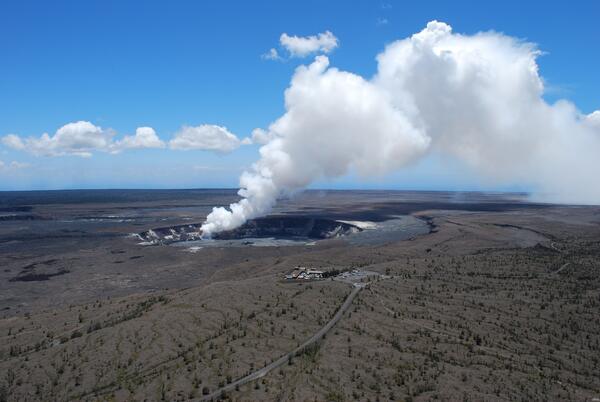
The Hawaiian Volcano Observatory perched on the west rim of Kīlauea Volcano's summit caldera, overlooks Halema‘uma‘u Crater, where a new vent that opened in March 2008 emits a volcanic gas plume.

The Hawaiian Volcano Observatory perched on the west rim of Kīlauea Volcano's summit caldera, overlooks Halema‘uma‘u Crater, where a new vent that opened in March 2008 emits a volcanic gas plume.

Lidar instrument uses light pulses to measure distances to the grou...
Lidar instrument uses light pulses to measure distances to ground s...

Lidar instrument uses light pulses to measure distances to the ground surface in the Kīlauea Caldera, Hawaii. Measurements are used to make a Digital Elevation Model - a very accurate topographic map.

Lidar instrument uses light pulses to measure distances to the ground surface in the Kīlauea Caldera, Hawaii. Measurements are used to make a Digital Elevation Model - a very accurate topographic map.

Narrow Gauge spring, Mammoth Hot Springs, Yellowstone National Park

Narrow Gauge spring, Mammoth Hot Springs, Yellowstone National Park.  Vent area is between the two trees on top of the travertine deposits.  Terraced pools form due to deposition of travertine from the fluids as they cool and degas carbon dioxide.

Narrow Gauge spring, Mammoth Hot Springs, Yellowstone National Park.  Vent area is between the two trees on top of the travertine deposits.  Terraced pools form due to deposition of travertine from the fluids as they cool and degas carbon dioxide.

Nighttime view of tephra-jet explosion, Kīlauea Volcano, Hawai‘i...
Nighttime view of tephra-jet explosion, Kīlauea, Hawai‘i

Incandescent arcs trace the path of lava fragments cast out during a tephra-jet explosion at the Waikupanaha ocean entry in 2008. This is a relatively small explosion, reaching a few tens of meters (yards) height, while one earlier in the day was nearly 70 meters (230 ft) in height.

Incandescent arcs trace the path of lava fragments cast out during a tephra-jet explosion at the Waikupanaha ocean entry in 2008. This is a relatively small explosion, reaching a few tens of meters (yards) height, while one earlier in the day was nearly 70 meters (230 ft) in height.

Image: Littoral Explosion At Kilauea Volcano, Hawai'i
Littoral Explosion At Kilauea Volcano, Hawai'i

When lava from the Pu'u 'Ō'ō-Kupaianaha eruption, active since 1983, meets the ocean, large littoral explosions can result.

Crater Lake Caldera with Wizard Island cinder cone and lava flows, ...

Crater Lake Caldera with Wizard Island cinder cone and lava flows, some of the youngest features in the caldera as seen from Merriam Point. Viewed toward the south. Oregon

image related to volcanoes. See description
Fissure 8 continues to send lava to the sea

The early morning helicopter overflight of the lower East Rift Zone shows lava continuing to enter the sea at Ahalanui. The southern margin of the flow remains about a quarter mile from the boat ramp at Isaac Hale Park (jetty visible in the center left of the photo). View to the northeast.

The early morning helicopter overflight of the lower East Rift Zone shows lava continuing to enter the sea at Ahalanui. The southern margin of the flow remains about a quarter mile from the boat ramp at Isaac Hale Park (jetty visible in the center left of the photo). View to the northeast.

Volcanic-gas plume rises from Halema‘uma‘u Crater, Kīlauea Volcano,...
Volcanic-gas plume rises from Halema‘uma‘u, Kīlauea

A plume of volcanic gases (chiefly water vapor, carbon dioxide, and sulfur dioxide), tiny lava and rock particles, and droplets drifts southwest in the tradewinds from Halema‘uma‘u Crater.

A plume of volcanic gases (chiefly water vapor, carbon dioxide, and sulfur dioxide), tiny lava and rock particles, and droplets drifts southwest in the tradewinds from Halema‘uma‘u Crater.

Image: Old Faithful Erupting
Old Faithful Erupting

Photograph of the Old Faithful Geyser erupting in Yellowstone Nationl Park. Old Faithful was named in 1870 during the Washburn-Langford-Doane Yellowstone expedition and was the first geyser in the Park to be named.

Photograph of the Old Faithful Geyser erupting in Yellowstone Nationl Park. Old Faithful was named in 1870 during the Washburn-Langford-Doane Yellowstone expedition and was the first geyser in the Park to be named.

May 2, 2008, Chaitén volcano in Chile erupted with an ash column th...

May 2, 2008, Chaitén volcano in Chile erupted with an ash column that rose to about 17 km (10 mi) and lasted for 6 hours. Activity continued into 2009, including this ash emission on May 27, 2008.

May 2, 2008, Chaitén volcano in Chile erupted with an ash column that rose to about 17 km (10 mi) and lasted for 6 hours. Activity continued into 2009, including this ash emission on May 27, 2008.

View of Chaitén lava dome looking north, on May 26, 2008. Note simu...

View of Chaitén lava dome looking north, on May 26, 2008. Note simultaneous explosion and effusion of new lava on left-central side of dome. Caldera is about 3 km wide.

Heavy rains in May 2008 remobilized ash laid down by the eruption o...

All visible streets and the nearby airport were buried in 3 to 6 feet of mud, and the city harbor was destroyed.

Gas plume rising from new vent at base of crater wall in Halema‘uma...

Gas plume drifts southwest in the tradewinds over the Halema‘uma‘u Crater parking lot and Crater Rim Drive. View is toward the east-northeast. From left to right, the broad cones on the skyline are Pu‘u ‘Ō‘ō (note steam plume), and the Kane Nui o Hamo and Mauna Ulu shields.

Gas plume drifts southwest in the tradewinds over the Halema‘uma‘u Crater parking lot and Crater Rim Drive. View is toward the east-northeast. From left to right, the broad cones on the skyline are Pu‘u ‘Ō‘ō (note steam plume), and the Kane Nui o Hamo and Mauna Ulu shields.

HVO and Jaggar Museum on Kīlauea Volcano's caldera rim, Hawai‘i...
HVO and Jaggar Museum on Kīlauea's caldera rim, Hawai‘i

Close view of the USGS Hawaiian Volcano Observatory (right, with viewing tower) and National Park Service Jaggar Museum and overlook (left) on Kīlauea Volcano's caldera rim. At least three fault blocks can be seen below the observatory, which developed when Kīlauea's summit collapsed about 500 years ago to form the present-day caldera.

Close view of the USGS Hawaiian Volcano Observatory (right, with viewing tower) and National Park Service Jaggar Museum and overlook (left) on Kīlauea Volcano's caldera rim. At least three fault blocks can be seen below the observatory, which developed when Kīlauea's summit collapsed about 500 years ago to form the present-day caldera.

Gas plume blown by tradewinds across Crater Rim Drive, Kīlauea Volc...
Gas plume blown by tradewinds across Crater Rim Drive, Kīlauea

This section of Crater Rim Drive in Hawai‘i Volcanoes National Park was closed in February 2008 because of the high concentration of volcanic gas blowing across the road from Halema‘uma‘u Crater by prevailing trade winds. The concentration of sulfur dioxide gas in this area is considered hazardous to human health.

This section of Crater Rim Drive in Hawai‘i Volcanoes National Park was closed in February 2008 because of the high concentration of volcanic gas blowing across the road from Halema‘uma‘u Crater by prevailing trade winds. The concentration of sulfur dioxide gas in this area is considered hazardous to human health.

Volcanic gas plume creates heavy vog conditions during slack tradew...

Volcanic air pollution, commonly called volcanic smog or vog, at the summit of Kīlauea Volcano created by the gas plume rising from Halema‘uma‘u Crater during slack tradewinds. High vog levels result in regionally hazy sky conditions that degrade air clarity and reduce visibility for everyone.

Volcanic air pollution, commonly called volcanic smog or vog, at the summit of Kīlauea Volcano created by the gas plume rising from Halema‘uma‘u Crater during slack tradewinds. High vog levels result in regionally hazy sky conditions that degrade air clarity and reduce visibility for everyone.

Was this page helpful?