U.S. flag

An official website of the United States government

Images

Volcano Hazard Program images.

Filter Total Items: 6273
Vents and lava flows from the Kīlauea eruption of 1955

This 88 day eruption spawned lava flows which crossed all major roads to lower Puna. Coastal villages from Kalapana to Kapoho were isolated. Major roads closed by lava included Pahoa-Pohoiki; Pahoa-Kapoho; Pahoa-Opihikao; and Pahoa-Kalapana as well as the lower Puna coastal highway.

This 88 day eruption spawned lava flows which crossed all major roads to lower Puna. Coastal villages from Kalapana to Kapoho were isolated. Major roads closed by lava included Pahoa-Pohoiki; Pahoa-Kapoho; Pahoa-Opihikao; and Pahoa-Kalapana as well as the lower Puna coastal highway.

Topographic map, Mount St. Helens, C.E. 1919 annotated with locatio...

Due to the cataclysmic eruption of May 18, 1980, many of the locations annotated on this map are now either covered or no longer visible.

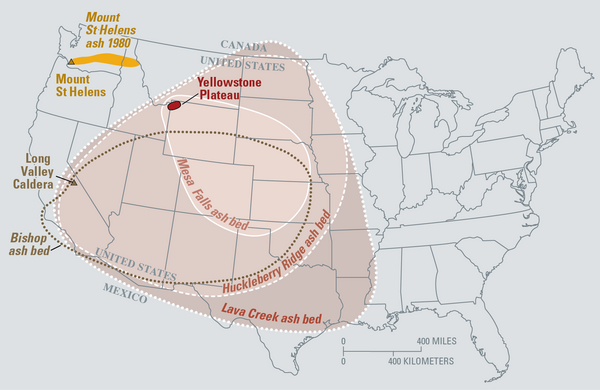
Map of the known ash-fall boundaries for several U.S. eruptions

Eruptions of the Yellowstone volcanic system have included the two largest volcanic eruptions in North America in the past few million years; the third largest was at Long Valley in California and produced the Bishop ash bed. The biggest of the Yellowstone eruptions occurred 2.1 million years ago, depositing the Huckleberry Ridge ash bed.

Eruptions of the Yellowstone volcanic system have included the two largest volcanic eruptions in North America in the past few million years; the third largest was at Long Valley in California and produced the Bishop ash bed. The biggest of the Yellowstone eruptions occurred 2.1 million years ago, depositing the Huckleberry Ridge ash bed.

USGS geologist taking notes sitting in a field.
Julie Donnelly-Nolan taking notes while working in the field.

Julie Donnelly-Nolan taking notes while working in the field at Newberry Volcano.

Crater Lake is the remnant of Mount Mazama, which erupted catastrop...

Crater Lake is the remnant of Mount Mazama, which erupted catastrophically 7,700 years ago to form the caldera.Wizard Island in lake and Mount Scott is peak on right shore. View from south. Oregon

USGS Debris-flow flume near Blue River, Oregon
USGS Debris-flow flume near Blue River, OR is used to conduct debris flow and landslide experiments.

USGS Debris-flow flume near Blue River, Oregon is used to conduct debris flows and landslide experiments. Flume is a reinforced concrete channel 95 m (310 ft long, 2 m (6.6 ft) wide, and 1.2 m (4 ft).

Crater Lake from the air viewed from the southwest. Wizard Island ...
Crater Lake from the air viewed from SW. Wizard Island is the coni...

Crater Lake from the air viewed from the southwest. Wizard Island is the conical mound in the lake and Mount Scott is the peak beyond the lake. Oregon

Mount Jefferson (pointed peak in middle) and Three Sisters (to the ...
Mount Jefferson (pointed peak in middle) and Three Sisters (to righ...

Mount Jefferson (pointed peak in middle) and Three Sisters (to the right) in Oregon, south-facing aerial view as seen from Mount St. Helens.

Drumbeat pattern of earthquakes on a webicorder plot (digital seism...

The station recording this pattern of seismicity was called Yellow Rock (YEL), which was approximately 1 km north of the 2004-2008 vent. YEL was removed in 2007 before the advancing Crater Glacier reached it. The YEL site is now under a hundred or so feet of ice.

The station recording this pattern of seismicity was called Yellow Rock (YEL), which was approximately 1 km north of the 2004-2008 vent. YEL was removed in 2007 before the advancing Crater Glacier reached it. The YEL site is now under a hundred or so feet of ice.

Global Positioning System receiver (dome on pole) and seismometer

Global Positioning System receiver (dome on pole) and seismometer (box on ground in distance) at a volcano monitoring station for Three Sisters in Central Oregon. Solar panel mounted to pole.

Global Positioning System receiver (dome on pole) and seismometer (box on ground in distance) at a volcano monitoring station for Three Sisters in Central Oregon. Solar panel mounted to pole.

Superimposed before and after photographs showing collapse of a lav...

Overlain photographs from a time-lapse camera show the East Lae‘apuki lava delta before and after part of the delta collapsed on August 27, 2005. The collapse occurred piecemeal during a 90-minute period. Loose rocks on the remaining delta were deposited there by large waves generated during the initial collapse.

Overlain photographs from a time-lapse camera show the East Lae‘apuki lava delta before and after part of the delta collapsed on August 27, 2005. The collapse occurred piecemeal during a 90-minute period. Loose rocks on the remaining delta were deposited there by large waves generated during the initial collapse.

Kīlauea Volcano's east Lae‘apuki lava delta after 70-100 m (230-330...
Kīlauea's east Lae‘apuki lava delta after 70-100 m (230-330 ft) lon...

Embayment of lava delta shows result of collapse. The initial collapse was large enough to send waves washing over much of the east half of the delta, because visibility was completely lost for almost 20 minutes, due to a steam white-out. Note rocky debris hurled by the waves onto the delta surface in foreground.

Embayment of lava delta shows result of collapse. The initial collapse was large enough to send waves washing over much of the east half of the delta, because visibility was completely lost for almost 20 minutes, due to a steam white-out. Note rocky debris hurled by the waves onto the delta surface in foreground.

Rock debris swept by hot waves onto lava delta during collapse, Kīl...
Rock debris swept by hot waves onto lava delta during collapse

Caught by a time-lapse camera, collapse of East Lae‘apuki lava delta in the early morning hours of August 27, 2005, generated waves that swept large lava fragments onto the delta. Daylight revealed boulders as large as 1 m (3 ft) in diameter on the surviving delta surface directly beneath the camera.

Caught by a time-lapse camera, collapse of East Lae‘apuki lava delta in the early morning hours of August 27, 2005, generated waves that swept large lava fragments onto the delta. Daylight revealed boulders as large as 1 m (3 ft) in diameter on the surviving delta surface directly beneath the camera.

Kīlauea Volcano's east Lae‘apuki lava delta pictured hours before i...
Kīlauea's east Lae‘apuki lava delta pictured hours before it collap...

Kīlauea Volcano's east Lae‘apuki lava delta pictured hours before it collapsed into the sea over a 90-minute period. White plume marks location of lava entering sea fed by a lava tube within delta.

Loowit Falls flows north out of Mount St. Helens crater. White buil...

Loowit Falls flows north out of Mount St. Helens crater. White building in upper right corner is the Loowit gage house, which contains an Acoustic Flow Monitor.

Lava spilling over sea cliff starts to build new lava delta, Kīlaue...
Lava spilling over sea cliff builds new lava delta, Kīlauea

pāhoehoe lava spilling over sea cliff on south coast of Kīlauea Volcano starts to build a new lava delta. Only three days old, the delta grows slowly as lava spreads over fragmented debris and flows that have accumulated on the steep submarine slope.

pāhoehoe lava spilling over sea cliff on south coast of Kīlauea Volcano starts to build a new lava delta. Only three days old, the delta grows slowly as lava spreads over fragmented debris and flows that have accumulated on the steep submarine slope.

Tephra-jet explosion at leading edge of an active lava delta, Kīlau...
Tephra-jet explosion at leading edge of an active lava delta, Kīlauea

Explosive interaction between lava and seawater blasts a tephra jet consisting of steam, hot water, black tephra, and molten fragments into the air. Such explosions are typically directed toward the sea, but many explosions also send a shower of lava more than 10 to 20 m (33 to 66 ft) inland.

Explosive interaction between lava and seawater blasts a tephra jet consisting of steam, hot water, black tephra, and molten fragments into the air. Such explosions are typically directed toward the sea, but many explosions also send a shower of lava more than 10 to 20 m (33 to 66 ft) inland.

Active lava delta on the south coast of Kīlauea Volcano, Hawai‘i...
Active lava delta on the south coast of Kīlauea, Hawai‘i

Active lava delta at East Lae‘apuki on the south coast of Kīlauea Volcano. White gas plume (right) marks location of lava entering the sea through a lava tube whose location is shown by blueish fume (left and center). In early August 2005, the delta encompassed an area of about 12 hectares (30 acres).

Active lava delta at East Lae‘apuki on the south coast of Kīlauea Volcano. White gas plume (right) marks location of lava entering the sea through a lava tube whose location is shown by blueish fume (left and center). In early August 2005, the delta encompassed an area of about 12 hectares (30 acres).

Scientists maintain an Acoustic Flow Monitor (AFM) at Mount St. Hel...
Scientists maintain an Acoustic Flow Monitor (AMF) at Mount St. Hel...

Scientists maintain an Acoustic Flow Monitor (AMF) at Mount St. Helens, Washington. It detects ground movement associated with lahars.

Was this page helpful?