
U.S. flag

An official website of the United States government

Images

Coastal and Marine Hazards and Resources Program images.

Filter Total Items: 2413
Image of Michael Casso giving a lab tour to the Woods Hole Children's School of Science
Woods Hole Science Center hosts Woods Hole Science School students

Michael Casso, Woods Hole Coastal and Marine Science Center physical scientist,  seeks volunteers from Children’s School of Science students to have their breath measured for carbon dioxide and methane, greenhouse gases USGS scientists measure in the oceans

Michael Casso, Woods Hole Coastal and Marine Science Center physical scientist,  seeks volunteers from Children’s School of Science students to have their breath measured for carbon dioxide and methane, greenhouse gases USGS scientists measure in the oceans

USGS pilot Sandy Brosnahan and Senate Pro Tempore Marc Pacheco
Pilots and Politics
Pilots and Politics
Pilots and Politics


USGS pilot Sandy Brosnahan and Senate Pro Tempore Marc Pacheco discuss the use of Umanned Aerial Systems (UASs, also known as drones) to collect data in coastal environments.


USGS pilot Sandy Brosnahan and Senate Pro Tempore Marc Pacheco discuss the use of Umanned Aerial Systems (UASs, also known as drones) to collect data in coastal environments.

Photograph of  methane plumes at the Norfolk Canyon seeps
Methane Plumes
Methane Plumes
Methane Plumes

(Top) Methane plumes at the Norfolk Canyon seeps (~1600 meters or 5250 feet) were detected using the EK60 sonar. The water column plumes are shown above the sub-seafloor structure as imaged by high-resolution multichannel seismic data acquired by the USGS and processed by J. Kluesner.

(Top) Methane plumes at the Norfolk Canyon seeps (~1600 meters or 5250 feet) were detected using the EK60 sonar. The water column plumes are shown above the sub-seafloor structure as imaged by high-resolution multichannel seismic data acquired by the USGS and processed by J. Kluesner.

Map of the general expedition area
IMMeRSS Cruise expedition area

Map of the general expedition area on the northern U.S. Atlantic Margin between Baltimore Canyon and Cape Hatteras

 Map of distribution of fine- and coarse-grained sand, Stellwagen Bank
Map of distribution of fine- and coarse-grained sand, Stellwagen Bank
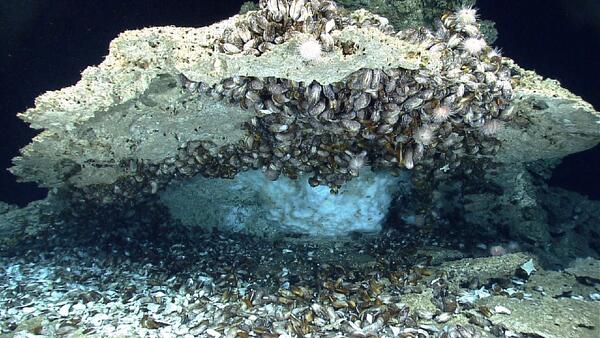
Methane bubbles emerging from the seafloor
Tiny bubbles (of methane)

Methane bubbles emerging from the seafloor at a seep site colonized by chemosynthetic mussels at ~1000 m water depth on the Virginia margin. Photograph taken by the Global Explorer operated by Oceaneering Inc.

Methane bubbles emerging from the seafloor at a seep site colonized by chemosynthetic mussels at ~1000 m water depth on the Virginia margin. Photograph taken by the Global Explorer operated by Oceaneering Inc.

deploying a multicorer to sample the seafloor near an Atlantic margin methane seep site.
Multicorer deployment to sample the seafloor

USGS ocean engineers Peter Dal Ferro and Gerry Hatcher, from the Pacific Coastal and Marine Science Center in Santa Cruz, California, deploying a multicorer to sample the seafloor near an Atlantic margin methane seep site.

A USGS drone pilot demonstrates flying an Unmanned Aircraft System

It's a bird? It's a plane? It's a drone! USGS drone pilot Emily Sturdivant (seated) demonstrates flying an Unmanned Aircraft System (UAS), much to the delight of the onlookers. 

Images of Madeira Beach, Florida, from video taken June 20, 2017

Views of Madeira Beach, Florida, produced from a 17-minute video shot on June 20, 2017. Left: Snapshot, or first frame of video. Right: Time-averaged image, sometimes called a “timex,” created by averaging the intensity of light recorded at each spot, or “pixel,” during the 17-minute video.

Views of Madeira Beach, Florida, produced from a 17-minute video shot on June 20, 2017. Left: Snapshot, or first frame of video. Right: Time-averaged image, sometimes called a “timex,” created by averaging the intensity of light recorded at each spot, or “pixel,” during the 17-minute video.

Big Sur coast. Red squares mark some of the sites damaged by 2016–17 winter storms, including Mud Creek and Paul’s Slide areas
Map of Big Sur coast with labels

Big Sur coast. Red squares mark some of the sites damaged by 2016–17 winter storms, including Mud Creek and Paul’s Slide areas.

Big Sur coast. Red squares mark some of the sites damaged by 2016–17 winter storms, including Mud Creek and Paul’s Slide areas.

Map of the NE US coast showing several types of data collected by NOAA and the USGS, with explanatory insets
Map shows hill-shaded bathymetric, backscatter, and photographic data

Hill-shaded bathymetric, backscatter, and photographic data collected by NOAA and the USGS. Backscatter data give indications of seafloor character. In general, low-backscatter intensity (blue) corresponds to finer-grained material, whereas high-backscatter intensity (orange) corresponds to coarser substrate.

Hill-shaded bathymetric, backscatter, and photographic data collected by NOAA and the USGS. Backscatter data give indications of seafloor character. In general, low-backscatter intensity (blue) corresponds to finer-grained material, whereas high-backscatter intensity (orange) corresponds to coarser substrate.

Map shows survey lines of the inner continental shelf of the Delmarva Peninsula in green, and data from partners in blue
The USGS conducted surveys on the inner continental shelf of the Delma

The USGS conducted surveys on the inner continental shelf of the Delmarva Peninsula (shown in green) to complement related datasets previously collected in the area by partners NOAA and BOEM. The inset map shows location of the study area.

The USGS conducted surveys on the inner continental shelf of the Delmarva Peninsula (shown in green) to complement related datasets previously collected in the area by partners NOAA and BOEM. The inset map shows location of the study area.

Large boulders have been placed along the beach edge to stop waves from eroding the sand. Palm trees stand behind the beach.
Installing large boulders to armor the shore against further erosion

Installing large boulders as riprap to armor the shore against further erosion at Goleta Beach in Southern California. The tide is very low (negative).

2 images of the California shore with squiggly lines drawn to show shoreline position change through time
An example of the CoSMoS-COAST shoreline data for La Jolla Shores

An example of the shoreline data for La Jolla Shores, used in the CoSMoS-COAST model. The many squiggly colored lines indicate the changing shoreline location through time [basemaps from Google Earth].

Was this page helpful?