



Wildlife and Terrestrial Species
Wildlife and Terrestrial Species
We provide rigorous and unbiased information on migratory birds, terrestrial and marine mammals, amphibians and reptiles, native plants, threatened and endangered species, wildlife disease, and on wildlife issues resulting from human activities. Our science contributes toward a more complete understanding of the Nation’s ecosystems and landscapes.
Species We Study
Species We Study

Healthy wildlife populations sustain communities across the Nation, and maintaining ecosystems thriving with biodiversity ensures these resources are available for generations to come.
Outstanding in the Field
Outstanding in the Field

In this episode we head to southern Florida to learn about one of North America’s most misunderstood - yet threatened - mammals: bats
Filter Total Items: 382

Species We Study: Birds
To understand information needs and respond to the many challenges in bird conservation, USGS scientists participate in Flyway committees, on Joint Venture boards and working groups, in professional organizations, and in other conservation partnerships. These activities connect USGS scientists to conservation partners with whom they work to address substantial challenges. More than one hundred...

Walrus Research
The USGS Alaska Science Center conducts long-term research on the Pacific walrus to provide scientific information to Department of Interior management agencies and Alaska Native co-management partners. In addition, the USGS Pacific walrus research program collaborates with the U.S. Fish and Wildlife Service (USFWS) and the State of Alaska’s Department of Fish and Game and Alaska Native co...

Data Harmonization for Greater Sage-Grouse Populations
Long-term wildlife monitoring is imperative for understanding population changes that can inform managers. However, working with population data collected by different organizations across multiple jurisdictions and over long time periods can be challenging due to varying data management approaches and organizational priorities. Through this project, we aimed to collaborate with eleven state...
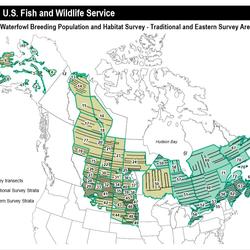
Redesigning the Eastern Breeding Waterfowl Population and Habitat Survey
USGS and partners are revising the design of a key waterfowl survey to increase management efficiency and cost-effectiveness, and inform annual harvest regulations in the U.S. and Canada.

Evaluating the Design of the Waterfowl Breeding Population and Habitat Survey
The Waterfowl Breeding Population and Habitat Survey (WBPHS) is a primary source of waterfowl population status and trend information for management of ducks in North America. The survey has not been reviewed in several decades, and since the last review new analysis approaches and information needs have created a need to reassess the design, scope of inference, and analysis of the survey to...

Landbird Research in Alaska
On this page, learn about USGS work with the Alaska Landbird Monitoring Survey (ALMS), Beak Deformities in Landbirds, and Boreal Partners in Flight (BPIF).

Waterfowl Research
Scientists at the USGS Alaska Science Center have conducted research on waterfowl species (ducks, geese, and swans) in Alaska since the 1970s. Because Alaska is an international crossroads of migratory bird flyways, with millions of birds from Asia and North America breeding in Alaska each summer, USGS research has also taken place in adjacent countries (Russia, Japan, Canada, Mexico) and in the...
Sea Duck Research
USGS research on sea ducks is designed to anticipate and address priority information needs of management agencies. Additionally, work is focused on individual species biology, migration and population status and trends because until recently, very little was known about sea ducks in Alaska.

Polar Bear Research
Polar bears ( Ursus maritimus) are one of 4 marine mammal species managed by the U.S. Department of Interior. The USGS Alaska Science Center leads long–term research on polar bears to inform local, state, national and international policy makers regarding conservation of the species and its habitat. Our studies, ongoing since 1985, are focused on population dynamics, health and energetics...

Shorebird Research
With its vast size and geographic position at the northern end of several migration pathways, Alaska is a critically important site for the world’s shorebirds. Thirty-seven shorebird species regularly breed in Alaska. Most of these species conduct epically long migrations to take advantage of Alaska’s abundant food resources and breeding habitat, making Alaska a global resource for shorebirds...

Terrestrial Mammal Research
Understanding the population dynamics, predator/prey relationships and habitat ecology of terrestrial mammals, such as caribou and muskoxen, is critical for the management of these species and their habitats in Alaska.

Nearshore Marine Ecosystem Research
Nearshore ecosystems include many resources that are of high ecological, recreational, subsistence, and economic value. They also are subject to influences from a wide variety of natural and human-caused perturbations, which can originate in terrestrial or oceanic environments. Our research is designed to evaluate sources of variation in the nearshore and how they influence resources of high...