



Wildlife and Terrestrial Species
Wildlife and Terrestrial Species
We provide rigorous and unbiased information on migratory birds, terrestrial and marine mammals, amphibians and reptiles, native plants, threatened and endangered species, wildlife disease, and on wildlife issues resulting from human activities. Our science contributes toward a more complete understanding of the Nation’s ecosystems and landscapes.
Species We Study
Species We Study

Healthy wildlife populations sustain communities across the Nation, and maintaining ecosystems thriving with biodiversity ensures these resources are available for generations to come.
Outstanding in the Field
Outstanding in the Field

In this episode we head to southern Florida to learn about one of North America’s most misunderstood - yet threatened - mammals: bats
Filter Total Items: 381

Seabirds and Forage Fish Ecology
Alaska's coastal and offshore waters provide foraging habitat for an estimated 100 million birds comprising more than 90 different species; from loons and seaducks that nest inland, to petrels and puffins that breed on islands off shore. All these birds depend on the sea to provide a wide variety of food types— from clams, crabs and urchins nearshore— to krill, forage fish, and squid offshore. The...

Advancing the Environmental DNA Toolkit for Ecosystem Monitoring and Management
The emerging field of Environmental DNA (eDNA) analysis allows characterization of species presence and community biodiversity by identifying trace amounts of genetic material left behind as organisms move through their environments. EESC scientists have been using eDNA technologies to detect native and rare species and as community biomonitoring tools.

Ecology and Distribution of the Endangered Hawaiian Hoary Bat
The ‘ōpe‘ape‘a (Hawaiian hoary bat, Lasiurus semotus) is listed as endangered due to population declines and a lack of knowledge on its distribution, abundance, and habitat needs. In order to help inform management for and recovery of this species, USGS-PIERC in collaboration with other agencies has conducted studies on the bat’s distribution, abundance, population genetics, food habitats, and...

Bighorn Sheep and Mountain Goat Research in Western National Park Units
Mountain goat and bighorn sheep are iconic symbols of many national lands in the West and are economically important as big game species on some public lands and as tourist attractions in and around national parks. Both species have limited distributions that can be difficult to observe and face multiple stressors including disease, increasing recreation in remote areas, and shifting weather...

North Pacific Pelagic Seabird Database
The North Pacific Pelagic Seabird Database (NPPSD) contains survey transect data designed and conducted by numerous partners primarily to census seabirds at sea. The NPPSD includes more than 486,000 transect segments and includes observations of over 20 million birds of 258 species collected over the span of 50 years (from 1973 to 2022).

USGS Northern Rocky Mountain Science Center Fiscal Year 2025 Highlights
The USGS Northern Rocky Mountain Science Center (NOROCK) proudly supports Federal, State, Tribal, and other partners by delivering high-quality data, cutting-edge science, and practical tools to support natural resource management. Below are some of NOROCK’s highlights during fiscal year 2025.

Boreal Partners in Flight
Welcome to the Alaska Landbird Resource Information System, the official web page for Boreal Partners in Flight! Thanks for taking the time to learn more about the Boreal Partners in Flight program and our efforts to understand and conserve northern populations of landbirds.
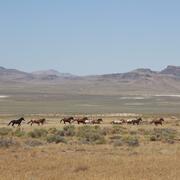
Science for management of America’s iconic wild horses and burros
Wild horses and burros are iconic wildlife of the western USA as well as a complicated management issue on tribal, state, and federal lands. Due to their history as domesticated animals, these wild equids – also called “free-roaming” or “feral” equids – can reproduce quickly, and have few natural predators, allowing their populations to grow rapidly if not managed. When populations are too large...

Greater Sage-Grouse Population Monitoring Framework: Cheat Sheet
The Greater Sage-grouse Population Monitoring Framework fills a prominent information gap to help inform current assessments of sage-grouse population trends at nested spatial and temporal scales. It is centered on four objectives: (1) create a standardized database of lek counts; (2) develop biologically based spatial population structures by clustering leks; (3) estimate spatial trends at...

Greater Sage-Grouse Population Monitoring Framework
Greater sage-grouse ( Centrocercus urophasianus) are at the center of state and national land use policies largely because of their unique life-history traits and their role as an ecological indicator for the health of sagebrush ecosystems. Multiple science centers with the U.S. Geological Survey (USGS) in conjunction with Colorado State University (CSU) have developed the Greater Sage-Grouse...

A user-friendly decision support tool for monitoring and managing greater sage-grouse populations
Researchers at the U.S. Geological Survey (USGS) and Colorado State University (CSU) collaborated with the Bureau of Land Management and state wildlife agencies to develop a hierarchical population monitoring framework for managing greater sage-grouse ( Centrocercus urophasianus) populations and the sagebrush ecosystems they depend on for survival and reproduction. This greater sage-grouse...

A targeted annual warning system (TAWS) for identifying aberrant declines in greater sage-grouse populations
Land and wildlife managers require accurate estimates of sensitive species’ trends to help guide conservation decisions that maintain biodiversity and promote healthy ecosystems. Multiple science centers with the U.S. Geological Survey (USGS), in conjunction with Colorado State University (CSU), developed a hierarchical population monitoring framework for managing greater sage-grouse (...