Hawksbill Sea Turtle Swimming over Elkhorn Coral, St. John, USVI
Hawksbill Sea Turtle Swimming over Elkhorn Coral, St. John, USVIHawksbill sea turtle swimming over elkhorn coral, St. John, U.S. Virgin Islands.


Official websites use .gov
A .gov website belongs to an official government organization in the United States.

Secure .gov websites use HTTPS
A lock () or https:// means you’ve safely connected to the .gov website. Share sensitive information only on official, secure websites.



Hawksbill sea turtle swimming over elkhorn coral, St. John, U.S. Virgin Islands.
Hawksbill sea turtle swimming over elkhorn coral, St. John, U.S. Virgin Islands.

Several species of scleractinian corals growing under red mangrove prop roots.
Several species of scleractinian corals growing under red mangrove prop roots.

A bleached colony of Diploria labyrinthiformis next to an unbleached colony of Colpophyllia natans.
A bleached colony of Diploria labyrinthiformis next to an unbleached colony of Colpophyllia natans.

Red mangrove trees fringe the shoreline of a bay in Hurricane Hole.
Red mangrove trees fringe the shoreline of a bay in Hurricane Hole.

Mangroves are "nurseries" for several species of grunts and other fishes which find shelter in the complex prop roots.
Mangroves are "nurseries" for several species of grunts and other fishes which find shelter in the complex prop roots.

The Buffalo Trunkfish (Lactophrys trigonus) is larger and less abundant than the Spotted and Smooth Trunkfishes seen frequently in the mangroves.
The Buffalo Trunkfish (Lactophrys trigonus) is larger and less abundant than the Spotted and Smooth Trunkfishes seen frequently in the mangroves.

Smooth Trunkfishes (Lactophrys triqueter) and other species of oddly-shaped "boxfishes" are characteristic of these mangroves.
Smooth Trunkfishes (Lactophrys triqueter) and other species of oddly-shaped "boxfishes" are characteristic of these mangroves.

Bright red Reef Urchins (Echinometra viridis) graze on algae growing on prop roots and rocks in shallow water.
Bright red Reef Urchins (Echinometra viridis) graze on algae growing on prop roots and rocks in shallow water.

Image of several species of coral growing on and near the prop roots of red mangrove trees. Sponges, feather duster worms, and sea grass also appear in the picture.
Image of several species of coral growing on and near the prop roots of red mangrove trees. Sponges, feather duster worms, and sea grass also appear in the picture.

A Cushion Sea Star (Oreaster reticulata) moves slowly along the bottom near some bright green algae (Caulerpa racemosa).
A Cushion Sea Star (Oreaster reticulata) moves slowly along the bottom near some bright green algae (Caulerpa racemosa).

Juvenile Four Eye Butterflyfishes (Chaetodon capistratus) find protection in the prop roots and feed on coral polyps.
Juvenile Four Eye Butterflyfishes (Chaetodon capistratus) find protection in the prop roots and feed on coral polyps.

A juvenile Gray Angelfish (Pomacanthus arcuatus) feeds on sponges with French Grunts nearby.
A juvenile Gray Angelfish (Pomacanthus arcuatus) feeds on sponges with French Grunts nearby.

The seedlings of Red Mangrove trees germinate from fruits while still attached to the trees. Here many are growing within the roots of adult trees.
The seedlings of Red Mangrove trees germinate from fruits while still attached to the trees. Here many are growing within the roots of adult trees.

At high tide, the red bark of the Red Mangrove Trees is submerged, creating a brilliant reflection at the water's surface. Flat Tree Oysters (Isognomon alatus) grow on the upper portions of the roots.
At high tide, the red bark of the Red Mangrove Trees is submerged, creating a brilliant reflection at the water's surface. Flat Tree Oysters (Isognomon alatus) grow on the upper portions of the roots.

Sponges, such as the blue, green and orange ones growing on these prop roots, provide much of the color in the Hurricane Hole mangroves.
Sponges, such as the blue, green and orange ones growing on these prop roots, provide much of the color in the Hurricane Hole mangroves.
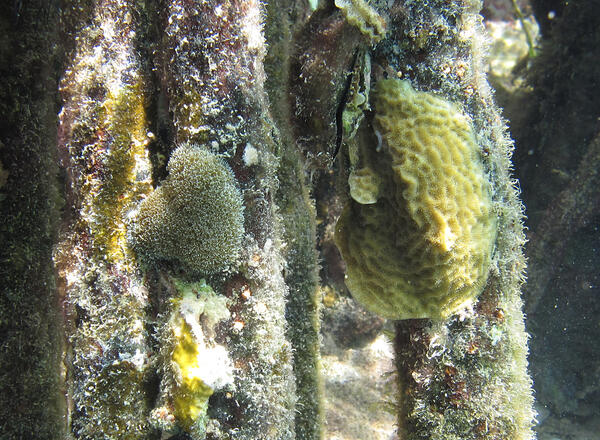
Small corals have settled and begun to grow on the prop roots (Finger Coral, Porites sp. on the left; Lettuce Coral, Agaricia sp. on the right).
Small corals have settled and begun to grow on the prop roots (Finger Coral, Porites sp. on the left; Lettuce Coral, Agaricia sp. on the right).

Giant Caribbean Anemones (Condylactis gigantea) display a wide range of colors but often have bright pink or purple tips.
Giant Caribbean Anemones (Condylactis gigantea) display a wide range of colors but often have bright pink or purple tips.

The beautiful yellow and black Rock Beauty (Holacanthus tricolor) is much less abundant than the other members of the Angelfish Family.
The beautiful yellow and black Rock Beauty (Holacanthus tricolor) is much less abundant than the other members of the Angelfish Family.

Spotted Trunkfishes (Lactophrys bicaudalis) feed mostly on Sea Squirts (Tunicates).
Spotted Trunkfishes (Lactophrys bicaudalis) feed mostly on Sea Squirts (Tunicates).

Bright red Fire Sponges (Tedania ignis) can cause severe reactions if touched.
Bright red Fire Sponges (Tedania ignis) can cause severe reactions if touched.

An adult Great Barracuda (Sphyraena barracuda) bares his teeth.
An adult Great Barracuda (Sphyraena barracuda) bares his teeth.
Hawksbill sea turtle swimming over elkhorn coral, St. John, U.S. Virgin Islands.
Hawksbill sea turtle swimming over elkhorn coral, St. John, U.S. Virgin Islands.
Several species of scleractinian corals growing under red mangrove prop roots.
Several species of scleractinian corals growing under red mangrove prop roots.
A bleached colony of Diploria labyrinthiformis next to an unbleached colony of Colpophyllia natans.
A bleached colony of Diploria labyrinthiformis next to an unbleached colony of Colpophyllia natans.
Red mangrove trees fringe the shoreline of a bay in Hurricane Hole.
Red mangrove trees fringe the shoreline of a bay in Hurricane Hole.
Mangroves are "nurseries" for several species of grunts and other fishes which find shelter in the complex prop roots.
Mangroves are "nurseries" for several species of grunts and other fishes which find shelter in the complex prop roots.
The Buffalo Trunkfish (Lactophrys trigonus) is larger and less abundant than the Spotted and Smooth Trunkfishes seen frequently in the mangroves.
The Buffalo Trunkfish (Lactophrys trigonus) is larger and less abundant than the Spotted and Smooth Trunkfishes seen frequently in the mangroves.
Smooth Trunkfishes (Lactophrys triqueter) and other species of oddly-shaped "boxfishes" are characteristic of these mangroves.
Smooth Trunkfishes (Lactophrys triqueter) and other species of oddly-shaped "boxfishes" are characteristic of these mangroves.
Bright red Reef Urchins (Echinometra viridis) graze on algae growing on prop roots and rocks in shallow water.
Bright red Reef Urchins (Echinometra viridis) graze on algae growing on prop roots and rocks in shallow water.
Image of several species of coral growing on and near the prop roots of red mangrove trees. Sponges, feather duster worms, and sea grass also appear in the picture.
Image of several species of coral growing on and near the prop roots of red mangrove trees. Sponges, feather duster worms, and sea grass also appear in the picture.
A Cushion Sea Star (Oreaster reticulata) moves slowly along the bottom near some bright green algae (Caulerpa racemosa).
A Cushion Sea Star (Oreaster reticulata) moves slowly along the bottom near some bright green algae (Caulerpa racemosa).
Juvenile Four Eye Butterflyfishes (Chaetodon capistratus) find protection in the prop roots and feed on coral polyps.
Juvenile Four Eye Butterflyfishes (Chaetodon capistratus) find protection in the prop roots and feed on coral polyps.
A juvenile Gray Angelfish (Pomacanthus arcuatus) feeds on sponges with French Grunts nearby.
A juvenile Gray Angelfish (Pomacanthus arcuatus) feeds on sponges with French Grunts nearby.
The seedlings of Red Mangrove trees germinate from fruits while still attached to the trees. Here many are growing within the roots of adult trees.
The seedlings of Red Mangrove trees germinate from fruits while still attached to the trees. Here many are growing within the roots of adult trees.
At high tide, the red bark of the Red Mangrove Trees is submerged, creating a brilliant reflection at the water's surface. Flat Tree Oysters (Isognomon alatus) grow on the upper portions of the roots.
At high tide, the red bark of the Red Mangrove Trees is submerged, creating a brilliant reflection at the water's surface. Flat Tree Oysters (Isognomon alatus) grow on the upper portions of the roots.
Sponges, such as the blue, green and orange ones growing on these prop roots, provide much of the color in the Hurricane Hole mangroves.
Sponges, such as the blue, green and orange ones growing on these prop roots, provide much of the color in the Hurricane Hole mangroves.
Small corals have settled and begun to grow on the prop roots (Finger Coral, Porites sp. on the left; Lettuce Coral, Agaricia sp. on the right).
Small corals have settled and begun to grow on the prop roots (Finger Coral, Porites sp. on the left; Lettuce Coral, Agaricia sp. on the right).
Giant Caribbean Anemones (Condylactis gigantea) display a wide range of colors but often have bright pink or purple tips.
Giant Caribbean Anemones (Condylactis gigantea) display a wide range of colors but often have bright pink or purple tips.
The beautiful yellow and black Rock Beauty (Holacanthus tricolor) is much less abundant than the other members of the Angelfish Family.
The beautiful yellow and black Rock Beauty (Holacanthus tricolor) is much less abundant than the other members of the Angelfish Family.
Spotted Trunkfishes (Lactophrys bicaudalis) feed mostly on Sea Squirts (Tunicates).
Spotted Trunkfishes (Lactophrys bicaudalis) feed mostly on Sea Squirts (Tunicates).
Bright red Fire Sponges (Tedania ignis) can cause severe reactions if touched.
Bright red Fire Sponges (Tedania ignis) can cause severe reactions if touched.
An adult Great Barracuda (Sphyraena barracuda) bares his teeth.
An adult Great Barracuda (Sphyraena barracuda) bares his teeth.