Amy Yackel Adams, PhD
Amy Yackel Adams is a Research Ecologist focusing on improving management decisions of invasive reptiles worldwide.
Amy leads a diverse research program with other USGS scientists and various collaborators (NPS, USDA-NWRC, USFWS, DoD, universities, and state agencies) pertaining to early detection and rapid response, biology, ecology, genetics, control tool evaluation, eradication, and quantitative model development to improve adaptive management of invasive reptile species. Yackel Adams’ research areas in the Greater Everglades Ecosystem and Pacific Islands include: 1) Population and vital rate estimation of invasive Burmese Pythons, Veiled Chameleons, and Brown Treesnakes; 2) Estimating the impact of Brown Treesnakes on prey populations; 3) Enhancing early detection of invasive reptiles using new tools; and 4) Development and evaluation of removal and abundance models to inform and optimize eradication efforts.
Education and Certifications
PhD, Ecology, Graduate Degree Program in Ecology, Colorado State University, 2005
MS, Ecology, Graduate Degree Program in Ecology, Colorado State University, 1999
BS, Resource Conservation and Environmental Studies, University of Montana, 1986
Science and Products
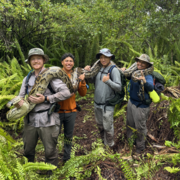
Invasive Burmese python research in the Greater Everglades
Land management research in support of streamlined energy development, economic growth, and wildfire management
Early detection and rapid response tools for invasive tegu lizards
Invasive species science in support of public safety, America’s natural resources, and economic growth
Developing and evaluating a point-of-use environmental DNA test for rapid field detection of highly invasive brown treesnakes
Fort Collins Science Center Labs and Facilities
Micronesian Starling (Aplonis opaca) nesting data on Guam, 2015-2018 Micronesian Starling (Aplonis opaca) nesting data on Guam, 2015-2018
Argentine black and white tegu (Salvator merianae) morphometrics and gastrointestinal contents, Florida, 2016-2021 Argentine black and white tegu (Salvator merianae) morphometrics and gastrointestinal contents, Florida, 2016-2021
Oviposition and pipping observations for three wild adult female Burmese pythons (Python molurus bivittatus) in southern Florida Oviposition and pipping observations for three wild adult female Burmese pythons (Python molurus bivittatus) in southern Florida
Model outputs of habitat suitability for three invasive tegu lizards across the contiguous United States under current and future climate scenarios Model outputs of habitat suitability for three invasive tegu lizards across the contiguous United States under current and future climate scenarios
Data and analytical code to model the growth rate of brown treesnakes (Boiga irregularis), Guam 2004-2013 Data and analytical code to model the growth rate of brown treesnakes (Boiga irregularis), Guam 2004-2013
Morphometric data of Burmese python and White-tailed deer in South Florida associated with a feeding event, 2025 Morphometric data of Burmese python and White-tailed deer in South Florida associated with a feeding event, 2025
Post-hatching maternal attendance in wild Burmese Pythons in southern Florida Post-hatching maternal attendance in wild Burmese Pythons in southern Florida
Consumption of a non-native Walking Catfish (Clarias batrachus) by a Florida Green Watersnake (Nerodia floridana) in Everglades National Park Consumption of a non-native Walking Catfish (Clarias batrachus) by a Florida Green Watersnake (Nerodia floridana) in Everglades National Park
Cold-induced vomiting of a white-tailed deer (Odocoileus virginianus) by an invasive Burmese python (Python bivitattus) in Big Cypress National Preserve, Florida, USA Cold-induced vomiting of a white-tailed deer (Odocoileus virginianus) by an invasive Burmese python (Python bivitattus) in Big Cypress National Preserve, Florida, USA
Modeling current and future distribution of invasive tegu lizards along geopolitical boundaries in the contiguous United States: Implications for invasion threat Modeling current and future distribution of invasive tegu lizards along geopolitical boundaries in the contiguous United States: Implications for invasion threat
Growth rate variation in Brown Treesnakes (Boiga irregularis): An invasive species of conservation concern Growth rate variation in Brown Treesnakes (Boiga irregularis): An invasive species of conservation concern
Coelomic foreign bodies in wild-caught Python spp. in the Greater Everglades Ecosystem, Florida, USA Coelomic foreign bodies in wild-caught Python spp. in the Greater Everglades Ecosystem, Florida, USA
Non-USGS Publications**
**Disclaimer: The views expressed in Non-USGS publications are those of the author and do not represent the views of the USGS, Department of the Interior, or the U.S. Government.
Identifying Pareto-efficient eradication strategies for invasive populations Identifying Pareto-efficient eradication strategies for invasive populations
Science and Products
Invasive Burmese python research in the Greater Everglades
Land management research in support of streamlined energy development, economic growth, and wildfire management
Early detection and rapid response tools for invasive tegu lizards
Invasive species science in support of public safety, America’s natural resources, and economic growth
Developing and evaluating a point-of-use environmental DNA test for rapid field detection of highly invasive brown treesnakes
Fort Collins Science Center Labs and Facilities
Micronesian Starling (Aplonis opaca) nesting data on Guam, 2015-2018 Micronesian Starling (Aplonis opaca) nesting data on Guam, 2015-2018
Argentine black and white tegu (Salvator merianae) morphometrics and gastrointestinal contents, Florida, 2016-2021 Argentine black and white tegu (Salvator merianae) morphometrics and gastrointestinal contents, Florida, 2016-2021
Oviposition and pipping observations for three wild adult female Burmese pythons (Python molurus bivittatus) in southern Florida Oviposition and pipping observations for three wild adult female Burmese pythons (Python molurus bivittatus) in southern Florida
Model outputs of habitat suitability for three invasive tegu lizards across the contiguous United States under current and future climate scenarios Model outputs of habitat suitability for three invasive tegu lizards across the contiguous United States under current and future climate scenarios
Data and analytical code to model the growth rate of brown treesnakes (Boiga irregularis), Guam 2004-2013 Data and analytical code to model the growth rate of brown treesnakes (Boiga irregularis), Guam 2004-2013
Morphometric data of Burmese python and White-tailed deer in South Florida associated with a feeding event, 2025 Morphometric data of Burmese python and White-tailed deer in South Florida associated with a feeding event, 2025
Post-hatching maternal attendance in wild Burmese Pythons in southern Florida Post-hatching maternal attendance in wild Burmese Pythons in southern Florida
Consumption of a non-native Walking Catfish (Clarias batrachus) by a Florida Green Watersnake (Nerodia floridana) in Everglades National Park Consumption of a non-native Walking Catfish (Clarias batrachus) by a Florida Green Watersnake (Nerodia floridana) in Everglades National Park
Cold-induced vomiting of a white-tailed deer (Odocoileus virginianus) by an invasive Burmese python (Python bivitattus) in Big Cypress National Preserve, Florida, USA Cold-induced vomiting of a white-tailed deer (Odocoileus virginianus) by an invasive Burmese python (Python bivitattus) in Big Cypress National Preserve, Florida, USA
Modeling current and future distribution of invasive tegu lizards along geopolitical boundaries in the contiguous United States: Implications for invasion threat Modeling current and future distribution of invasive tegu lizards along geopolitical boundaries in the contiguous United States: Implications for invasion threat
Growth rate variation in Brown Treesnakes (Boiga irregularis): An invasive species of conservation concern Growth rate variation in Brown Treesnakes (Boiga irregularis): An invasive species of conservation concern
Coelomic foreign bodies in wild-caught Python spp. in the Greater Everglades Ecosystem, Florida, USA Coelomic foreign bodies in wild-caught Python spp. in the Greater Everglades Ecosystem, Florida, USA
Non-USGS Publications**
**Disclaimer: The views expressed in Non-USGS publications are those of the author and do not represent the views of the USGS, Department of the Interior, or the U.S. Government.