



This is a screenshot of the INHABIT web-based decision support tool for invasive species habitat visualization and assessment across the contiguous United States
Catherine S. Jarnevich, PhD
Catherine began working for the USGS while obtaining her doctorate in ecology in 2000. She gained skills in integrating disparate datasets of species’ location data and using these to generate spatially explicit models of species occurrence and abundance.
Catherine has developed a research program to assist multiple agencies and groups with species distributions, focusing on invasive species. Her current research involves the application of habitat suitability models to answer different applied research and management questions for various species across a range of taxa and spatial scales. A major focus involves predicting current and potential distributions of invasive species and deliver this information through a co-produced webtool to inform management actions. She has also been working with spatially explicit state and transition modeling to inform efficient landscape scale invasive plant management.
Science and Products
Filter Total Items: 23
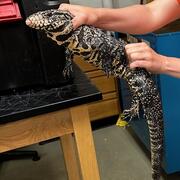
Early detection and rapid response tools for invasive tegu lizards
Scientists at USGS have shown that much of the US is suitable for invasion by tegu lizards, and suitability will likely increase in the future. While tegus can be removed via trapping, it is difficult to monitor every geographic area where tegus could invade. Thus, methods for quickly detecting and removing tegus in new areas are the best way to prevent spread and minimize damage from these...

Scaling-up phenological date matching for invasive species mapping: a free opensource workflow
Matching imagery dates to phenological events across large geographic regions for invasive species mapping.

Fostering greater use of habitat models for managing rare and invasive plants on public lands
Habitat models can provide critical information on the current and potential distribution of plant species, as well as help target and support conservation efforts. Despite their potential utility in public land management, model use may be constrained by a variety of factors including staff access to and trust in models. In this project, we seek to bring together model users and model developers...

Economic assessment of addressing annual invasive grasses across the sagebrush biome
This interdisciplinary project combines expert judgment on treatment costs with spatially explicit ecological modeling to estimate the financial resources needed to address the threat of invasive annual grass across the entire sagebrush biome. Results of the assessment will provide economic insights that can inform cost-effective resource allocation to efficiently achieve sagebrush conservation...

FORT Cottonwood Common Garden
FORT scientists established a Common Garden at the Colorado State Forest Service Nursery in Fort Collins, Colorado in 2005 to study the phenology of riparian cottonwood in relation to annual variation in temperature. Phenology is the seasonal timing of life history events including leaf opening, flowering, seed release, bud formation and leaf senescence.

INHABIT: A web tool for invasive plant management across the contiguous United States
INHABIT is a desktop-optimized web application and decision support tool with mapped and tabular summaries of habitat suitability models for over two hundred fifty terrestrial invasive plant species of management concern across the contiguous United States. It is the product of a scientist-practitioner partnership and is designed to facilitate enhanced invasive species management actions...

INHABIT Screenshot
This is a screenshot of the INHABIT web-based decision support tool for invasive species habitat visualization and assessment across the contiguous United States
Science and Products
Filter Total Items: 23
Early detection and rapid response tools for invasive tegu lizards
Scientists at USGS have shown that much of the US is suitable for invasion by tegu lizards, and suitability will likely increase in the future. While tegus can be removed via trapping, it is difficult to monitor every geographic area where tegus could invade. Thus, methods for quickly detecting and removing tegus in new areas are the best way to prevent spread and minimize damage from these...
Scaling-up phenological date matching for invasive species mapping: a free opensource workflow
Matching imagery dates to phenological events across large geographic regions for invasive species mapping.
Fostering greater use of habitat models for managing rare and invasive plants on public lands
Habitat models can provide critical information on the current and potential distribution of plant species, as well as help target and support conservation efforts. Despite their potential utility in public land management, model use may be constrained by a variety of factors including staff access to and trust in models. In this project, we seek to bring together model users and model developers...
Economic assessment of addressing annual invasive grasses across the sagebrush biome
This interdisciplinary project combines expert judgment on treatment costs with spatially explicit ecological modeling to estimate the financial resources needed to address the threat of invasive annual grass across the entire sagebrush biome. Results of the assessment will provide economic insights that can inform cost-effective resource allocation to efficiently achieve sagebrush conservation...
FORT Cottonwood Common Garden
FORT scientists established a Common Garden at the Colorado State Forest Service Nursery in Fort Collins, Colorado in 2005 to study the phenology of riparian cottonwood in relation to annual variation in temperature. Phenology is the seasonal timing of life history events including leaf opening, flowering, seed release, bud formation and leaf senescence.
INHABIT: A web tool for invasive plant management across the contiguous United States
INHABIT is a desktop-optimized web application and decision support tool with mapped and tabular summaries of habitat suitability models for over two hundred fifty terrestrial invasive plant species of management concern across the contiguous United States. It is the product of a scientist-practitioner partnership and is designed to facilitate enhanced invasive species management actions...
INHABIT Screenshot
This is a screenshot of the INHABIT web-based decision support tool for invasive species habitat visualization and assessment across the contiguous United States
This is a screenshot of the INHABIT web-based decision support tool for invasive species habitat visualization and assessment across the contiguous United States