
Denis R LeBlanc
Denis LeBlanc is a Scientist Emeritus with the New England Water Science Center.
Denis presently coordinates a multidisciplinary research effort at the USGS Cape Cod Toxic Substances Hydrology Research site at the Joint Base Cape Cod (JBCC) near Falmouth, Mass. He also provides technical support to Air Force and Army National Guard environmental restoration programs at JBCC and participates in several projects with the U.S Environmental Protection Agency on nitrogen and other wastewater contaminants in Cape Cod's groundwater.
Denis received his B.S. in Hydrology from the University of New Hampshire and his M.S. in Civil and Environmental Engineering from the Massachusetts Institute of Technology. He is a member of the National Ground Water Association and the Geological Society of America, where he is a GSA Fellow. He has focused on Cape Cod's freshwater resources since joining the USGS in 1975.
Professional Experience
1975 - present, U.S. Geological Survey - Research Hydrologist
Education and Certifications
M.S. Civil and Environmental Engineering, Massachusetts Institute of Technology
B.S. Hydrology, University of New Hampshire
Science and Products
Assessment of Potential Effects of Water-Supply Withdrawals on Groundwater Levels near the Hyannis Ponds Complex, Barnstable, Massachusetts
Hydrologic Site Assessment for Passive Treatment of Groundwater Nitrogen with Permeable Reactive Barriers, Cape Cod, Massachusetts
USGS Publications on the Water Resources of Cape Cod and Southeastern Massachusetts
Per- and Polyfluoroalkyl Substances From Firefighting and Domestic Wastewater Remain in Groundwater for Decades
Water-Quality Data in and near Groundwater Flow-Through Kettle-Hole Lakes, Western Cape Cod, Massachusetts, 2003 - 2018 Water-Quality Data in and near Groundwater Flow-Through Kettle-Hole Lakes, Western Cape Cod, Massachusetts, 2003 - 2018
Baseline Groundwater-Quality Data from a Densely Developed Coastal Neighborhood, Falmouth, Massachusetts (June 2016 - August 2024) (ver. 6.0, September 2025) Baseline Groundwater-Quality Data from a Densely Developed Coastal Neighborhood, Falmouth, Massachusetts (June 2016 - August 2024) (ver. 6.0, September 2025)
Concentrations of Per- and Polyfluoroalkyl Substances (PFAS) in Lake-Bottom Sediments of Ashumet Pond on Cape Cod, Massachusetts, 2020 (ver. 2.0, February 2024) Concentrations of Per- and Polyfluoroalkyl Substances (PFAS) in Lake-Bottom Sediments of Ashumet Pond on Cape Cod, Massachusetts, 2020 (ver. 2.0, February 2024)
Uptake of Per- and Polyfluoroalkyl Substances by Fish, Mussel, and Passive Samplers in Mobile Laboratory Exposures using Groundwater from a Contamination Plume at a Historical Fire Training Area, Cape Cod, Massachusetts - Chemical and Biological Data from Uptake of Per- and Polyfluoroalkyl Substances by Fish, Mussel, and Passive Samplers in Mobile Laboratory Exposures using Groundwater from a Contamination Plume at a Historical Fire Training Area, Cape Cod, Massachusetts - Chemical and Biological Data from
Heat tracing of potential groundwater seepage zones along the upper Coonamessett River bog area (Cape Cod, Massachusetts, 2021) Heat tracing of potential groundwater seepage zones along the upper Coonamessett River bog area (Cape Cod, Massachusetts, 2021)
Concentrations of per- and polyfluoroalkyl substances (PFAS) and related chemical and physical data at and near surface-water/groundwater boundaries on Cape Cod, Massachusetts, 2016-19 Concentrations of per- and polyfluoroalkyl substances (PFAS) and related chemical and physical data at and near surface-water/groundwater boundaries on Cape Cod, Massachusetts, 2016-19
40 Years Presenting Cape Cod Hydrology
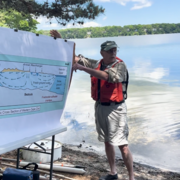
USGS has studied the hydrology of Cape Cod and the Islands and demonstrated our science to the public for more than four decades. Many visitor groups from government agencies, universities, nonprofit organizations, and local communities have learned about our groundwater and surface water research in southeastern Massachusetts. USGS Research Hydrologist Emeritus Denis Leblanc has been a pillar in...
Uptake of per- and polyfluoroalkyl substances by fish, mussel, and passive samplers in mobile laboratory exposures using groundwater from a contamination plume at a historical fire training area, Cape Cod, Massachusetts Uptake of per- and polyfluoroalkyl substances by fish, mussel, and passive samplers in mobile laboratory exposures using groundwater from a contamination plume at a historical fire training area, Cape Cod, Massachusetts
Integrated science for the study of perfluoroalkyl and polyfluoroalkyl substances (PFAS) in the environment—A strategic science vision for the U.S. Geological Survey Integrated science for the study of perfluoroalkyl and polyfluoroalkyl substances (PFAS) in the environment—A strategic science vision for the U.S. Geological Survey
Surface-water/groundwater boundaries affect seasonal PFAS concentrations and PFAA precursor transformations Surface-water/groundwater boundaries affect seasonal PFAS concentrations and PFAA precursor transformations
Public and private tapwater: Comparative analysis of contaminant exposure and potential risk, Cape Cod, Massachusetts, USA Public and private tapwater: Comparative analysis of contaminant exposure and potential risk, Cape Cod, Massachusetts, USA
Isolating the AFFF signature in coastal watersheds using oxidizable PFAS precursors and unexplained organofluorine Isolating the AFFF signature in coastal watersheds using oxidizable PFAS precursors and unexplained organofluorine
Evaluating the effects of replacing septic systems with municipal sewers on groundwater quality in a densely developed coastal neighborhood, Falmouth, Massachusetts, 2016–19 Evaluating the effects of replacing septic systems with municipal sewers on groundwater quality in a densely developed coastal neighborhood, Falmouth, Massachusetts, 2016–19
Science and Products
Assessment of Potential Effects of Water-Supply Withdrawals on Groundwater Levels near the Hyannis Ponds Complex, Barnstable, Massachusetts
Hydrologic Site Assessment for Passive Treatment of Groundwater Nitrogen with Permeable Reactive Barriers, Cape Cod, Massachusetts
USGS Publications on the Water Resources of Cape Cod and Southeastern Massachusetts
Per- and Polyfluoroalkyl Substances From Firefighting and Domestic Wastewater Remain in Groundwater for Decades
Water-Quality Data in and near Groundwater Flow-Through Kettle-Hole Lakes, Western Cape Cod, Massachusetts, 2003 - 2018 Water-Quality Data in and near Groundwater Flow-Through Kettle-Hole Lakes, Western Cape Cod, Massachusetts, 2003 - 2018
Baseline Groundwater-Quality Data from a Densely Developed Coastal Neighborhood, Falmouth, Massachusetts (June 2016 - August 2024) (ver. 6.0, September 2025) Baseline Groundwater-Quality Data from a Densely Developed Coastal Neighborhood, Falmouth, Massachusetts (June 2016 - August 2024) (ver. 6.0, September 2025)
Concentrations of Per- and Polyfluoroalkyl Substances (PFAS) in Lake-Bottom Sediments of Ashumet Pond on Cape Cod, Massachusetts, 2020 (ver. 2.0, February 2024) Concentrations of Per- and Polyfluoroalkyl Substances (PFAS) in Lake-Bottom Sediments of Ashumet Pond on Cape Cod, Massachusetts, 2020 (ver. 2.0, February 2024)
Uptake of Per- and Polyfluoroalkyl Substances by Fish, Mussel, and Passive Samplers in Mobile Laboratory Exposures using Groundwater from a Contamination Plume at a Historical Fire Training Area, Cape Cod, Massachusetts - Chemical and Biological Data from Uptake of Per- and Polyfluoroalkyl Substances by Fish, Mussel, and Passive Samplers in Mobile Laboratory Exposures using Groundwater from a Contamination Plume at a Historical Fire Training Area, Cape Cod, Massachusetts - Chemical and Biological Data from
Heat tracing of potential groundwater seepage zones along the upper Coonamessett River bog area (Cape Cod, Massachusetts, 2021) Heat tracing of potential groundwater seepage zones along the upper Coonamessett River bog area (Cape Cod, Massachusetts, 2021)
Concentrations of per- and polyfluoroalkyl substances (PFAS) and related chemical and physical data at and near surface-water/groundwater boundaries on Cape Cod, Massachusetts, 2016-19 Concentrations of per- and polyfluoroalkyl substances (PFAS) and related chemical and physical data at and near surface-water/groundwater boundaries on Cape Cod, Massachusetts, 2016-19
40 Years Presenting Cape Cod Hydrology
USGS has studied the hydrology of Cape Cod and the Islands and demonstrated our science to the public for more than four decades. Many visitor groups from government agencies, universities, nonprofit organizations, and local communities have learned about our groundwater and surface water research in southeastern Massachusetts. USGS Research Hydrologist Emeritus Denis Leblanc has been a pillar in...