
Karen Thorne, Ph.D. (Former Employee)
Science and Products
Filter Total Items: 28
Assessing Genomic Diversity and Clonality in Tape Seagrass in Guam and Surrounding Pacific Islands to Inform Climate Resilient Restoration
Project Overview Seagrass meadows support island communities by sustaining fisheries and protecting shorelines. However, some species, such as tape grass, may lack the genetic variation needed to survive and adapt to warmer, saltier ocean waters. Researchers supported by this Pacific Islands CASC project will sequence the tape grass genome and assess genetic variation across Micronesia...
Habitat Vulnerability to Climate Change: Identifying Climate Change Induced Mass Mortality Events Across Large Landscapes of the United States
USGS researchers will characterize extreme climatic events across U.S. following a review of case studies of mass mortality events associated with climate extremes including drought, precipitation, freeze, heat waves, and storm events.
Coastal Wetland Vulnerability to Climate Change and Sea-Level Rise: Understanding Ecological Thresholds and Ecosystem Transformations
Eighteen USGS coastal scientists from all four coasts of the conterminous United States are working together to advance the understanding of climate change and sea-level rise impacts to coastal wetlands.
By
California Water Science Center, Chesapeake Bay Activities, Eastern Ecological Science Center, Florence Bascom Geoscience Center, Great Lakes Science Center, Pacific Coastal and Marine Science Center, St. Petersburg Coastal and Marine Science Center, Western Ecological Research Center (WERC), Western Geographic Science Center, Wetland and Aquatic Research Center , Woods Hole Coastal and Marine Science Center
Spread of invasive vegetation under climate change in the national parks of the Klamath Region
Project Overview: The Klamath Region of Oregon and California is a global hotspot of biodiversity, but invasive species, climate change, and severe fires threaten native biodiversity, even within national parks. Scientists supported by this Southwest CASC project will create early-warning maps of where invasive plants are most likely to spread, helping national park managers target their
Enhancing Community and Wildlife Resilience to Sea‐Level Rise and Infrastructure Development in the San Pablo Baylands
Project Overview: The San Pablo Baylands support critical wildlife habitat and major transportation infrastructure, but the combined effects of sea-level rise and planned highway redesigns on habitat and public access remain uncertain. Scientists supported by this Southwest CASC project will work with federal, state, and regional managers to fill key data gaps and model how sea-level...
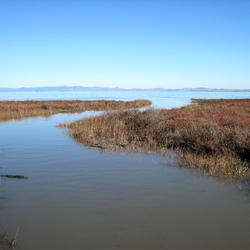
Modeling vulnerability for San Francisco Bay estuary tidal marshes
Karen Thorne researches the effects of inundation and ecological processes within the San Francisco Bay-Delta estuary.
Developing a Pacific Mangrove Monitoring Network (PACMAN) in Response to Sea Level Rise
Continued sea-level rise from a changing climate is expected to result in the loss of many coastal mangrove trees, which, will strongly affect human populations on isolated Western Pacific islands as they rely heavily on mangrove forests for food (fish, shrimp, and crabs), building materials, and firewood. Mangroves also protect local communities from tsunamis and cyclones and are...
Wetland Carbon Working Group: Improving Methodologies and Estimates of Carbon and Greenhouse Gas Flux in Wetlands
WARC researchers are working to quantify the impacts of future climate and land use/land cover change on greenhouse gas emissions and reductions.
Sea-level Rise Vulnerability of Mangrove Forests in Micronesia and the Pacific
The USGS and partners are studying how mangrove forests in the Federated States of Micronesia may respond to sea-level rise over the coming century. Their projections will help Micronesian communities plan for the future.
The Response of Coastal Wetlands to Sea-level Rise: Understanding how Macroscale Drivers Influence Local Processes and Feedbacks
The purpose of this work is to advance our understanding of how coastal wetland responses to sea-level rise (SLR) within the conterminous United States are likely to vary as a function of local, regional, and macroscale drivers, including climate. Based on our interactions with managers and decision makers, as well as our knowledge of the current state of the science, we propose to: (a) conduct a...
The response of coastal wetlands to sea-level rise: Understanding how macroscale drivers influence local processes and feedbacks
The purpose of this work is to advance our understanding of how coastal wetland responses to SLR within the conterminous United States are likely to vary as a function of local, regional, and macroscale drivers, including climate. Based on our interactions with managers and decision makers, as well as our knowledge of the current state of the science, we propose to (a) conduct a national synoptic...
Science to Inform the Management of Mangrove Ecosystems Undergoing Sea Level Rise at Ding Darling National Wildlife Refuge, Sanibel Island, Florida
Mangroves are forested tidal wetlands that occur in tropical, sub-tropical, and warm temperate coastal regions around the world. Mangroves occupy a significant area of coastlines globally and provide important ecosystem services to humans and wildlife. These services include aesthetic value, storm protection, food provisioning, recreation, critical wildlife habitat, and biological carbon
Filter Total Items: 40
No Result Found
Filter Total Items: 83
Sea‐level rise, habitat loss, and potential extirpation of a salt marsh specialist bird in urbanized landscapes Sea‐level rise, habitat loss, and potential extirpation of a salt marsh specialist bird in urbanized landscapes
Sea‐level rise (SLR) impacts on intertidal habitat depend on coastal topology, accretion, and constraints from surrounding development. Such habitat changes might affect species like Belding's savannah sparrows (Passerculus sandwichensis beldingi; BSSP), which live in high‐elevation salt marsh in the Southern California Bight. To predict how BSSP habitat might change under various SLR...
Authors
Jordan Rosencranz, Karen M. Thorne, Kevin J. Buffington, John Y. Takekawa, Ryan F. Hechinger, Tara E. Stewart, Richard F. Ambrose, Glen M. MacDonald, Mark A. Holmgren, Jeff A. Crooks, Robert T. Patton, Kevin D. Lafferty
Vertical zonation and niche breadth of tidal marsh plants along the Northeast Pacific coast Vertical zonation and niche breadth of tidal marsh plants along the Northeast Pacific coast
The distribution patterns of sessile organisms in coastal intertidal habitats typically exhibit vertical zonation, but little is known about variability in zonation among sites or species at larger spatial scales. Data on such heterogeneity could inform mechanistic understanding of factors affecting species distributions as well as efforts to assess and manage coastal species and habitat
Authors
Christopher N. Janousek, Karen M. Thorne, John Y. Takekawa
Climate-related variation in plant peak biomass and growth phenology across Pacific Northwest tidal marshes Climate-related variation in plant peak biomass and growth phenology across Pacific Northwest tidal marshes
The interannual variability of tidal marsh plant phenology is largely unknown and may have important ecological consequences. Marsh plants are critical to the biogeomorphic feedback processes that build estuarine soils, maintain marsh elevation relative to sea level, and sequester carbon. We calculated Tasseled Cap Greenness, a metric of plant biomass, using remotely sensed data...
Authors
Kevin J. Buffington, Bruce D. Dugger, Karen M. Thorne
U.S. Pacific coastal wetland resilience and vulnerability to sea-level rise U.S. Pacific coastal wetland resilience and vulnerability to sea-level rise
We used a first-of-its-kind comprehensive scenario approach to evaluate both the vertical and horizontal response of tidal wetlands to projected changes in the rate of sea-level rise (SLR) across 14 estuaries along the Pacific coast of the continental United States. Throughout the U.S. Pacific region, we found that tidal wetlands are highly vulnerable to end-of-century submergence, with...
Authors
Karen M. Thorne, Glen M. MacDonald, Glenn R. Guntenspergen, Richard F. Ambrose, Kevin J. Buffington, Bruce D. Dugger, Chase M. Freeman, Christopher Janousek, Lauren N. Brown, Jordan A. Rosencranz, James Homquist, John P. Smol, Kathryn Hargan, John Y. Takekawa
Inundation, vegetation, and sediment effects on litter decomposition in Pacific Coast tidal marshes Inundation, vegetation, and sediment effects on litter decomposition in Pacific Coast tidal marshes
The cycling and sequestration of carbon are important ecosystem functions of estuarine wetlands that may be affected by climate change. We conducted experiments across a latitudinal and climate gradient of tidal marshes in the northeast Pacific to evaluate the effects of climate- and vegetation-related factors on litter decomposition. We manipulated tidal exposure and litter type in...
Authors
Christopher Janousek, Kevin J. Buffington, Glenn R. Guntenspergen, Karen M. Thorne, Bruce D. Dugger, John Y. Takekawa
Are coastal managers ready for climate change? A case study from estuaries along the Pacific coast of the United States Are coastal managers ready for climate change? A case study from estuaries along the Pacific coast of the United States
A key challenge for coastal resource managers is to plan and implement climate change adaptation strategies inlight of uncertainties and competing management priorities. In 2014, we held six workshops across estuaries along the Pacific coast of North America with over 150 participants to evaluate resource managers' perceived level of understanding of climate change science, where they...
Authors
Karen M. Thorne, Deborah L. Elliott-Fisk, Chase M. Freeman, Thuy-Vy D. Bui, Katherine Powelson, Christopher Janousek, Kevin J. Buffington, John Y. Takekawa
Statistical correction of lidar-derived digital elevation models with multispectral airborne imagery in tidal marshes Statistical correction of lidar-derived digital elevation models with multispectral airborne imagery in tidal marshes
Airborne light detection and ranging (lidar) is a valuable tool for collecting large amounts of elevation data across large areas; however, the limited ability to penetrate dense vegetation with lidar hinders its usefulness for measuring tidal marsh platforms. Methods to correct lidar elevation data are available, but a reliable method that requires limited field work and maintains...
Authors
Kevin J. Buffington, Bruce D. Dugger, Karen M. Thorne, John Y. Takekawa
Balanced sediment fluxes in southern California’s Mediterranean-climate zone salt marshes Balanced sediment fluxes in southern California’s Mediterranean-climate zone salt marshes
Salt marsh elevation and geomorphic stability depends on mineral sedimentation. Many Mediterranean-climate salt marshes along southern California, USA coast import sediment during El Niño storm events, but sediment fluxes and mechanisms during dry weather are potentially important for marsh stability. We calculated tidal creek sediment fluxes within a highly modified, sediment-starved, 1...
Authors
Jordan A. Rosencranz, Neil K. Ganju, Richard F. Ambrose, Sandra M. Brosnahan, Patrick J. Dickhudt, Glenn R. Guntenspergen, Glen M. MacDonald, John Y. Takekawa, Karen M. Thorne
Effects of climate change on tidal marshes along a latitudinal gradient in California Effects of climate change on tidal marshes along a latitudinal gradient in California
Authors
Karen M. Thorne, Glen M. MacDonald, Rich F. Ambrose, Kevin J. Buffington, Chase M. Freeman, Christopher N. Janousek, Lauren N. Brown, James R. Holmquist, Glenn R. Guntenspergen, Katherine W. Powelson, Patrick L. Barnard, John Y. Takekawa
Assessing wildlife benefits and carbon storage from restored and natural coastal marshes in the Nisqually River Delta: Determining marsh net ecosystem carbon balance Assessing wildlife benefits and carbon storage from restored and natural coastal marshes in the Nisqually River Delta: Determining marsh net ecosystem carbon balance
Working in partnership since 1996, the U.S. Fish and Wildlife Service and the Nisqually Indian Tribe have restored 902 acres of tidally influenced coastal marsh in the Nisqually River Delta (NRD), making it the largest estuary-restoration project in the Pacific Northwest to date. Marsh restoration increases the capacity of the estuary to support a diversity of wildlife species...
Authors
Frank Anderson, Brian A. Bergamaschi, Lisamarie Windham-Myers, Isa Woo, Susan De La Cruz, Judith Z. Drexler, Kristin B. Byrd, Karen M. Thorne
Potential effects of sea-level rise on plant productivity: Species-specific responses in northeast Pacific tidal marshes Potential effects of sea-level rise on plant productivity: Species-specific responses in northeast Pacific tidal marshes
Coastal wetland plants are adapted to varying degrees of inundation. However, functional relationships between inundation and productivity are poorly characterized for most species. Determining species-specific tolerances to inundation is necessary to evaluate sea-level rise (SLR) effects on future marsh plant community composition, quantify organic matter inputs to marsh accretion, and...
Authors
Christopher Janousek, Kevin J. Buffington, Karen M. Thorne, Glenn R. Guntenspergen, John Y. Takekawa, Bruce D. Dugger
Tidal marsh susceptibility to sea-level rise: importance of local-scale models Tidal marsh susceptibility to sea-level rise: importance of local-scale models
Increasing concern over sea-level rise impacts to coastal tidal marsh ecosystems has led to modeling efforts to anticipate outcomes for resource management decision making. Few studies on the Pacific coast of North America have modeled sea-level rise marsh susceptibility at a scale relevant to local wildlife populations and plant communities. Here, we use a novel approach in developing...
Authors
Karen M. Thorne, Kevin J. Buffington, Deborah L. Elliott-Fisk, John Y. Takekawa
Science and Products
Filter Total Items: 28
Assessing Genomic Diversity and Clonality in Tape Seagrass in Guam and Surrounding Pacific Islands to Inform Climate Resilient Restoration
Project Overview Seagrass meadows support island communities by sustaining fisheries and protecting shorelines. However, some species, such as tape grass, may lack the genetic variation needed to survive and adapt to warmer, saltier ocean waters. Researchers supported by this Pacific Islands CASC project will sequence the tape grass genome and assess genetic variation across Micronesia...
Habitat Vulnerability to Climate Change: Identifying Climate Change Induced Mass Mortality Events Across Large Landscapes of the United States
USGS researchers will characterize extreme climatic events across U.S. following a review of case studies of mass mortality events associated with climate extremes including drought, precipitation, freeze, heat waves, and storm events.
Coastal Wetland Vulnerability to Climate Change and Sea-Level Rise: Understanding Ecological Thresholds and Ecosystem Transformations
Eighteen USGS coastal scientists from all four coasts of the conterminous United States are working together to advance the understanding of climate change and sea-level rise impacts to coastal wetlands.
By
California Water Science Center, Chesapeake Bay Activities, Eastern Ecological Science Center, Florence Bascom Geoscience Center, Great Lakes Science Center, Pacific Coastal and Marine Science Center, St. Petersburg Coastal and Marine Science Center, Western Ecological Research Center (WERC), Western Geographic Science Center, Wetland and Aquatic Research Center , Woods Hole Coastal and Marine Science Center
Spread of invasive vegetation under climate change in the national parks of the Klamath Region
Project Overview: The Klamath Region of Oregon and California is a global hotspot of biodiversity, but invasive species, climate change, and severe fires threaten native biodiversity, even within national parks. Scientists supported by this Southwest CASC project will create early-warning maps of where invasive plants are most likely to spread, helping national park managers target their
Enhancing Community and Wildlife Resilience to Sea‐Level Rise and Infrastructure Development in the San Pablo Baylands
Project Overview: The San Pablo Baylands support critical wildlife habitat and major transportation infrastructure, but the combined effects of sea-level rise and planned highway redesigns on habitat and public access remain uncertain. Scientists supported by this Southwest CASC project will work with federal, state, and regional managers to fill key data gaps and model how sea-level...
Modeling vulnerability for San Francisco Bay estuary tidal marshes
Karen Thorne researches the effects of inundation and ecological processes within the San Francisco Bay-Delta estuary.
Developing a Pacific Mangrove Monitoring Network (PACMAN) in Response to Sea Level Rise
Continued sea-level rise from a changing climate is expected to result in the loss of many coastal mangrove trees, which, will strongly affect human populations on isolated Western Pacific islands as they rely heavily on mangrove forests for food (fish, shrimp, and crabs), building materials, and firewood. Mangroves also protect local communities from tsunamis and cyclones and are...
Wetland Carbon Working Group: Improving Methodologies and Estimates of Carbon and Greenhouse Gas Flux in Wetlands
WARC researchers are working to quantify the impacts of future climate and land use/land cover change on greenhouse gas emissions and reductions.
Sea-level Rise Vulnerability of Mangrove Forests in Micronesia and the Pacific
The USGS and partners are studying how mangrove forests in the Federated States of Micronesia may respond to sea-level rise over the coming century. Their projections will help Micronesian communities plan for the future.
The Response of Coastal Wetlands to Sea-level Rise: Understanding how Macroscale Drivers Influence Local Processes and Feedbacks
The purpose of this work is to advance our understanding of how coastal wetland responses to sea-level rise (SLR) within the conterminous United States are likely to vary as a function of local, regional, and macroscale drivers, including climate. Based on our interactions with managers and decision makers, as well as our knowledge of the current state of the science, we propose to: (a) conduct a...
The response of coastal wetlands to sea-level rise: Understanding how macroscale drivers influence local processes and feedbacks
The purpose of this work is to advance our understanding of how coastal wetland responses to SLR within the conterminous United States are likely to vary as a function of local, regional, and macroscale drivers, including climate. Based on our interactions with managers and decision makers, as well as our knowledge of the current state of the science, we propose to (a) conduct a national synoptic...
Science to Inform the Management of Mangrove Ecosystems Undergoing Sea Level Rise at Ding Darling National Wildlife Refuge, Sanibel Island, Florida
Mangroves are forested tidal wetlands that occur in tropical, sub-tropical, and warm temperate coastal regions around the world. Mangroves occupy a significant area of coastlines globally and provide important ecosystem services to humans and wildlife. These services include aesthetic value, storm protection, food provisioning, recreation, critical wildlife habitat, and biological carbon
Filter Total Items: 40
No Result Found
Filter Total Items: 83
Sea‐level rise, habitat loss, and potential extirpation of a salt marsh specialist bird in urbanized landscapes Sea‐level rise, habitat loss, and potential extirpation of a salt marsh specialist bird in urbanized landscapes
Sea‐level rise (SLR) impacts on intertidal habitat depend on coastal topology, accretion, and constraints from surrounding development. Such habitat changes might affect species like Belding's savannah sparrows (Passerculus sandwichensis beldingi; BSSP), which live in high‐elevation salt marsh in the Southern California Bight. To predict how BSSP habitat might change under various SLR...
Authors
Jordan Rosencranz, Karen M. Thorne, Kevin J. Buffington, John Y. Takekawa, Ryan F. Hechinger, Tara E. Stewart, Richard F. Ambrose, Glen M. MacDonald, Mark A. Holmgren, Jeff A. Crooks, Robert T. Patton, Kevin D. Lafferty
Vertical zonation and niche breadth of tidal marsh plants along the Northeast Pacific coast Vertical zonation and niche breadth of tidal marsh plants along the Northeast Pacific coast
The distribution patterns of sessile organisms in coastal intertidal habitats typically exhibit vertical zonation, but little is known about variability in zonation among sites or species at larger spatial scales. Data on such heterogeneity could inform mechanistic understanding of factors affecting species distributions as well as efforts to assess and manage coastal species and habitat
Authors
Christopher N. Janousek, Karen M. Thorne, John Y. Takekawa
Climate-related variation in plant peak biomass and growth phenology across Pacific Northwest tidal marshes Climate-related variation in plant peak biomass and growth phenology across Pacific Northwest tidal marshes
The interannual variability of tidal marsh plant phenology is largely unknown and may have important ecological consequences. Marsh plants are critical to the biogeomorphic feedback processes that build estuarine soils, maintain marsh elevation relative to sea level, and sequester carbon. We calculated Tasseled Cap Greenness, a metric of plant biomass, using remotely sensed data...
Authors
Kevin J. Buffington, Bruce D. Dugger, Karen M. Thorne
U.S. Pacific coastal wetland resilience and vulnerability to sea-level rise U.S. Pacific coastal wetland resilience and vulnerability to sea-level rise
We used a first-of-its-kind comprehensive scenario approach to evaluate both the vertical and horizontal response of tidal wetlands to projected changes in the rate of sea-level rise (SLR) across 14 estuaries along the Pacific coast of the continental United States. Throughout the U.S. Pacific region, we found that tidal wetlands are highly vulnerable to end-of-century submergence, with...
Authors
Karen M. Thorne, Glen M. MacDonald, Glenn R. Guntenspergen, Richard F. Ambrose, Kevin J. Buffington, Bruce D. Dugger, Chase M. Freeman, Christopher Janousek, Lauren N. Brown, Jordan A. Rosencranz, James Homquist, John P. Smol, Kathryn Hargan, John Y. Takekawa
Inundation, vegetation, and sediment effects on litter decomposition in Pacific Coast tidal marshes Inundation, vegetation, and sediment effects on litter decomposition in Pacific Coast tidal marshes
The cycling and sequestration of carbon are important ecosystem functions of estuarine wetlands that may be affected by climate change. We conducted experiments across a latitudinal and climate gradient of tidal marshes in the northeast Pacific to evaluate the effects of climate- and vegetation-related factors on litter decomposition. We manipulated tidal exposure and litter type in...
Authors
Christopher Janousek, Kevin J. Buffington, Glenn R. Guntenspergen, Karen M. Thorne, Bruce D. Dugger, John Y. Takekawa
Are coastal managers ready for climate change? A case study from estuaries along the Pacific coast of the United States Are coastal managers ready for climate change? A case study from estuaries along the Pacific coast of the United States
A key challenge for coastal resource managers is to plan and implement climate change adaptation strategies inlight of uncertainties and competing management priorities. In 2014, we held six workshops across estuaries along the Pacific coast of North America with over 150 participants to evaluate resource managers' perceived level of understanding of climate change science, where they...
Authors
Karen M. Thorne, Deborah L. Elliott-Fisk, Chase M. Freeman, Thuy-Vy D. Bui, Katherine Powelson, Christopher Janousek, Kevin J. Buffington, John Y. Takekawa
Statistical correction of lidar-derived digital elevation models with multispectral airborne imagery in tidal marshes Statistical correction of lidar-derived digital elevation models with multispectral airborne imagery in tidal marshes
Airborne light detection and ranging (lidar) is a valuable tool for collecting large amounts of elevation data across large areas; however, the limited ability to penetrate dense vegetation with lidar hinders its usefulness for measuring tidal marsh platforms. Methods to correct lidar elevation data are available, but a reliable method that requires limited field work and maintains...
Authors
Kevin J. Buffington, Bruce D. Dugger, Karen M. Thorne, John Y. Takekawa
Balanced sediment fluxes in southern California’s Mediterranean-climate zone salt marshes Balanced sediment fluxes in southern California’s Mediterranean-climate zone salt marshes
Salt marsh elevation and geomorphic stability depends on mineral sedimentation. Many Mediterranean-climate salt marshes along southern California, USA coast import sediment during El Niño storm events, but sediment fluxes and mechanisms during dry weather are potentially important for marsh stability. We calculated tidal creek sediment fluxes within a highly modified, sediment-starved, 1...
Authors
Jordan A. Rosencranz, Neil K. Ganju, Richard F. Ambrose, Sandra M. Brosnahan, Patrick J. Dickhudt, Glenn R. Guntenspergen, Glen M. MacDonald, John Y. Takekawa, Karen M. Thorne
Effects of climate change on tidal marshes along a latitudinal gradient in California Effects of climate change on tidal marshes along a latitudinal gradient in California
Authors
Karen M. Thorne, Glen M. MacDonald, Rich F. Ambrose, Kevin J. Buffington, Chase M. Freeman, Christopher N. Janousek, Lauren N. Brown, James R. Holmquist, Glenn R. Guntenspergen, Katherine W. Powelson, Patrick L. Barnard, John Y. Takekawa
Assessing wildlife benefits and carbon storage from restored and natural coastal marshes in the Nisqually River Delta: Determining marsh net ecosystem carbon balance Assessing wildlife benefits and carbon storage from restored and natural coastal marshes in the Nisqually River Delta: Determining marsh net ecosystem carbon balance
Working in partnership since 1996, the U.S. Fish and Wildlife Service and the Nisqually Indian Tribe have restored 902 acres of tidally influenced coastal marsh in the Nisqually River Delta (NRD), making it the largest estuary-restoration project in the Pacific Northwest to date. Marsh restoration increases the capacity of the estuary to support a diversity of wildlife species...
Authors
Frank Anderson, Brian A. Bergamaschi, Lisamarie Windham-Myers, Isa Woo, Susan De La Cruz, Judith Z. Drexler, Kristin B. Byrd, Karen M. Thorne
Potential effects of sea-level rise on plant productivity: Species-specific responses in northeast Pacific tidal marshes Potential effects of sea-level rise on plant productivity: Species-specific responses in northeast Pacific tidal marshes
Coastal wetland plants are adapted to varying degrees of inundation. However, functional relationships between inundation and productivity are poorly characterized for most species. Determining species-specific tolerances to inundation is necessary to evaluate sea-level rise (SLR) effects on future marsh plant community composition, quantify organic matter inputs to marsh accretion, and...
Authors
Christopher Janousek, Kevin J. Buffington, Karen M. Thorne, Glenn R. Guntenspergen, John Y. Takekawa, Bruce D. Dugger
Tidal marsh susceptibility to sea-level rise: importance of local-scale models Tidal marsh susceptibility to sea-level rise: importance of local-scale models
Increasing concern over sea-level rise impacts to coastal tidal marsh ecosystems has led to modeling efforts to anticipate outcomes for resource management decision making. Few studies on the Pacific coast of North America have modeled sea-level rise marsh susceptibility at a scale relevant to local wildlife populations and plant communities. Here, we use a novel approach in developing...
Authors
Karen M. Thorne, Kevin J. Buffington, Deborah L. Elliott-Fisk, John Y. Takekawa
*Disclaimer: Listing outside positions with professional scientific organizations on this Staff Profile are for informational purposes only and do not constitute an endorsement of those professional scientific organizations or their activities by the USGS, Department of the Interior, or U.S. Government