U.S. flag

An official website of the United States government

Images

Images intro.
Filter Total Items: 695
Graph showing explosions recorded at Black Diamond Pool in Biscuit Basin, Yellowstone National Park, during 2006 through 2016

Graph showing explosions recorded at Black Diamond Pool in Biscuit Basin, Yellowstone National Park, during 2006 through 2016. Confirmed events refer to eruptions that were witnessed, recorded by temperature loggers, or inferred from their aftermath. Unconfirmed events refer to eruptions that were questionable or might have been misattributed to Black Diamond.

Graph showing explosions recorded at Black Diamond Pool in Biscuit Basin, Yellowstone National Park, during 2006 through 2016. Confirmed events refer to eruptions that were witnessed, recorded by temperature loggers, or inferred from their aftermath. Unconfirmed events refer to eruptions that were questionable or might have been misattributed to Black Diamond.

Lidar hillshade maps of fault scarps that offset Pinedale glacial till along the East Gallatin-Reese Creek fault system, Yellowstone National Park

Lidar hillshade maps of fault scarps that offset Pinedale glacial till along the East Gallatin-Reese Creek fault system (EGRCFS) near Fawn Creek (A) and Panther Creek (B). Fault scarps are visible as darker lineaments in the hillshade and are marked by the black arrows. Red rectangles on inset maps show location along the EGRCFS.

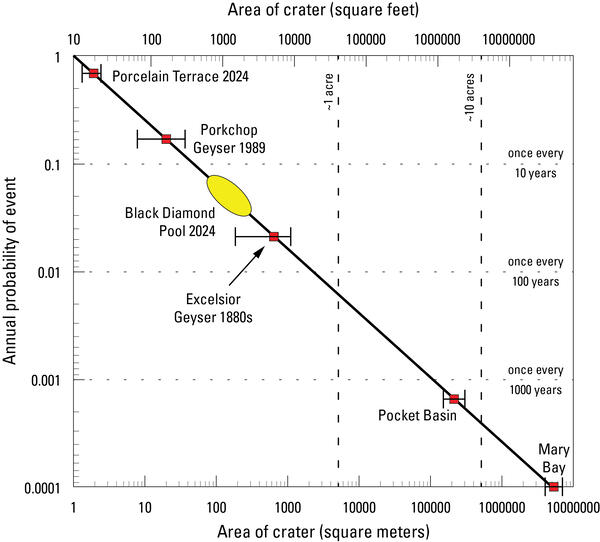
Plot of size versus annual probability for hydrothermal explosion craters in Yellowstone National Park

Plot of size versus annual probability for hydrothermal explosion craters in Yellowstone National Park. The line is a model based on the energy required to form a crater of a specific size, and it is fit to known hydrothermal explosion craters in Yellowstone National Park.

Photomicrograph showing water distribution in a quartz-hosted embayment, with greater concentrations at the embayment mouth. Includes a plot showing that the temperature in which the water circulated must have been about 500 degrees Celsius.
Water distribution in a quartz-hosted embayment from the Mesa Falls Tuff

(A) Water distribution in a quartz-hosted embayment measured with synchrotron Fourier Transform Infrared spectroscopy. Warmer colors indicate higher concentrations of water.  Dashed line shows a transect of water content that is modeled in panel (B) to indicate that the emplacement temperature of the ash flow deposit must have been about 500 °C (930 °F).

(A) Water distribution in a quartz-hosted embayment measured with synchrotron Fourier Transform Infrared spectroscopy. Warmer colors indicate higher concentrations of water.  Dashed line shows a transect of water content that is modeled in panel (B) to indicate that the emplacement temperature of the ash flow deposit must have been about 500 °C (930 °F).

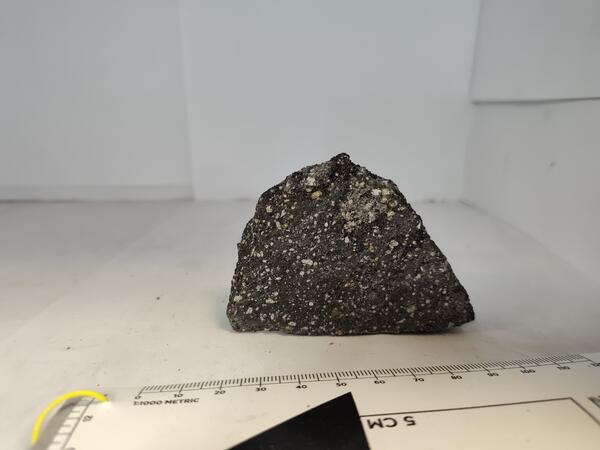
Fist sized sample of rock, black in color with white flecks
Hand sample of the Mount Jackson vitrophyre

A clean hand sample of the Mount Jackson vitrophyre. This sample has a black, glassy groundmass with large (1–3 mm, or a small fraction of an inch), white phenocrysts suspended in the glass. Photo by Liv Wheeler, Montana State University, August 2024.

A clean hand sample of the Mount Jackson vitrophyre. This sample has a black, glassy groundmass with large (1–3 mm, or a small fraction of an inch), white phenocrysts suspended in the glass. Photo by Liv Wheeler, Montana State University, August 2024.

Large block of debris in front of a steaming pool.  The block was transported by the July 23, 2024, hydrothermal explosion at Biscuit Basin, Yellowstone National Park
Largest identified boulder displaced by the July 23, 2024, explosion from Black Diamond Pool, Yellowstone National Park

This boulder is the largest that is confirmed to have been part of the July 23, 2024, hydrothermal explosion from Black Diamond Pool, Biscuit Basin, Yellowstone National Park.  The tape measure is 50 centimeters (20 inches) long.  Black Diamond Pool and a boardwalk are in the background.

High-resolution Planet satellite image of Biscuit Basin, Yellowstone National Park, from July 24, 2024

High-resolution Planet satellite image of Biscuit Basin, Yellowstone National Park, from July 24, 2024.  The image shows changes that occurred as a result of the July 23, 2024, hydrothermal explosion from Black Diamond Pool, including deposition of material in the vicinity of the pool and a plume of discolored water in the Forehole River.

High-resolution Planet satellite image of Biscuit Basin, Yellowstone National Park, from July 24, 2024.  The image shows changes that occurred as a result of the July 23, 2024, hydrothermal explosion from Black Diamond Pool, including deposition of material in the vicinity of the pool and a plume of discolored water in the Forehole River.

Two seismic records from Yellowstone showing more noise during daytime hours due to hikers and auto traffic
Examples of seismic noise in Yellowstone caused by people

Webicorders of Yellowstone Seismic Network stations YMR (West Entrance road) and YNM (Norris Geyser Basin Museum) showing traffic signals (left) and visitors walking (right) during daytime hours.  Both records span the entire 24-hour period of July 23, 2024, MDT. 

Webicorders of Yellowstone Seismic Network stations YMR (West Entrance road) and YNM (Norris Geyser Basin Museum) showing traffic signals (left) and visitors walking (right) during daytime hours.  Both records span the entire 24-hour period of July 23, 2024, MDT. 

Two seismic records from Yellowstone showing more noise during daytime hours due to hikers and auto traffic
Examples of seismic noise in Yellowstone caused by people

Webicorders of Yellowstone Seismic Network stations YMR (West Entrance road) and YNM (Norris Geyser Basin Museum) showing traffic signals (left) and visitors walking (right) during daytime hours.  Both records span the entire 24-hour period of July 23, 2024, MDT. 

Webicorders of Yellowstone Seismic Network stations YMR (West Entrance road) and YNM (Norris Geyser Basin Museum) showing traffic signals (left) and visitors walking (right) during daytime hours.  Both records span the entire 24-hour period of July 23, 2024, MDT. 

Report cover with a damaged boardwalk and inset showing progression of a hydrothermal explosion
Cover of the Yellowstone Volcano Observatory response plan

Cover of the Yellowstone Volcano Observatory response plan for geological hazards in the Yellowstone region.  The report can be accessed at https://pubs.usgs.gov/circ/1351/.  Cover features a photograph by Mike Poland and frame captures from a video by Juliet Su.

Cover of the Yellowstone Volcano Observatory response plan for geological hazards in the Yellowstone region.  The report can be accessed at https://pubs.usgs.gov/circ/1351/.  Cover features a photograph by Mike Poland and frame captures from a video by Juliet Su.

Two seismic records from Yellowstone showing more noise during daytime hours due to hikers and auto traffic
Examples of seismic noise in Yellowstone caused by people

Webicorders of Yellowstone Seismic Network stations YMR (West Entrance road) and YNM (Norris Geyser Basin Museum) showing traffic signals (left) and visitors walking (right) during daytime hours.  Both records span the entire 24-hour period of July 23, 2024, MDT. 

Webicorders of Yellowstone Seismic Network stations YMR (West Entrance road) and YNM (Norris Geyser Basin Museum) showing traffic signals (left) and visitors walking (right) during daytime hours.  Both records span the entire 24-hour period of July 23, 2024, MDT. 

Aerial view of Biscuit Basin, Yellowstone National Park, showing debris deposited by the July 23, 2024, hydrothermal explosion from Black Diamond Pool

Aerial view of Biscuit Basin, Yellowstone National Park, showing debris deposited by the July 23, 2024, hydrothermal explosion from Black Diamond Pool.  Major features are labeled.  The main debris field (within dashed yellow line) has a gray appearance.  Photo taken by Joe Bueter, Yellowstone National Park, on July 23, 2024.

Two seismic records from Yellowstone showing more noise during daytime hours due to hikers and auto traffic
Examples of seismic noise in Yellowstone caused by people

Webicorders of Yellowstone Seismic Network stations YMR (West Entrance road) and YNM (Norris Geyser Basin Museum) showing traffic signals (left) and visitors walking (right) during daytime hours.  Both records span the entire 24-hour period of July 23, 2024, MDT. 

Webicorders of Yellowstone Seismic Network stations YMR (West Entrance road) and YNM (Norris Geyser Basin Museum) showing traffic signals (left) and visitors walking (right) during daytime hours.  Both records span the entire 24-hour period of July 23, 2024, MDT. 

Two seismic records from Yellowstone showing more noise during daytime hours due to hikers and auto traffic
Examples of seismic noise in Yellowstone caused by people

Webicorders of Yellowstone Seismic Network stations YMR (West Entrance road) and YNM (Norris Geyser Basin Museum) showing traffic signals (left) and visitors walking (right) during daytime hours.  Both records span the entire 24-hour period of July 23, 2024, MDT. 

Webicorders of Yellowstone Seismic Network stations YMR (West Entrance road) and YNM (Norris Geyser Basin Museum) showing traffic signals (left) and visitors walking (right) during daytime hours.  Both records span the entire 24-hour period of July 23, 2024, MDT. 

High-resolution Planet satellite image of Biscuit Basin, Yellowstone National Park, from July 21, 2024

High-resolution Planet satellite image of Biscuit Basin, Yellowstone National Park, from July 21, 2024.  This work utilized data made available through the NASA Commercial Smallsat Data Acquisition (CSDA) Program.  Data are copyright, Planet Labs Inc. 2024, all rights reserved.
 

Geologist compare new sediment core in a trans-disciplinary effort to reconstruct past climate change across the country.
USGS Geologist compare sediment core

USGS geologists at a site of new sediment core in a trans-disciplinary effort to reconstruct past climate change across the country near Hannah, Wyoming, on June 26, 2024. Pictured left to right: Marci Robinson and Jean Self-Trail both Research Geologist, Northeast Region; and Marieke Dechesne, Reasearch Geologist, Rocky Mountain Region. 

USGS geologists at a site of new sediment core in a trans-disciplinary effort to reconstruct past climate change across the country near Hannah, Wyoming, on June 26, 2024. Pictured left to right: Marci Robinson and Jean Self-Trail both Research Geologist, Northeast Region; and Marieke Dechesne, Reasearch Geologist, Rocky Mountain Region. 

Animation of annual Yellowstone seismicity 2017-2023

This animation shows a map of of Yellowstone seismicity by year from 2017 through 2023.  Earthquakes are red circles, with the circle size indicating earthquake magnitude.  Gray lines are roads, black dashed line shows the caldera boundary, Yellowstone National Park is outlined by black dot-dashed line, and gray dashed lines denote state boundaries.

This animation shows a map of of Yellowstone seismicity by year from 2017 through 2023.  Earthquakes are red circles, with the circle size indicating earthquake magnitude.  Gray lines are roads, black dashed line shows the caldera boundary, Yellowstone National Park is outlined by black dot-dashed line, and gray dashed lines denote state boundaries.

Front cover of the Yellowstone Volcano Observatory 2023 annual report

Front cover of the Yellowstone Volcano Observatory 2023 annual report, which includes a summary of earthquake, deformation, and geyser activity, as well as research investigations and other information. The report is freely available online athttps://pubs.usgs.gov/publication/cir1524.

Front cover of the Yellowstone Volcano Observatory 2023 annual report, which includes a summary of earthquake, deformation, and geyser activity, as well as research investigations and other information. The report is freely available online athttps://pubs.usgs.gov/publication/cir1524.

Infographic giving earthquake, deformation, thermal emission, and geyser statistics for the Yellowstone region for the year 2023

Infographic giving earthquake, deformation, thermal emission, and geyser statistics for the Yellowstone region for the year 2023.  The graphic accompanies the Yellowstone Volcano Observatory 2023 annual report, freely available online athttps://pubs.usgs.gov/publication/cir1524.

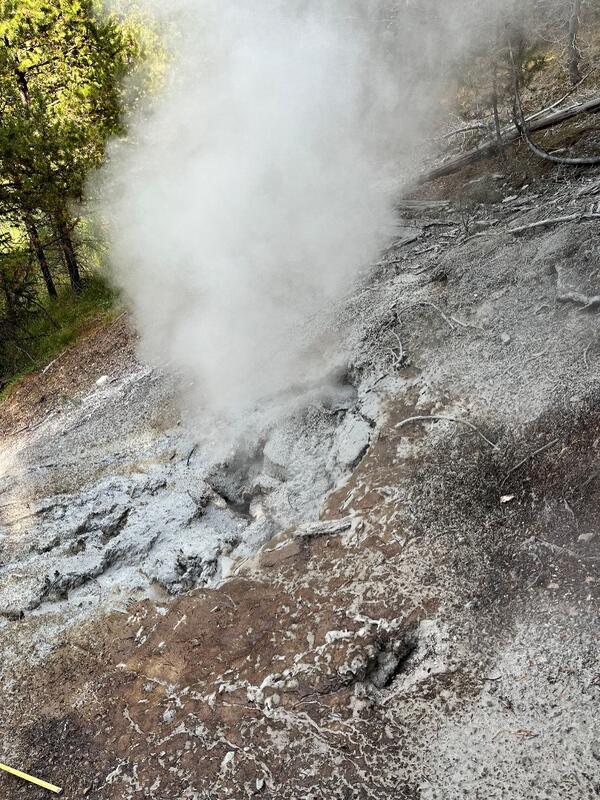
Site of April 15, 2024, hydrothermal explosion on Porcelain Terrace, Norris Geyser Basin, Yellowstone National Park

Site of April 15, 2024, hydrothermal explosion on Porcelain Terrace, Norris Geyser Basin, Yellowstone National Park.  The small crater and disrupted ground are in silica sinter deposits that formed in the past two years, since water has been flowing from the terrace into Nuphar Lake (off photo to right), and angular fragments of ejecta on top of the sinter are

Site of April 15, 2024, hydrothermal explosion on Porcelain Terrace, Norris Geyser Basin, Yellowstone National Park.  The small crater and disrupted ground are in silica sinter deposits that formed in the past two years, since water has been flowing from the terrace into Nuphar Lake (off photo to right), and angular fragments of ejecta on top of the sinter are

Was this page helpful?