
USGS scientists, working with researchers from the University of Ghent, probed the floor of Eklutna Lake, Anchorage Borough, Alaska, for evidence of turbidity currents triggered by strong shaking during the 2018 Mw7.1 Anchorage earthquake.
Images
Browse images from a wide range of science topics covered by USGS. All items in this gallery are considered public domain unless otherwise noted.
USGS scientists, working with researchers from the University of Ghent, probed the floor of Eklutna Lake, Anchorage Borough, Alaska, for evidence of turbidity currents triggered by strong shaking during the 2018 Mw7.1 Anchorage earthquake.
Unuk River sampling site.
Impacts of iron mobilization in a stream tributary of the Akillik River located in Kobuk Valley National Park, Alaska. These images were taken two years apart. The clear picture was taken in June 2016 and the orange picture was August 2018.
USGS biologist conducting drone survey of walruses resting on shore
USGS biologist conducting drone survey of walruses resting on shoreUSGS uses survey drones, which are also termed “unoccupied aerial systems” or UAS, to survey walruses resting on shore. Use of these small survey drones enables collection of replicated surveys with minimal risk to walruses and humans. Being able to collect numerous replicate surveys enables precise estimates of walrus population abundance when these sur
USGS biologist conducting drone survey of walruses resting on shore
USGS biologist conducting drone survey of walruses resting on shoreUSGS uses survey drones, which are also termed “unoccupied aerial systems” or UAS, to survey walruses resting on shore. Use of these small survey drones enables collection of replicated surveys with minimal risk to walruses and humans. Being able to collect numerous replicate surveys enables precise estimates of walrus population abundance when these sur
USGS biologist using survey drone to survey walrus
USGS biologist using survey drone to survey walrusUSGS uses survey drones, which are also termed “unoccupied aerial systems” or UAS, to survey walruses resting on shore. Use of these small survey drones enables collection of replicated surveys with minimal risk to walruses and humans. Being able to collect numerous replicate surveys enables precise estimates of walrus population abundance when these sur
USGS biologist using survey drone to survey walrus
USGS biologist using survey drone to survey walrusUSGS uses survey drones, which are also termed “unoccupied aerial systems” or UAS, to survey walruses resting on shore. Use of these small survey drones enables collection of replicated surveys with minimal risk to walruses and humans. Being able to collect numerous replicate surveys enables precise estimates of walrus population abundance when these sur
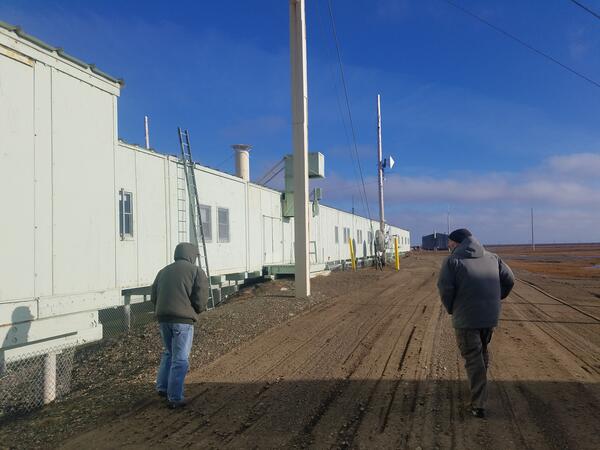
Todd Atwood (USGS), left, and Harry Stern (University of Washington), right, reviewing the Alaska Oliktok Point Distant Early Warning (DEW) facility bear safety video.
Distant Early Warning (DEW) Line site contractor and Todd Atwood (USGS) walking the perimeter of the Alaska Oliktok Point Dew Line site and discussing polar bear safety.
Polar bear near the Katkotivk DEW Line site in Alaska
Polar bear near the Katkotivk DEW Line site in AlaskaPolar bear near the Kaktovik, Alaska, Distant Early Warning (DEW) Line site. In fall, polar bears gather at Kaktovik to feed on the remains of subsistence-harvested bowhead whales. Human-bear encounters at the DEW Line site are common.
Polar bear near the Katkotivk DEW Line site in Alaska
Polar bear near the Katkotivk DEW Line site in AlaskaPolar bear near the Kaktovik, Alaska, Distant Early Warning (DEW) Line site. In fall, polar bears gather at Kaktovik to feed on the remains of subsistence-harvested bowhead whales. Human-bear encounters at the DEW Line site are common.
USGS scientist investigates cracks along Trunk Road in Wasilla, AK
USGS scientist investigates cracks along Trunk Road in Wasilla, AKA USGS scientist investigates cracks along Trunk Road in Wasilla, Alaska. Extensional crack and damage to roadway along S Trunk Rd.
USGS scientist investigates cracks along Trunk Road in Wasilla, AK
USGS scientist investigates cracks along Trunk Road in Wasilla, AKA USGS scientist investigates cracks along Trunk Road in Wasilla, Alaska. Extensional crack and damage to roadway along S Trunk Rd.
A USGS geologist stands in a crack in tide flat sediment, Alaska
A USGS geologist stands in a crack in tide flat sediment, AlaskaA USGS scientist stands in a crack in tide flat sediment that opened during strong shaking in the November 30, 2018 Anchorage earthquake. This upland ground crack near Cottonwood Creek, Palmer Slough had horizontal displacements of ~2.5ft locally and observed maximum depth of ~3ft. The crack was observed ~150ft from the active river channel.
A USGS geologist stands in a crack in tide flat sediment, Alaska
A USGS geologist stands in a crack in tide flat sediment, AlaskaA USGS scientist stands in a crack in tide flat sediment that opened during strong shaking in the November 30, 2018 Anchorage earthquake. This upland ground crack near Cottonwood Creek, Palmer Slough had horizontal displacements of ~2.5ft locally and observed maximum depth of ~3ft. The crack was observed ~150ft from the active river channel.
Measuring a crack in sandy sediment along the Knik River, Alaska
Measuring a crack in sandy sediment along the Knik River, AlaskaExposed sand within a extensional crack along the Knik River, Alaska. Measuring a crack in sandy sediment along the south bank of the Knik River. This crack was one of many that opened across the Anchorage and Mat-Su region due to strong shaking during the M7.1 November 30, 2018 Anchorage earthquake.
Measuring a crack in sandy sediment along the Knik River, Alaska
Measuring a crack in sandy sediment along the Knik River, AlaskaExposed sand within a extensional crack along the Knik River, Alaska. Measuring a crack in sandy sediment along the south bank of the Knik River. This crack was one of many that opened across the Anchorage and Mat-Su region due to strong shaking during the M7.1 November 30, 2018 Anchorage earthquake.
Landslide from bluff below rail grade north of Rabbit Creek. Main scarp of slump/flow slide at Potter Hill. Railroad grade is to the left, tidal flat to the right. Note ponded drainage and disrupted slide material.
2018 Anchorage Earthquake
Landslide from bluff below rail grade north of Rabbit Creek. Main scarp of slump/flow slide at Potter Hill. Railroad grade is to the left, tidal flat to the right. Note ponded drainage and disrupted slide material.
2018 Anchorage Earthquake
Cracks at the north end of the Port of Anchorage, Alaska
Cracks at the north end of the Port of Anchorage, AlaskaLateral spread cracks at the north end of the Port of Anchorage, Alaska. These cracks were among many that opened across the Anchorage and Mat-Su region due to strong shaking during the M7.1 November 30, 2018 Anchorage earthquake.
Cracks at the north end of the Port of Anchorage, Alaska
Cracks at the north end of the Port of Anchorage, AlaskaLateral spread cracks at the north end of the Port of Anchorage, Alaska. These cracks were among many that opened across the Anchorage and Mat-Su region due to strong shaking during the M7.1 November 30, 2018 Anchorage earthquake.
Close up of cracks at the north end of the Port of Anchorage, Alaska
Close up of cracks at the north end of the Port of Anchorage, AlaskaLateral spread cracks at northern end of Port of Anchorage. These cracks were among many that opened across the Anchorage and Mat-Su region due to strong shaking during the M7.1 November 30, 2018 Anchorage earthquake.
Close up of cracks at the north end of the Port of Anchorage, Alaska
Close up of cracks at the north end of the Port of Anchorage, AlaskaLateral spread cracks at northern end of Port of Anchorage. These cracks were among many that opened across the Anchorage and Mat-Su region due to strong shaking during the M7.1 November 30, 2018 Anchorage earthquake.
Extensional cracking and settling around private residence in Chugiak.
2018 Anchorage Earthquake
Extensional cracking and settling around private residence in Chugiak.
2018 Anchorage Earthquake
Crack observed in 2018 along headscarp of 1964 Government Hill landslide.
2018 Anchorage Earthquake
Crack observed in 2018 along headscarp of 1964 Government Hill landslide.
2018 Anchorage Earthquake
Superficial slides along Eagle River east of Eagle River Loop Road.
2018 Anchorage Earthquake
Superficial slides along Eagle River east of Eagle River Loop Road.
2018 Anchorage Earthquake
USGS scientists in helicopter conduct an aerial inspection
USGS scientists in helicopter conduct an aerial inspectionUSGS scientists conduct an aerial inspection of a line of sand vents along the Cook Inlet tide flat at Earthquake Park in Anchorage. Cook Inlet coastal plain liquefaction and bluff raveling near Earthquake Park. These vents opened and ejected sand due to liquefaction triggered by strong shaking during the M7.1 November 30, 2018 Anchorage earthquake.
USGS scientists in helicopter conduct an aerial inspection
USGS scientists in helicopter conduct an aerial inspectionUSGS scientists conduct an aerial inspection of a line of sand vents along the Cook Inlet tide flat at Earthquake Park in Anchorage. Cook Inlet coastal plain liquefaction and bluff raveling near Earthquake Park. These vents opened and ejected sand due to liquefaction triggered by strong shaking during the M7.1 November 30, 2018 Anchorage earthquake.
Earthquake damage of Minnesota Drive onramp, Anchorage, Alaska
Earthquake damage of Minnesota Drive onramp, Anchorage, AlaskaMinnesota Blvd off-ramp failure under repair. Construction crews rebuild the Minnesota Drive onramp in Anchorage on December 1, 2018. Engineered fill beneath the onramp failed the day before as a result of strong shaking during the M7.1 November 30, 2018 Anchorage earthquake.
Earthquake damage of Minnesota Drive onramp, Anchorage, Alaska
Earthquake damage of Minnesota Drive onramp, Anchorage, AlaskaMinnesota Blvd off-ramp failure under repair. Construction crews rebuild the Minnesota Drive onramp in Anchorage on December 1, 2018. Engineered fill beneath the onramp failed the day before as a result of strong shaking during the M7.1 November 30, 2018 Anchorage earthquake.
Eklutna Lake dam appeared to be undamaged the day after the earthquake; overflights of the lake showed no landslides impacted the lake shoreline.
Slumping along the Alaska Railroad right-of-way evolved into long-runout landslides. The same area failed in earthquakes in 1954 and 1964.
2018 Anchorage Earthquake
Slumping along the Alaska Railroad right-of-way evolved into long-runout landslides. The same area failed in earthquakes in 1954 and 1964.
2018 Anchorage Earthquake