



Knik River sonar on a bridge
Images
Browse images from a wide range of science topics covered by USGS. All items in this gallery are considered public domain unless otherwise noted.
Filter Total Items: 1616

Knik River sonar on a bridge
Knik River sonar on a bridge

USGS scientist investigates bedrock canyon cut by a river
USGS scientist investigates bedrock canyon cut by a riverA scientist at The Kink on North Fork Fortymile River. He is standing next to gravel that was in the river in 1900 but is now on the rim of a 20-foot-deep bedrock canyon. The canyon formed as a result of human mining activity that diverted the river in 1900.
USGS scientist investigates bedrock canyon cut by a river
USGS scientist investigates bedrock canyon cut by a riverA scientist at The Kink on North Fork Fortymile River. He is standing next to gravel that was in the river in 1900 but is now on the rim of a 20-foot-deep bedrock canyon. The canyon formed as a result of human mining activity that diverted the river in 1900.

Scientist investigates bedrock canyon, North Fork Fortymile River, AK
Scientist investigates bedrock canyon, North Fork Fortymile River, AKA scientist investigates a bedrock canyon cut by the North Fork Fortymile River in response to human mining activity in 1900. The smooth grooves on the rock in the lower right corner were formed by river erosion in the last century.
Scientist investigates bedrock canyon, North Fork Fortymile River, AK
Scientist investigates bedrock canyon, North Fork Fortymile River, AKA scientist investigates a bedrock canyon cut by the North Fork Fortymile River in response to human mining activity in 1900. The smooth grooves on the rock in the lower right corner were formed by river erosion in the last century.

Scientist standing on the pre-1900 riverbed
A scientist standing on the pre-1900 riverbed that is now 20 feet above the rapids at The Kink on the North Fork Fortymile River. The Kink resulted from human mining activity that diverted the river in 1900.
A scientist standing on the pre-1900 riverbed that is now 20 feet above the rapids at The Kink on the North Fork Fortymile River. The Kink resulted from human mining activity that diverted the river in 1900.

USGS scientist at The Kink, North Fork Fortymile River, Alaska
USGS scientist at The Kink, North Fork Fortymile River, AlaskaA USGS scientist standing on the pre-1900 riverbed that is now the rim of the bedrock canyon at The Kink on North Fork Fortymile River. The Kink resulted from human mining activity that diverted the river in 1900.
USGS scientist at The Kink, North Fork Fortymile River, Alaska
USGS scientist at The Kink, North Fork Fortymile River, AlaskaA USGS scientist standing on the pre-1900 riverbed that is now the rim of the bedrock canyon at The Kink on North Fork Fortymile River. The Kink resulted from human mining activity that diverted the river in 1900.

Skinny Common Murre (in foreground) with keel protruding
Skinny Common Murre (in foreground) with keel protrudingSkinny Common Murre (in foreground) with keel protruding in lower Cook Inlet, Alaska.
Skinny Common Murre (in foreground) with keel protruding
Skinny Common Murre (in foreground) with keel protrudingSkinny Common Murre (in foreground) with keel protruding in lower Cook Inlet, Alaska.

Geologic mapping in remote interior Alaska
A USGS scientist is recording structural measurements collected from an outcrop of deformed and metamorphosed bedrock in the Yukon-Tanana upland of eastern interior Alaska. A team of two geologists were deployed by helicopter to conduct a geologic mapping and sampling traverse covering approximately 5 miles along the top of this ridge.
A USGS scientist is recording structural measurements collected from an outcrop of deformed and metamorphosed bedrock in the Yukon-Tanana upland of eastern interior Alaska. A team of two geologists were deployed by helicopter to conduct a geologic mapping and sampling traverse covering approximately 5 miles along the top of this ridge.

Scientists in kayaks next to floating limnocorral
Two scientists in kayaks next to a floating limnocorral on McKinley Lake, near Cordova, Alaska for Elodea spp. experiment. This experiment is studying the effect of the invasive species Elodea spp. on aquatic ecosystems. Disclaimer statement: Any use of trade, firm, or product names is for descriptive purposes only and does not imply endorsement by the U.S.
Two scientists in kayaks next to a floating limnocorral on McKinley Lake, near Cordova, Alaska for Elodea spp. experiment. This experiment is studying the effect of the invasive species Elodea spp. on aquatic ecosystems. Disclaimer statement: Any use of trade, firm, or product names is for descriptive purposes only and does not imply endorsement by the U.S.
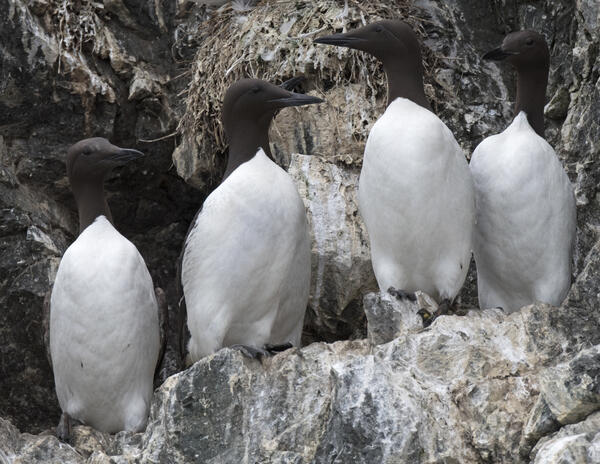
Skinny Common Murre with keel protruding (second from the left)
Skinny Common Murre with keel protruding (second from the left)Skinny Common Murre with keel protruding (second from the left) contrasted by normal murres. Lower Cook Inlet, Alaska.
Skinny Common Murre with keel protruding (second from the left)
Skinny Common Murre with keel protruding (second from the left)Skinny Common Murre with keel protruding (second from the left) contrasted by normal murres. Lower Cook Inlet, Alaska.

USGS on the Colville River Delta, Alaska
Alaska Native Science and Engineer Program (ANSEP) student and USGS intern Parker Pickett on the Colville River Delta, Alaska, helping to band molting snow geese and black brant.
Alaska Native Science and Engineer Program (ANSEP) student and USGS intern Parker Pickett on the Colville River Delta, Alaska, helping to band molting snow geese and black brant.

A Black-legged Kittiwake harasses a melanistic Common Murre
A Black-legged Kittiwake harasses a melanistic Common MurreA Black-legged Kittiwake harasses a melanistic (all black) Common Murre, forcing it off its breeding site in Kachemak Bay, Alaska, 2018. See related paper published in the Marine Ornithology: Journal of Seabird Research and Conservation at: http://www.marineornithology.org/PDF/50_2/50_2_225-22
A Black-legged Kittiwake harasses a melanistic Common Murre
A Black-legged Kittiwake harasses a melanistic Common MurreA Black-legged Kittiwake harasses a melanistic (all black) Common Murre, forcing it off its breeding site in Kachemak Bay, Alaska, 2018. See related paper published in the Marine Ornithology: Journal of Seabird Research and Conservation at: http://www.marineornithology.org/PDF/50_2/50_2_225-22

Before and after views of Kasatochi Volcano's eruption of 2008
Before and after views of Kasatochi Volcano's eruption of 2008Before and after views of Kasatochi Volcano's eruption of 2008
Before and after views of Kasatochi Volcano's eruption of 2008
Before and after views of Kasatochi Volcano's eruption of 2008Before and after views of Kasatochi Volcano's eruption of 2008

Glaucous-winged Gulls grab eggs abandoned by breeding Common Murres
Glaucous-winged Gulls grab eggs abandoned by breeding Common MurresGlaucous-winged Gulls capitalize upon a disturbance at the Gull Island colony in 2018 to grab eggs abandoned by breeding Common Murres. One lone Common Murre continues incubation despite the rest of the colony flushing.
Glaucous-winged Gulls grab eggs abandoned by breeding Common Murres
Glaucous-winged Gulls grab eggs abandoned by breeding Common MurresGlaucous-winged Gulls capitalize upon a disturbance at the Gull Island colony in 2018 to grab eggs abandoned by breeding Common Murres. One lone Common Murre continues incubation despite the rest of the colony flushing.

Melanistic Common Murre flies near its colony
A melanistic (all dark) Common Murre flies above its colony on Gull Island in Kachemak Bay, Alaska, 2018. See related paper published in the Marine Ornithology: Journal of Seabird Research and Conservation at: http://www.marineornithology.org/PDF/50_2/50_2_225-227.pdf.
A melanistic (all dark) Common Murre flies above its colony on Gull Island in Kachemak Bay, Alaska, 2018. See related paper published in the Marine Ornithology: Journal of Seabird Research and Conservation at: http://www.marineornithology.org/PDF/50_2/50_2_225-227.pdf.

Damian Menning preparing eDNA Elodea samples
Dr. Damian Menning, Geneticist with the USGS Alaska Science Center, preparing environmental samples containing Elodea species to test universal eDNA Elodea species primers that can be used to detect all five Elodea sp. in aquatic samples.
Dr. Damian Menning, Geneticist with the USGS Alaska Science Center, preparing environmental samples containing Elodea species to test universal eDNA Elodea species primers that can be used to detect all five Elodea sp. in aquatic samples.

Geneticist preparing environmental samples containing Elodea species
Geneticist preparing environmental samples containing Elodea speciesDr. Damian Menning, Geneticist with the USGS Alaska Science Center, preparing environmental samples containing Elodea species to test universal eDNA Elodea sp. primers that can be used to detect all five Elodea sp. in aquatic samples.
Geneticist preparing environmental samples containing Elodea species
Geneticist preparing environmental samples containing Elodea speciesDr. Damian Menning, Geneticist with the USGS Alaska Science Center, preparing environmental samples containing Elodea species to test universal eDNA Elodea sp. primers that can be used to detect all five Elodea sp. in aquatic samples.

Common Murre flying in lower Cook Inlet, Alaska
Common Murre flying in lower Cook Inlet, Alaska.
Common Murre flying in lower Cook Inlet, Alaska.

Juvenile Bald Eagle flies away with Black-legged Kittiwake chick
Juvenile Bald Eagle flies away with Black-legged Kittiwake chickA juvenile Bald Eagle flies away with a young Black-legged Kittiwake chick taken from its nest at Gull Island, Alaska.
Juvenile Bald Eagle flies away with Black-legged Kittiwake chick
Juvenile Bald Eagle flies away with Black-legged Kittiwake chickA juvenile Bald Eagle flies away with a young Black-legged Kittiwake chick taken from its nest at Gull Island, Alaska.

A Northern Fulmar flying in Lower Cook Inlet, Alaska
A Northern Fulmar flying in Lower Cook Inlet, AlaskaNorthern Fulmars, Black-legged Kittiwakes, and Common Murres have all been tested for and contained harmful algal bloom (HAB) toxins. Since 2015, the USGS has worked with a variety of stakeholders to develop testing methods and research projects to better understand the geographic extent, timing and impacts of algal toxins in Alaska marine ecosystems.
A Northern Fulmar flying in Lower Cook Inlet, Alaska
A Northern Fulmar flying in Lower Cook Inlet, AlaskaNorthern Fulmars, Black-legged Kittiwakes, and Common Murres have all been tested for and contained harmful algal bloom (HAB) toxins. Since 2015, the USGS has worked with a variety of stakeholders to develop testing methods and research projects to better understand the geographic extent, timing and impacts of algal toxins in Alaska marine ecosystems.

Rainbow on the Taku River
Heading upriver in the USGS boat.
Heading upriver in the USGS boat.

A Northern Fulmar on the water offshore of Anchor Point, Cook Inlet
A Northern Fulmar on the water offshore of Anchor Point, Cook InletA Northern Fulmar on the water offshore of Anchor Point, Cook Inlet on July 18, 2018.
A Northern Fulmar on the water offshore of Anchor Point, Cook Inlet
A Northern Fulmar on the water offshore of Anchor Point, Cook InletA Northern Fulmar on the water offshore of Anchor Point, Cook Inlet on July 18, 2018.