U.S. flag

An official website of the United States government

Images

Browse images from a wide range of science topics covered by USGS. All items in this gallery are considered public domain unless otherwise noted.

Filter Total Items: 1585
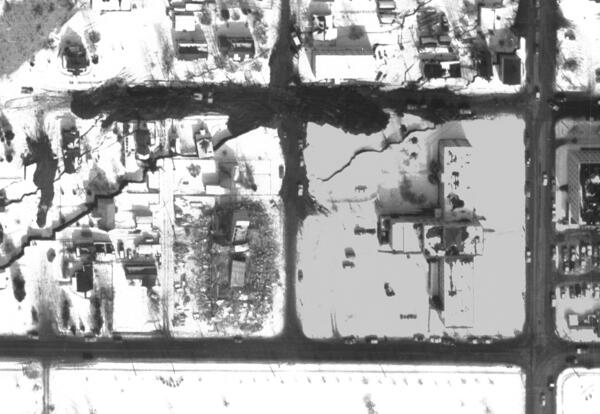
House surround by snow is undamaged and intact. Apartment building behind house is crumbling and broken in two.
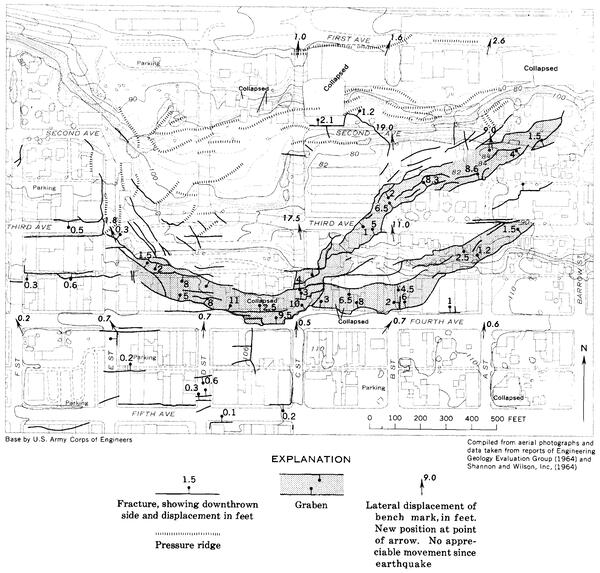
Landslides and damage, Anchorage District

Destructive landslides and damage in Anchorage: graben at the head of the L Street landslide.
Anchorage District, Cook Inlet Region, Alaska, 1964.
Photo by A. Grantz.
Published in U. S.Geological Survey. Circular 491, Figures 18A & 18B, p.31. 1964.

Destructive landslides and damage in Anchorage: graben at the head of the L Street landslide.
Anchorage District, Cook Inlet Region, Alaska, 1964.
Photo by A. Grantz.
Published in U. S.Geological Survey. Circular 491, Figures 18A & 18B, p.31. 1964.

Two buildings on hill. One is damaged, exposed brick, no windows and other house has no damage.
Hillside apartment complex

Alaska Earthquake March 27, 1964.
Compare the damage sustained by the Hillside Apartment Building and the adjacent three-story wood-frame dwelling with the tall chimney. In general, wood frame buildings in Anchorage sustained little damage from seismic vibration.

Alaska Earthquake March 27, 1964.
Compare the damage sustained by the Hillside Apartment Building and the adjacent three-story wood-frame dwelling with the tall chimney. In general, wood frame buildings in Anchorage sustained little damage from seismic vibration.

Cracks in multiple story building. Streetlight in front with wood panels converging broken glass doors and windows.
Damage to Mt. McKinley apartments caused by 1964 earthquake

View of damage to the Mt. McKinley Apartments in Anchorage, Alaska caused by the March 27, 1964 earthquake. Image includes automobiles, people, and power lines. Yellow sign on building reads fallout shelter. Sign on building reads Blue mirror bar lounge. Sign on building, lower right, reads Physicians optical guild opticans.

View of damage to the Mt. McKinley Apartments in Anchorage, Alaska caused by the March 27, 1964 earthquake. Image includes automobiles, people, and power lines. Yellow sign on building reads fallout shelter. Sign on building reads Blue mirror bar lounge. Sign on building, lower right, reads Physicians optical guild opticans.

Fairweather fault 1958

Low-level oblique aerial view of Fairweather fault. Photo taken east of North Dome, looking northwest, August 26, 1958.

Low-level oblique aerial view of Fairweather fault. Photo taken east of North Dome, looking northwest, August 26, 1958.

A raft of sea otters near Cohen Island in Kachemak Bay, Alaska. Snow caped mountains in the background.
A raft of sea otters, Alaska

A raft of sea otters near Cohen Island in Kachemak Bay, Alaska. Sea otters rest together in groups called rafts. A raft can generally contain 10 to 100 sea otters. You will see either all male or all female with pups rafts.

A raft of sea otters near Cohen Island in Kachemak Bay, Alaska. Sea otters rest together in groups called rafts. A raft can generally contain 10 to 100 sea otters. You will see either all male or all female with pups rafts.

Graduate student on rock looking through a spotting scope on tripod used to observe sea otters.
Emily Reynolds watching sea otters through a spotting scope

Emily Reynolds, a graduate student, looks through a spotting scope. The student is watching sea otters in Kachemak Bay forage. USGS researchers spend hundreds of hours annually observing sea otter foraging behavior to document prey composition and energy recovery rates.

Emily Reynolds, a graduate student, looks through a spotting scope. The student is watching sea otters in Kachemak Bay forage. USGS researchers spend hundreds of hours annually observing sea otter foraging behavior to document prey composition and energy recovery rates.

Image: Sea Star Succumbing to Sea Star Wasting Disease
Sea Star Succumbing to Sea Star Wasting Disease

Unlike their smiling cartoon brethren on television, since 2013, real-life sea stars have been suffering from a wasting disease epidemic in which they lose limbs and literally disintegrate in a matter of days. 

Unlike their smiling cartoon brethren on television, since 2013, real-life sea stars have been suffering from a wasting disease epidemic in which they lose limbs and literally disintegrate in a matter of days. 

Image: Old Chevak Goose Camp
Old Chevak Goose Camp

Old Chevak ancestral church reborn as research site in 1986 for 25 year cooperative banding program where Chevak youth worked with U.S. Geological Survey and U.S. Fish and Wildlife Service capturing and banding geese and swans along the Kashunuk River on Yukon-Kuskokwim Delta, Alaska.

Old Chevak ancestral church reborn as research site in 1986 for 25 year cooperative banding program where Chevak youth worked with U.S. Geological Survey and U.S. Fish and Wildlife Service capturing and banding geese and swans along the Kashunuk River on Yukon-Kuskokwim Delta, Alaska.

Image: Goose Roundup
Goose Roundup
Goose Roundup
Goose Roundup

Chevak youth help funnel Cackling Geese into holding pen for banding.

Chevak youth help funnel Cackling Geese into holding pen for banding.

Was this page helpful?